

Blog
Scavenger Hunt for Kids: Ultimate 2026 Guide (Ages 3–15, Free Toolkit PDF)
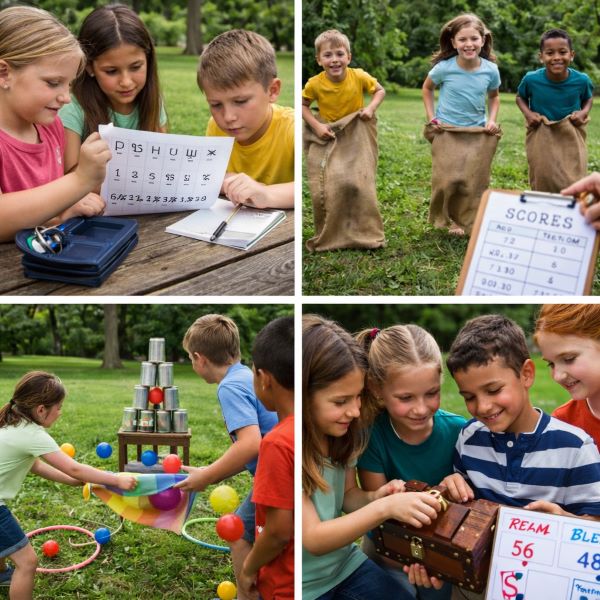
The Ultimate Scavenger Hunt Guide for Kids: Everything You Need to Plan the Perfect Adventure
Last updated: May 2026 | Reading time: 18 min | Master pillar guide — 200+ hunts tested
This guide is based on hands-on experience designing and running over 200 scavenger hunts for kids of all ages. Every recommendation has been tested with real families to ensure maximum fun and engagement.
A scavenger hunt for kids is the most versatile activity you can run at a birthday party, on a rainy afternoon, or at a family gathering — and this guide covers everything you need. Whether you have 20 minutes or 2 hours, a backyard or a two-bedroom apartment, this guide will help you plan a scavenger hunt that kids actually beg to do again.
📥 Download the Free Master Toolkit (Quick-Start, Decision Tree, 30 Clue Templates) →
Choose your route: free ideas or a printable story kit
Plan a DIY hunt: Use the free toolkit above and the age-by-age ideas below to write clues for your own hiding places.
Prefer a ready-written adventure? These paid PDF kits each include separate versions for ages 4–6 and 6–9. Follow the product links to see preview images and preparation details:
- Pirate Treasure Hunt — a treasure-map adventure for 3–15 children.
- Dinosaur Treasure Hunt — help the dinosaurs after an earthquake, for 3–12 children.
- Safari Scavenger Hunt — animal puzzles and a pretend river-crossing team game, for 3–10 children.
An adult prints and prepares the materials and guides the group. No physical kit or prizes are shipped. For other ages, browse the full range and check each game’s age recommendation.
What Makes a Great Scavenger Hunt for Kids?
Not every scavenger hunt lands. I’ve seen kids lose interest after three clues and I’ve seen them refuse to stop even when the pizza arrived cold. The difference almost always comes down to four things:
- Age-appropriate challenge. Too easy and kids are bored by clue three. Too hard and the tears start. The sweet spot is clues where kids need to think but can solve within 30–60 seconds with a little effort.
- Momentum. Clues should flow into each other without long pauses. Kids can’t sustain attention through waiting. Keep the pace up.
- A real payoff. The treasure matters. It doesn’t have to be expensive — a certificate, a silly trophy, or a small treat all work — but there must be a satisfying endpoint.
- A theme that gets them invested. “You’re a detective looking for a stolen jewel” beats “Go find the clue under the pillow.” Narrative context makes everything more engaging.
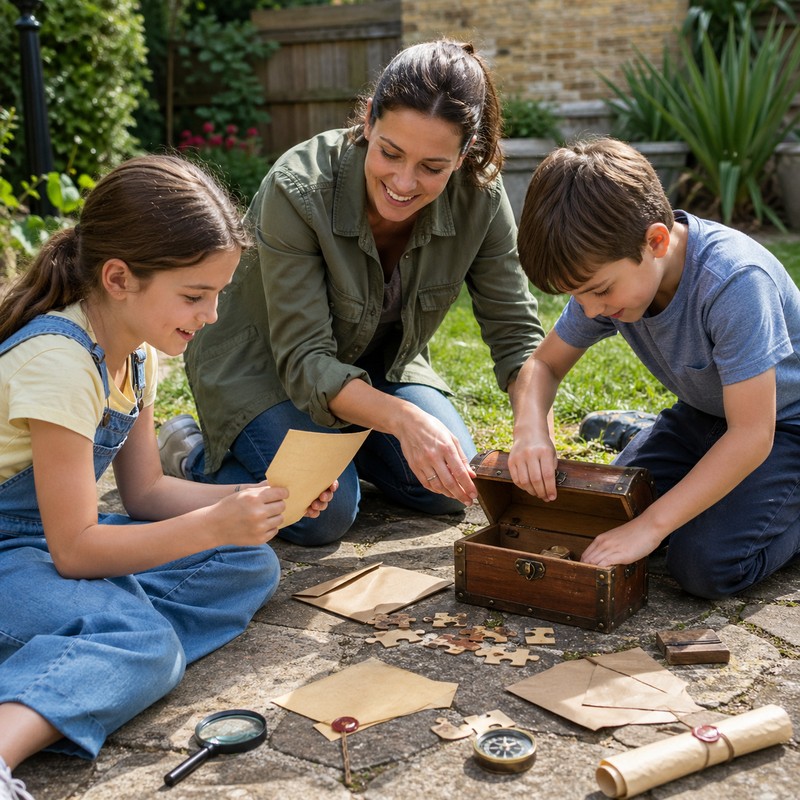
Scavenger Hunt by Age: What Works at Each Stage
One of the biggest mistakes parents make is picking a hunt format that’s wrong for their child’s age. Here’s a breakdown of what actually works:
Ages 3–5: Picture Hunts
At this age, kids can’t read, so your clues need to be visual. Draw or print simple pictures of locations around the house or yard. The treasure map format works brilliantly — big bold illustrations, bright colors, and an X for each stop. Keep it to 5–6 stops maximum and make sure an adult walks alongside. The excitement is in the discovery and the treasure reveal, not the puzzle difficulty.
Ages 6–8: Rhyming Riddles
This is the golden age for scavenger hunts. Kids this age love the combination of simple reading and the “aha!” moment of figuring out a clue. Short rhyming riddles work beautifully: “I keep food cold and love to hum, open me up and find clue one.” Themes like pirates and detectives become magical at this age — kids buy into the narrative completely and stay invested through 10–12 stations without losing steam.
Ages 9–12: Code-Breaking and Logic
Older kids want to feel clever, not just fast. At this age, introduce cipher codes, backwards-written clues, letter-number substitutions, and multi-step puzzles. A clue that requires decoding before you know where to go is perfect for this group. The detective scavenger hunt format works especially well — build a full mystery narrative around a stolen item, and watch 10-year-olds become completely absorbed investigators.
Ages 13+: Teen-Appropriate Challenges
Teens respond well to challenges that feel genuinely difficult, not dumbed-down. Think cryptic clues, trivia-based puzzles, or hunts that tap into their specific interests (music, movies, sports). Competitive team formats — racing against another team — tend to generate far more energy than cooperative formats at this age group. Make the stakes feel real, even if the prize is just bragging rights.
“My 8-year-old absolutely LOVED the detective hunt. He asked if we could do it again the next day. Worth every penny!”
The 5 Best Scavenger Hunt Themes for Kids
Theme is everything. Kids don’t just want to find clues — they want to be someone on an adventure. These are the five themes that consistently get the best response across all age groups:
1. Pirate Treasure Hunt
A classic for good reason. Kids love becoming pirates, following a treasure map, and digging for “gold.” The pirate treasure hunt format works across ages 4–12 with minimal adaptation — younger kids love the map, older kids love decoding the clues. Include an X-marks-the-spot treasure map and a small “treasure chest” prop (even a shoebox works) for maximum effect. Bonus: pirate vocabulary makes every clue feel more exciting.
2. Detective / Mystery Hunt
Perfect for ages 7 and up. Set up a “crime scene” — something has been stolen, and the kids are the investigators. Each clue reveals a piece of evidence that leads to the next location. This theme naturally creates a narrative arc and generates genuine investment in the outcome. Kids don’t just want to find the treasure — they want to solve the crime. Our detective kit is consistently our bestselling format.
3. Unicorn / Fantasy Hunt
For younger kids, especially ages 4–7, magical themes create a sense of wonder that sustains engagement even through harder clues. Unicorn, fairy, and wizard themes work particularly well for birthday parties where imagination is the whole point. Add sparkly “magic dust” (a pinch of glitter confetti) tucked in with each clue — kids go absolutely wild for it.
4. Outdoor Nature Hunt
No props needed, and no setup time. Create a checklist of things to find in your backyard or local park: a specific leaf shape, a bug, something yellow, something rough to touch, a bird call. This is the easiest format to run spontaneously and doubles as genuine nature education. Pair with a simple homemade “field journal” (folded paper stapled together) for kids to sketch or describe their finds.
5. Seasonal and Holiday Hunts
These hunts feel special because they happen at special times. A Halloween scavenger hunt in October, a Christmas morning hunt where clues lead to the big present, an Easter hunt with riddle clues instead of just searching for eggs. Seasonal hunts become family traditions — kids anticipate them every year and talk about them for months afterward.
Ready-to-Use Printable Scavenger Hunt Kits
Choose a printable story kit with prepared puzzles and game materials. An adult needs to read the instructions, print and cut the pages, prepare a safe route and provide the final treasure. Preparation time depends on the kit and your setup.
Instant Download · Print at Home · 4.8/5 from 323+ Reviews

More Party Themes to Explore
Choose a setting your group enjoys, then use a theme guide to plan the activities around your hunt. These guides combine party ideas, related riddles and links to printable games:
- Mermaid party planning and ocean activities
- Space party planning and astronaut activities
- Ninja party planning and training games
- Detective party planning and mystery games
- Jungle party planning and safari activities
The DIY activities in a guide are separate from the contents of a purchased kit. Check the product page for included materials, ages and preparation requirements.
Indoor vs. Outdoor: How to Choose
You don’t need a big yard to run a great scavenger hunt. Here’s how to pick the right format for your actual space:
Indoor Scavenger Hunts
Ideal for: rainy days, apartments, winter birthdays, or kids under 6 who need closer supervision. The indoor format is actually easier to run than outdoor because you have more control over the environment.
- Use rooms as zones: kitchen, living room, bathroom, bedroom each become a “territory”
- Choose clean, child-height hiding spots: under a sofa cushion, beside a toy box, inside an empty shoe or in an accessible coat pocket. Keep clues away from appliances, toilets, medicines, cords and anything that requires climbing.
- Do a walk-through before hiding clues so you can visualize each transition
- Scale down clue count to match space: 8–10 stations works for a standard apartment
For a complete indoor guide with 30+ clue examples organized by room, see our indoor scavenger hunt for kids guide.
Outdoor Scavenger Hunts
Ideal for: summer birthday parties, spring days, active older kids, and groups of 6 or more. Outdoor hunts give kids the physical freedom they need and naturally lend themselves to larger groups spread across multiple zones.
- Use landmarks: big tree, garden shed, mailbox, gate, swing set, garden bed
- Laminate clue cards or put them in ziplock bags if weather is uncertain
- Designate one adult helper per team if running competitive format outdoors
- Mark boundaries clearly before you start — kids will test the limits
For outdoor planning ideas, see our outdoor scavenger hunt ideas guide.
Quick Comparison
| Factor | Indoor | Outdoor |
|---|---|---|
| Best age range | 3–12 | 5–15 |
| Setup time | 10–15 min | 15–25 min |
| Group size | 2–10 kids | 4–30+ kids |
| Weather risk | None | Plan B needed |
| Supervision level | Low | Medium–High |
How to Prepare a Scavenger Hunt Step by Step
You genuinely don’t need hours of prep. Here’s the fastest path from idea to running hunt — used and tested with 200+ families:
- Pick your theme and format. Choose a theme that fits your child’s current interests. Decide: linear hunt (each clue leads to the next) or list hunt (find everything in any order)?
- Pick suitable locations for your group. Walk through your space and note obvious, accessible hiding spots. Write them down in order — this becomes your clue sequence.
- Write or assign clues. One clue per location, each pointing to the next. For a printable kit, this step is already done.
- Hide the clues and test the route. Work backwards from the treasure. Clue 10 sits at the final location, clue 9 points there, and so on. Keep clue 1 in your hand to give the kids at the start.
- Set up the treasure. Place the prize at the final location. A decorated box or small basket elevates the reveal significantly.
- Brief the kids. Explain the rules: stay in bounds, work as a team (or race), no peeking at other teams’ clues.
Birthday Party Scavenger Hunts: Complete Checklist
Running a hunt at a birthday party adds complexity: you’re managing excited kids, anxious parents hovering nearby, a strict schedule, and high expectations. Here’s what consistently works:
Before the Party
- Confirm the hunt format fits the age group and available space
- Do a full walk-through with all clues hidden (always test first — you will find problems)
- Prepare one complete clue set per team for competitive play, or one shared set for co-op
- Prepare prizes for every child — nobody goes home empty-handed
- Designate one helper adult per team for outdoor hunts
- Print backup clues in case any go missing mid-hunt
During the Hunt
- Maintain high energy with running commentary: “Ooh, you’re getting warmer!” works for any age
- Monitor pace — if a team is stuck more than 2 minutes, give a gentle hint
- Pair older kids with younger kids on mixed-age teams
- Have your phone ready to film the treasure reveal — it’s always the best moment
After the Hunt
- Celebrate every team — everyone completed the adventure
- Distribute prizes and goody bags together, not individually
- Transition immediately to the next activity — don’t let the energy drop
For a full planning guide including themed party ideas and specific kit recommendations by age, visit our dedicated birthday scavenger hunt for kids guide.
Free Scavenger Hunt Ideas vs. Printable Kits
The most common question we get: “Can I just write my own clues?” Yes — but here’s the honest tradeoff so you can make the right call for your situation:
DIY / Free Ideas
Works best when: you have 2–3 hours to invest in writing, designing, and testing clues; you’re running a small casual hunt at home with your own kids; you want to hyper-customize around a specific location, inside joke, or very niche interest.
Common pitfalls: Clues that are accidentally far too hard or trivially easy (you can’t tell until you run them). Uneven pacing — some sections drag, others end abruptly. No props, certificates, or design elements. The last-minute scramble on a busy party morning.
Printable Kits
Works best when: you want prepared puzzles rather than writing every clue yourself; your group fits the selected kit’s age range and player count; you want professionally designed clue cards, maps, and treasure hunter certificates; you want clues that have been tested with real kids across 200+ runs.
These are digital PDF kits, not physical deliveries. Check each product page for its current price, age versions, player count and included materials. You provide printing supplies, any activity materials listed in the instructions and the final treasure.
60-Second Decision Tree: Which Scavenger Hunt Should You Run?
Stop second-guessing. Answer four quick questions and you’ll have a perfect-fit hunt format:
- How old is the youngest player?
- 3–5 → Picture map hunt with 5–6 stops (15–20 min)
- 6–8 → Rhyming riddles, 8–10 stops (30–45 min)
- 9–12 → Code-breaking + logic, 10–14 stops (45–75 min)
- 13+ → Cryptic clues, team race, 12+ stops (60–120 min)
- Indoor or outdoor? Indoor for rainy days, apartments, or under-6s; outdoor for warm weather, 6+ kids, and high-energy groups. See our indoor scavenger hunt guide or nature scavenger hunt guide.
- How many kids? 1–6 → cooperative; 6+ → split into 2–4 teams; 15+ → tournament-style with parallel routes.
- Setup time you have? Choose a printable kit to avoid writing every puzzle yourself, or use the free clue templates for a DIY route. In either case, allow time to prepare materials, check hiding places and test the clue sequence.
9 Scavenger Hunt Formats (Compared)
Not every hunt is built the same. Here are the nine formats that work best for kids — and when to pick each:
| Format | Best for ages | Setup | Notes |
|---|---|---|---|
| Picture Map Hunt | 3–5 | 10 min | Visual clues, adult walks along |
| Riddle Chain | 6–9 | 15 min | Each riddle leads to the next clue’s location |
| List Hunt (Photo or Item) | 5–13 | 5 min | No clue chain — find anything in any order |
| Cipher Hunt | 9–14 | 20–30 min | Caesar/atbash/symbol codes; see cipher guide |
| Detective Mystery | 7–12 | 20 min | Suspect board + evidence — guide |
| Pirate Treasure Hunt | 4–12 | 15–25 min | Map + chest + gold coins — guide |
| Quiz Question Hunt | 6–11 | 15 min | Answer to unlock next clue — 120 questions |
| Nature/Outdoor List | 4–12 | 5 min | No props — see nature guide |
| Selfie/Photo Hunt | 10+ | 5 min | Phones-as-tools; great for tweens & teens |
12 Plug-and-Play Clue Templates (Steal These)
These are the templates we have used across 200+ hunts. Swap the bold item for your hiding spot and you have an instant clue. (Get all 30 templates inside the free toolkit PDF.)
- “I keep food cold and love to hum, open me up and find clue one.” → Refrigerator
- “Four legs hold me steady here; take a seat, your clue is near.” → Chair
- “I have arms but cannot hug, peek behind me — quick, don’t shrug.” → Couch / armchair
- “Twirl my dial and water flows, look beneath me, the next clue grows.” → Bathroom sink
- “I show a picture in a frame; beside me waits your next clue game.” → Picture frame on a low shelf
- “My pages turn but I don’t speak, between my covers, take a peek.” → Bookshelf book
- “I hold the clothes that need a wash; beside my handle, take a look.” → Laundry basket
- “I tell the time throughout the day; beside me is where clues can stay.” → Table clock on a low shelf
- “Before you step outside to play, wipe your shoes on me today.” → Doormat, with the clue beside it
- “Blocks and toys rest here each day; beside their box, a clue will stay.” → Toy box
- “Soft and bouncy where you dream, peek beneath this fluffy team.” → Bed pillow / mattress
- “Where shoes go to rest at night, your next clue is hiding in plain sight.” → Shoe rack / closet
7 Mistakes to Avoid (Hard-Won From 200+ Hunts)
- Too many clues for the age group. Cap it. 4–6 year olds: 5–6 clues. 7–10: 8–12. 11+: 12–15.
- No test-run before the kids arrive. A 5-minute walk-through catches missing clues, ambiguous riddles, and unsafe hiding spots.
- Hiding clues in unsafe spots — anything that requires climbing, opening hot appliances, or unlocking medicine cabinets. Always ground-floor and visible-from-standing.
- Treasure that doesn’t feel earned. A wrapped snack inside a decorated box delivers 10× the joy of an unwrapped candy on a counter.
- Cluing without a narrative. “Find the next clue” is bland. “Captain Greybeard hid the loot, follow the map” doubles engagement.
- Ignoring mixed-age groups. Pair an older kid with a younger one on each team — natural mentoring beats any rule.
- No phone backup. Photograph each clue’s hiding spot and answer in order, so you can recover if a card goes missing mid-hunt.
Related Riddlelicious Guides (Pillar Hub)
This page is your starting point. Dive into any specific format or theme below:
- Indoor Scavenger Hunt Guide
- Nature Scavenger Hunt Guide
- Birthday Scavenger Hunt Guide
- Detective Scavenger Hunt Guide
- Pirate Treasure Hunt Guide
- Easter Scavenger Hunt
- Math Scavenger Hunt
- Spring Scavenger Hunt
- Toddler Scavenger Hunt
- 120 Quiz Questions
- Printable Scavenger Hunts Buyer’s Guide
- Murder Mystery Party (Teens & Adults)
Frequently Asked Questions
Ready to Run the Perfect Scavenger Hunt?
Choose a printable kit with prepared puzzles, then read the instructions, print and cut the materials, prepare your route and test it before the children start.
Browse All Scavenger Hunt Kits →
Starting at $14.99 · Instant download · Print at home · Unlimited reprints
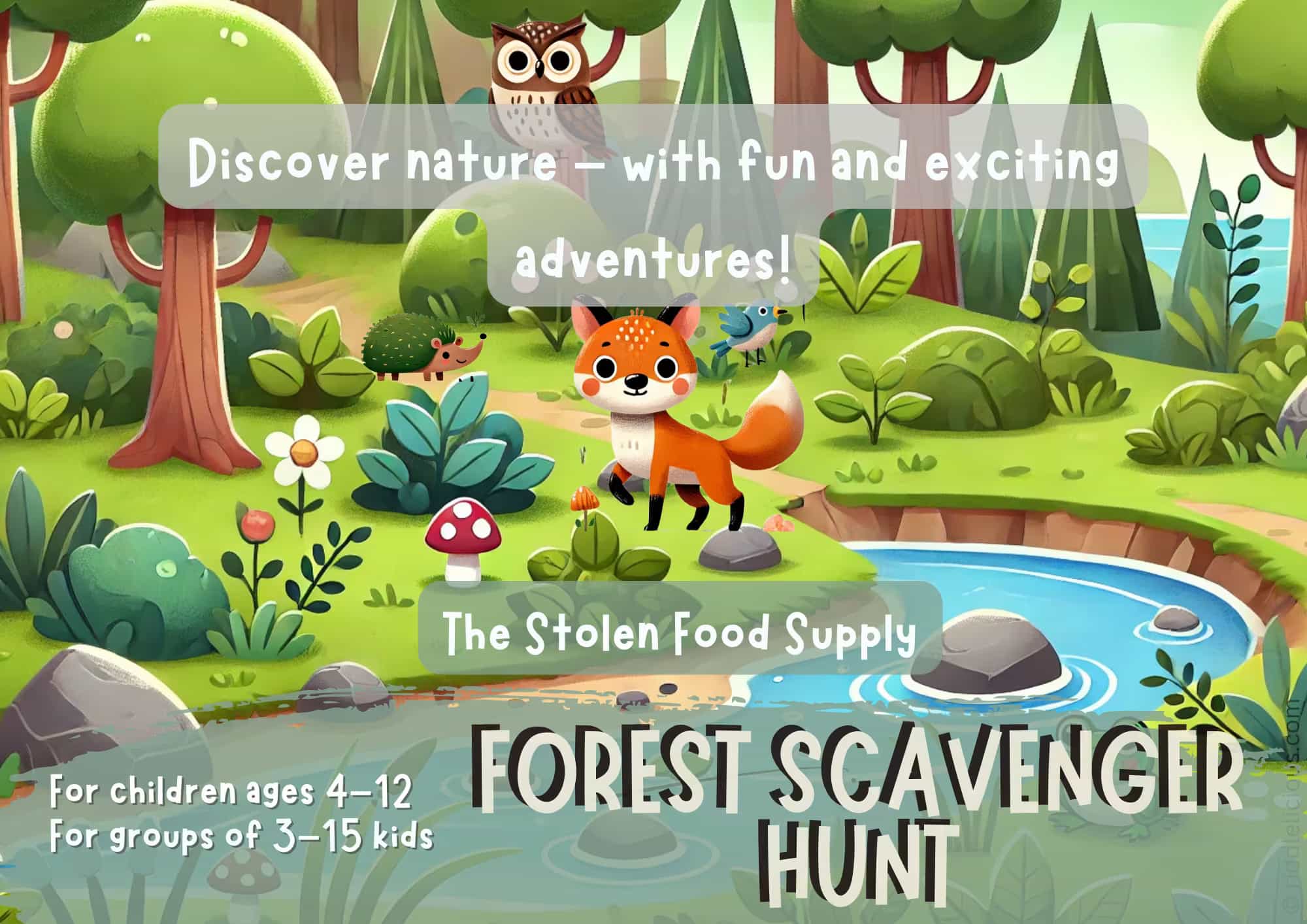
Forest Treasure Hunt
$14.99 — View & Download