

Blog
Math Scavenger Hunt for Kids: 50+ Challenges, 8 Themes & Free Toolkit (Ages 3–15)
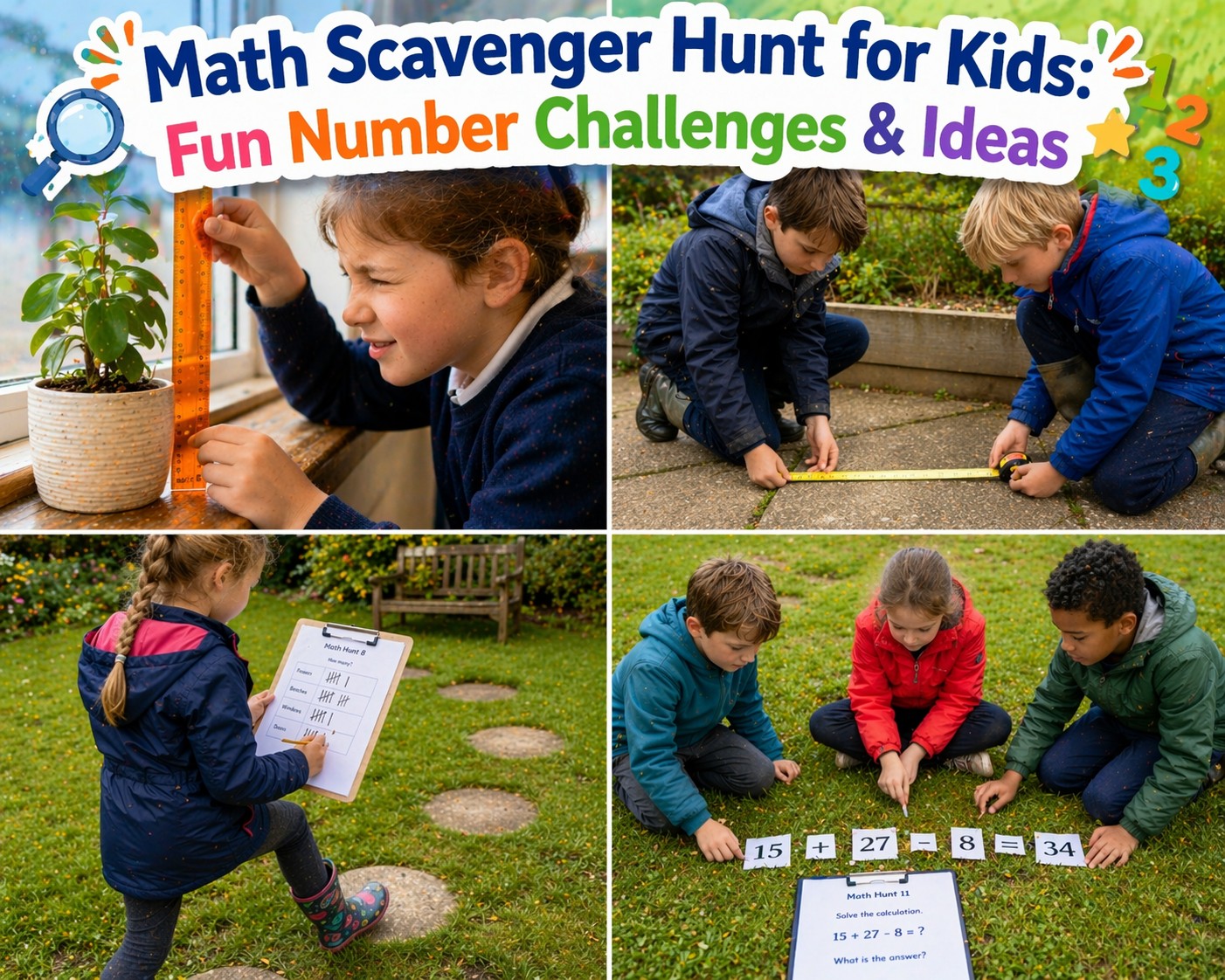
A math scavenger hunt for kids proves that numbers can be genuinely exciting. Instead of worksheets and flashcards, children solve math puzzles to unlock clues, measure real objects, and discover geometry in the world around them. It works at home, in the classroom, or outdoors.
Last updated: May 2026 | Reading time: 14 min | 50+ challenges across 5 age tiers, 8 location themes & free toolkit PDF
These math scavenger hunt challenges are designed to align with common curriculum standards while keeping learning fun. Each activity has been crafted to develop mathematical thinking through hands-on exploration rather than rote memorization.
📥 Download the Free Math Hunt Toolkit (Printable Sheets + Answer Key + Certificate) →
Why Math Scavenger Hunts Work (Backed by Research)
When kids hunt for answers in the real world, they stop seeing math as worksheets and start seeing it as a tool. Three reasons math scavenger hunts beat traditional drill:
- Movement boosts retention. Studies on embodied cognition show kids retain math concepts 30–40% better when they physically move while learning (vs. seated worksheets).
- Real-world anchoring. Counting fence posts or measuring a tree turns abstract numbers into concrete memories — exactly what cognitive science calls “transfer-friendly” learning.
- Lower math anxiety. Hunt format hides the math behind play. Kids who freeze on a worksheet will happily solve the same problem to “unlock” the next clue.
This guide collects 50+ tested challenges, 8 location themes, and a free printable toolkit so you can run a math hunt at home, in the classroom, or outdoors in 15 minutes.
Math Scavenger Hunt Ideas by Skill Level
Pre-Numeracy (Ages 3 to 4)
Sorting & Comparing
- Find one small thing, one medium thing, and one large thing.
- Find an object that is more than and one that is less than your favorite toy.
- Sort 5 found objects from smallest to biggest.
- Find two things that are the same and two things that are different.
- Find something round, something square, and something triangle-shaped.
- Pair up matching socks from the laundry basket — count the pairs.
Counting and Basic Numbers (Ages 4 to 6)
Counting Challenges
- Find 5 red objects and 3 blue objects. How many altogether?
- Count the windows on the front of the house
- Find a group of exactly 4 things
- Look for the numbers 1 through 10 on doors, signs, or car plates
- Find something you can split into 2 equal halves
- Clap your hands the number of times shown on the clue card
Addition, Subtraction, and Patterns (Ages 6 to 9)
Number Operations
- Find a house number. Add the digits. That sum tells you how many steps to the next clue
- Count the legs on 3 chairs. Subtract the legs on 1 table. What is left?
- Find a pattern in nature and sketch it
- Measure a stick with your hand spans
- Solve: “Double a number, add 3, and you get 11. What is the number?” → 4
- Find 3 different shapes in the environment and name them
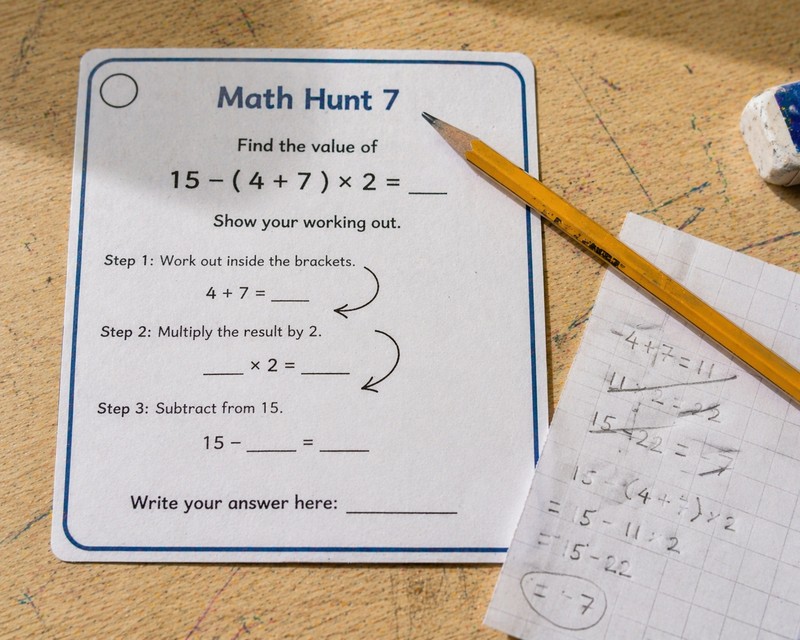
Multiplication, Geometry, and Logic (Ages 9 to 12)
Advanced Challenges
- Find a rectangular object. Measure length and width. Calculate the area
- Estimate a tree’s height using shadow ratios
- Solve: “5 creatures have 34 legs total. Spiders (8 legs) and beetles (6 legs). How many of each?” → 2 spiders, 3 beetles
- Find and photograph 3 examples of symmetry
- Calculate the perimeter of a garden by stepping it out
- Decode: each letter = a number (A=1, B=2…). “8-9-4-4-5-14” = ? → HIDDEN
Pre-Algebra & Real-World Math (Ages 12 to 15)
Advanced Real-World Challenges
- Grocery budget: Plan a $25 picnic with at least 5 items. Photograph the list and totals.
- Speed = distance ÷ time. Time yourself walking 100 paces. Calculate your speed in steps per minute.
- Pythagoras outdoors: Measure a fence diagonal and confirm a² + b² = c² in two corners.
- Percentage hunt: Find 5 price tags. Calculate a 15% discount and a 7% sales tax for each.
- Probability: Roll 2 dice 20 times. Tally outcomes. Compare to expected probability.
- Volume estimation: Estimate, then measure, the volume of a cereal box. Compare your estimate to the actual.
15 Math Riddles & Brain Teasers
- “I have 4 equal sides and 4 right angles. What shape am I?” → Square
- “12 cookies shared equally among 4 friends. How many each?” → 3
- “I am an odd number. Take away one letter and I become even.” → Seven (remove ‘s’ = even)
- “A farmer has 17 sheep. All but 9 escape. How many are left?” → 9
- “What 3 numbers give the same result added and multiplied?” → 1, 2, 3
- “My tens digit is 5 more than my ones digit. My hundreds digit is 8 less than my tens digit. What 3-digit number am I?” → 160
- “If a clock shows 3:15, what angle between the hands?” → 7.5 degrees
- “How many triangles in a five-pointed star?” → 10
- “I double every day. On day 10, I fill a jar. When was I half full?” → Day 9
- “What has a head and a tail but no body?” → A coin
- “I’m a 2-digit prime number. The sum of my digits is 7. My ones digit is bigger than my tens digit. Who am I?” → 43
- “You are in a race and overtake the person in 2nd place. What place are you in now?” → 2nd
- “A snail climbs 3 m up a wall during the day but slips down 2 m at night. How many days to reach the top of a 10 m wall?” → 8 days
- “Two fathers and two sons split 3 oranges so each gets one. How is it possible?” → Three people: grandfather, father, son.
- “I’m a number. Half of me is 25% of 80. What am I?” → 40
For more brain teasers, browse our challenging brain teasers and complete riddle collection.
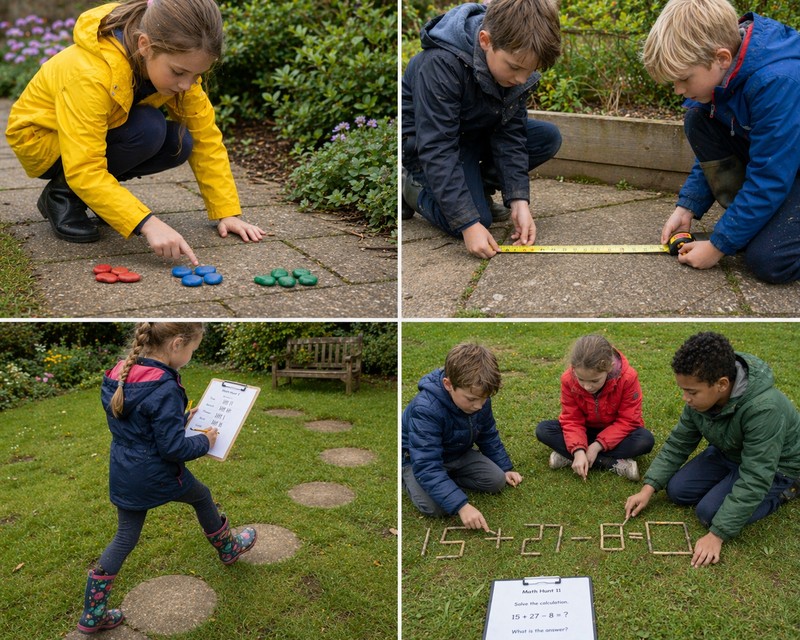
8 Location-Themed Math Hunts (Indoor & Outdoor)
The same skills work everywhere. Pick the location your kids will most look forward to:
| Location | Sample math task | Best ages |
|---|---|---|
| 🏠 Around the House | Count the windows, doors, chairs. Subtract chairs from windows. | 4–10 |
| 🍳 Kitchen | Halve a recipe. Measure 250ml of water. Count the eggs in the box. | 6–12 |
| 🛒 Grocery Store | Find a $1.50 item. Find an item with a 20% discount. Estimate the total of 5 fruits. | 8–14 |
| 🌳 Backyard / Park | Measure your shadow. Count birds for 60 seconds. Find a leaf with 5 lobes. | 5–12 |
| 🏫 Classroom | Hunt the answers to 10 problems hidden on cards. Race in teams. | 7–13 |
| 🚗 Road Trip | Add license-plate digits. Count blue cars vs. red cars. Estimate distance to next sign. | 7–14 |
| 📚 Library | Find books with even Dewey codes. Count chapters in a book. Find page numbers that sum to 50. | 8–13 |
| 🏛️ Museum | Find an exhibit dated before 1800. Count the steps to the next floor. Estimate a sculpture’s height. | 9–15 |
10 Decoder Clue Templates (Math = Key)
These are the secret sauce: the kid must solve a math problem to figure out where to go next. Use them on a printed card or sticky note.
- House-number Add-Up: “Take the digits of the house number, add them up. That sum tells you which page in the book to open.”
- Letter-Number Decode: “8-9-4-4-5-14 (A=1, B=2…) → HIDDEN. Look behind the hidden item.”
- Clock Position: “When the clock hands form a right angle (90°), the next clue appears at the location that starts with the letter at that hour.”
- Step Counter: “Solve 7 × 8 — that’s how many paces in the direction of the morning sun.”
- Time Lock: “Subtract 17 from 60. That number is the minute on the clock where the next clue is taped.”
- Page Riddle: “The answer to (15 + 12) × 2 is the page number. Open that page in your favorite book.”
- Geometry Doors: “How many sides on a hexagon? Count that many doors in the house — your next clue is behind the last one.”
- Fraction Hint: “1/4 of 40 = the number of cushions to lift. Last one wins.”
- Symmetry Hunt: “Find an item with a vertical line of symmetry. The clue is taped behind it.”
- Algebra Lock: “If 2x + 5 = 21, what is x? Look in the cabinet at that height in inches.”
Curriculum Alignment (K–5 Skills Covered)
Teachers and homeschool parents asked: which Common Core / KS1–KS2 skills does a math hunt practice? Here is the rough map:
- K (Kindergarten): Counting to 100, comparing numbers, basic shapes — Pre-Numeracy + Basic Numbers tiers.
- Grade 1–2: Addition / subtraction within 20, place value, telling time — Counting + Addition/Subtraction tiers.
- Grade 3–4: Multiplication, fractions, geometry, area & perimeter — Multiplication tier + Decoder Clues.
- Grade 5–6: Decimals, percent, volume, basic algebra — Pre-Algebra tier + grocery / road-trip themes.
- Grade 7+: Probability, Pythagoras, ratios — Pre-Algebra extension + library / museum hunts.
How to Set Up a Math Scavenger Hunt (15 Minutes)
- Choose your venue: Classroom, house, garden, or park
- Write 8 to 12 clue cards: Each has a math problem whose answer leads to the next location
- Mix problem types: Alternate between calculation, geometry, logic, and measurement
- Include manipulatives: Place physical objects at stations (blocks, rulers, shapes)
- End with a prize: A “math champion” certificate or small treasure chest reward
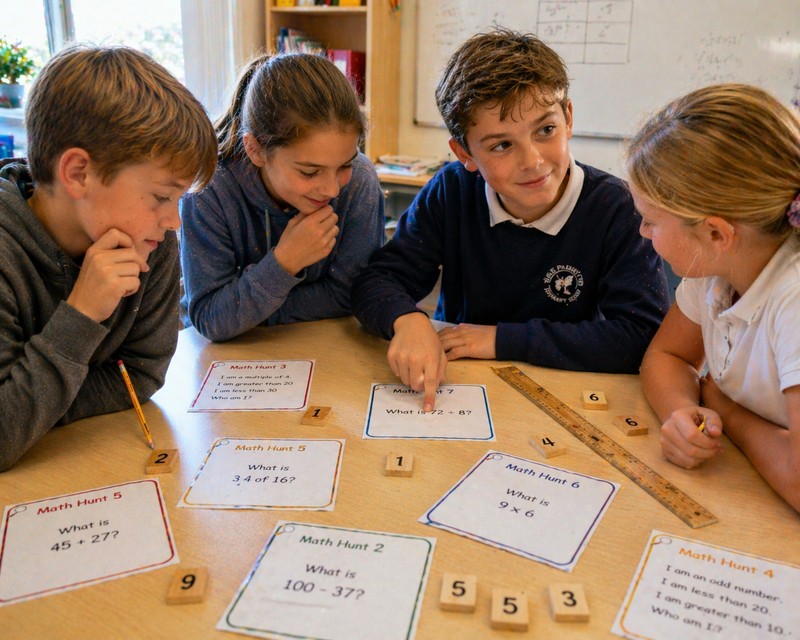
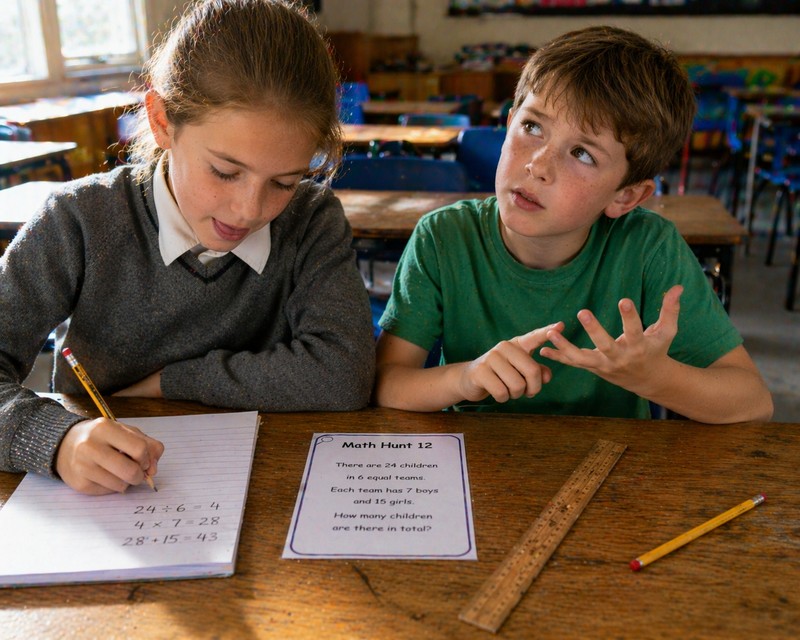
Math Hunt for the Classroom
5 Mistakes to Avoid With Math Scavenger Hunts
- Mismatching difficulty to age. A 5-year-old will not solve “12 × 8” — but they will count 12 fence posts. Match the challenge format to reading level and math level.
- Too many problems per station. One math task per station. Save the rest for the next hunt. Long stations kill momentum.
- No physical movement. The whole point is to move. If kids solve from one chair, you have rebranded a worksheet — not a hunt.
- Forgetting answer-key cards. Print or write a master answer key. Kids will get stuck; you will forget which clue points where.
- No celebration at the end. A “Math Champion” certificate, a small treat, or a final group cheer matters more than the prize value.
What You Need (Supplies Checklist)
- 📄 8–12 clue cards (printable or hand-drawn sticky notes)
- ✏️ Pencil + paper per child for working out answers
- 📐 1 ruler or measuring tape (essential for geometry tier)
- ⏱️ 1 timer or stopwatch (phone works)
- 🎲 Optional: 2 dice for probability tier
- 🧮 Optional: small calculator for ages 8+
- 🏆 Final prize: certificate, treat, or small treasure
Math Scavenger Hunt FAQ
Discover more educational fun in our scavenger hunt collection or explore knowledge and research riddles.

Detective Scavenger Hunt
Printable scavenger hunt — print at home, play in minutes. Includes clues, treasure map, certificates & more.