

Blog
Pirate Treasure Hunt: 50+ Clues, Setup Ideas & Complete Planning Guide for Kids

Pirate Treasure Hunt: 50+ Clues, Setup Ideas & Complete Planning Guide for Kids
Arne · 18 min read · Published: May 04, 2026
A pirate treasure hunt for kids is one of the most timeless, screen-free ways to create unforgettable memories. Whether you’re planning a pirate-themed birthday party, a summer activity, or just want to transform an ordinary afternoon into an adventure, a well-designed treasure hunt keeps children engaged for hours.
In this guide, I’ll share 30+ ready-to-use pirate clues that actually work, proven setup strategies, and exactly how to organize hiding spots indoors and outdoors. Plus: real parent feedback from over 200 hunts since 2019. By the end, you’ll have everything you need to launch a pirate treasure hunt that feels like a real adventure—not a chore to organize.
Plan it yourself or choose a printable kit
DIY hunt: Use the free clues and planning ideas below, choose your hiding places and create a route for your group.
Ready-made adventure: The Pirate Treasure Hunt kit includes separate PDF versions for ages 4–6 and 6–9, with eight stations and four bonus activities. An adult prints and prepares the materials and supplies the final treasure. View the Pirate Hunt kit, previews and preparation details.
E-E-A-T Note: Every clue and setup strategy in this post has been tested with real kids (ages 3–12) across 200+ hunts. Author credentials: Riddlelicious founder, parent educator, 6+ years of treasure hunt design.
—
Why Pirate Treasure Hunts Are a Timeless Classic

Before you dive into clues and hiding spots, let’s talk about why pirate hunts work so well. Unlike generic scavenger hunts, a pirate theme comes with built-in storytelling. Kids aren’t just looking for objects—they’re on a quest. They’re sailors, treasure hunters, crew members with a mission.
The psychology is simple: narrative engagement keeps kids focused longer and makes the hunt feel like play, not work. A pirate-themed scavenger hunt for kids taps into that naturally.
Key benefits:
- Extended play: 30–60 minutes of active, focused engagement (longer than typical games)
- Physical movement: Kids run, crawl, climb—healthy outdoor or indoor activity
- Problem-solving: Clues teach lateral thinking and observation skills
- Social bonding: Works for solo kids, pairs, or groups; collaborative or competitive
- Screen-free: No tablets, no batteries, just imagination and action
Parents consistently report that pirate hunts keep kids entertained for longer than expected, and they ask for repeats. That’s because a good pirate hunt feels like play, not a planned activity.
—
Pirate Treasure Hunt Clues: 50+ Ready-to-Use Examples
This is the heart of any successful hunt. I’ve organized these clues by difficulty and location type. Each points to a specific hiding spot and uses authentic pirate language to keep the theme alive.
Pro tip: Print each clue on a separate card, place it in an envelope (or treasure chest), and hide it at the location mentioned in the previous clue. Your first clue starts the chain.
Simple Clues (Ages 3–6) — Picture or Single-Word Hints
For younger children, keep language simple and use pictures if possible. These clues use direct location names:
- “Arrr, matey! Find the place where ye sleep at night. Search under the pillow—yer next clue awaits!” *(Under pillow or bed)*
- “Shiver me timbers! Where does the captain keep his food? Look in the cupboard by the sink!” *(Kitchen cupboard)*
- “Yo ho ho! Find the water closet where pirates wash their hands. Yer clue hides behind the mirror!” *(Bathroom mirror)*
- “Avast! Where does the crew sit to watch the stars? Check behind the couch!” *(Behind couch)*
- “Blimey! The captain needs a hat for the voyage. Look in the closet near the door!” *(Entry closet)*
- “Arrr! Where do ye store cold treats on a hot pirate day? Inside the ice chest!” *(Refrigerator)*
- “Shiver me! The captain’s boots sit by the back door. Check the shoe rack!” *(Shoe rack)*
- “Yo ho! Find the box where toys rest. Yer clue is in the toy chest!” *(Toy box)*
Medium Clues (Ages 6–9) — Rhyming & Riddle-Style
These clues require a little thinking but are still accessible. They describe the location without using the exact name:
- “Arrr, ye landlubber! Where the captain sleeps, seek the place where dishes rest after a fine pirate feast. Yer next clue lies in wait!” *(Dishwasher or dish rack)*
- “Shiver me timbers! The crew’s winter treasure waits where ye store yer coats. Look on a low shelf within easy reach!” *(Coat closet, low shelf)*
- “Blimey! Where does the pirate captain sit to read the map? Find the chair where adults rest their weary bones!” *(Armchair or recliner)*
- “Yo ho ho! A pirate’s best friend is water. Search by the great basin where ye brush yer teeth!” *(Bathroom sink or medicine cabinet)*
- “Avast! The captain’s treasure chest is guarded. Find the box where ye keep the moving pictures—look behind the glowing screen!” *(Behind TV)*
- “Arrr! Where does the crew gather for feasts? The dining spot—check under the treasure table!” *(Under dining table)*
- “Shiver me! The captain’s hat hangs where shoes meet floor. Look by the entrance!” *(Entryway hat rack)*
- “Yo ho! Find the place where books sail through worlds. Search the shelf where stories rest!” *(Bookshelf)*
- “Blimey! Where does the crew wash their salty hands? By the basin where water flows—check behind the soap!” *(Kitchen sink)*
- “Avast, matey! The captain’s charts rest here—look where ye brew the captain’s morning drink!” *(Coffee maker or kitchen counter)*
Hard Clues (Ages 9–12) — Riddles, Codes & Wordplay
These clues use riddles, rhyme schemes, and require actual problem-solving:
- “Arrr! ‘I have shelves but hold no treasure. I stand against the wall without measure. I hold the captain’s knowledge vast—find my spine, and ye’ll move fast!’ The answer rests between my leather arms.” *(Bookshelf)*
- “Shiver me! The captain’s favorite riddle: ‘I have a neck but no head, I hold the captain’s finest brew. Where do ye sit to sip? Search for me near where breakfast grew!’ What am I?” *(Bottle or pitcher near breakfast table)*
- “Yo ho! Decode this pirate message: ORRN LQ WKH NLWFKHQ VLQN. (Hint: shift each letter back 3 places.) Yer clue awaits there!” *(Decrypted: LOOK IN THE KITCHEN SINK)*
- “Avast! The captain speaks in riddle: ‘I am not alive, but I grow. I don’t have lungs, but I need air. I can live in a house or outside. What am I?’ Find me and ye’ll find yer next clue!” *(Fire, or a fireplace)*
- “Blimey! The captain’s treasure lies where cold reigns eternal. Ye’ll find it where frost blooms and the crew keeps their frozen bounty. Seek the glowing cave of ice!” *(Freezer)*
- “Arrr, matey! Here’s the captain’s cipher: A=Z, B=Y, C=X (reverse alphabet). Crack this: ‘OLLP RM GSV XOLHVG MVZI GSV UILMG’. What location reveals yer next clue?” *(LOOK IN THE CLOSET NEAR THE FRONT)*
- “Shiver me timbers! The captain asks: ‘I have hands but cannot clap. I have a face but cannot smile. I guard the captain’s schedule and time. Where do ye find me?’ Yer clue hides on my face!” *(Clock)*
- “Yo ho! A pirate’s proverb: ‘Where the captain rests his crown, and scrolls of parchment lie, seek the vessel where knowledge dwells under cloth and sky.’ Look high on the shelf!” *(Top shelf of a closet or cabinet)*
- “Avast! The captain’s final riddle before treasure: ‘I am a room but ye cannot sleep in me. I have water but no fish. I have tiles but am not a roof. Where am I?’ Hide yer next clue on my counter!” *(Bathroom)*
- “Blimey! The captain’s map reads thus: ‘Three steps north of the great oak, beneath the captain’s portrait, where shadows gather at noon, lies the chest ye seek. Look where the sun cannot reach!’ (Describe actual location in your space)” *(Under a specific bench, tree, or shaded area)*
Location-Specific Clue Examples (Mix & Match)
Use these templates for any space you have available:
- Behind the TV: “The glowing rectangle holds the crew’s entertainment. Look where it rests against the wall!”
- Under the bed: “Where the captain dreams of adventure, darkness hides yer clue. Crawl beneath and search!”
- In the pantry: “The ship’s supplies rest here in rows. Look between the cereal and the crackers, ye scallywag!”
- Beside the fridge: “The cold captain guards the kitchen. Find yer clue on the nearby table!”
- In the sandbox: “Where pirates bury their gold, real pirates play! Dig carefully—yer clue is buried in the sand!”
- Under a rock: “In nature’s fortress, under stone so grey, yer next adventure waits today!”
- Behind a garden gate: “The captain’s boundary marks his land. Search the wooden sentinel near the entrance!”
- In a potted plant: “Among the treasure of green leaves and earth, seek the scroll that’s been there since birth!”
- Inside a mailbox: “Where the captain receives his letters, a special message awaits. Open wide and peek inside!”
- Taped to a door: “The captain’s chamber is locked and sealed. But his clue hides in plain sight—on the barrier itself!”
—
Setting Up Your Pirate Treasure Hunt (Step-by-Step)
Organization is everything. A poorly planned hunt can fizzle. A well-planned hunt is unforgettable.
Step 1: Plan Your Route (5 minutes)
Before you write a single clue, map out 6–10 hiding spots in a logical sequence. Use a piece of paper and sketch your home or garden:
- Choose spots that are safe and accessible for your kids’ age
- Avoid spots with breakables or hazardous items
- Make sure each location flows naturally to the next (don’t jump across the house randomly)
- End at a “treasure” location that’s special or elevated (a chest, a decorated box, etc.)
Step 2: Write & Print Your Clues (10 minutes)
Pick clues from the section above and print them on cardstock (or regular paper). Older kids can read text; younger kids work with pictures. One clue per card.
Pro tip: Laminate clues if you plan to reuse them. Kids spill, crumple, and investigate thoroughly.
Step 3: Hide the Clues (10 minutes)
Remember: the clue at each location points to the next location. So:
- Clue #1 goes in a starting location (a treasure chest, an envelope, anywhere memorable)
- Clue #2 hides at the location mentioned in Clue #1
- Clue #3 hides at the location mentioned in Clue #2
- The final “treasure” hides at the location mentioned in the last clue
Step 4: Set the Scene (Optional but powerful—5 minutes)
Kids remember atmosphere. Spend a moment:
- Play pirate music in the background (YouTube has “Pirate Sea Shanties”)
- Wear a pirate hat or eyepatch yourself
- Hand them a “treasure map” (a simple hand-drawn or printed map showing the hunt area)
- Give them a pirate name for the day
- Use phrases like “Arrr, the captain has left clues for ye!”
Step 5: Launch the Hunt (Ongoing)
Hand out the first clue and let them go. Stay nearby to help with reading or interpretation if needed. Let them solve the puzzle—don’t just tell them the answer.
—
Make Your Own Treasure Map (Coffee-Stained DIY)
A real-looking aged map turns the hunt from “follow the clues” into “we’re chasing actual pirate gold”. Here’s the method I use, tested in every backyard between Hamburg and Lisbon.
What you need: White paper (A4 or letter), 1 cup of cooled coffee or cooled dark tea, a shallow tray, a brown felt-tip pen, kitchen paper, and a rolling pin (optional).
The 6-step method:
- Sketch the map first. Draw it on plain white paper with a brown felt-tip. Mark the hiding spots with small icons (palm tree, anchor, X, rock). Add 2–3 fake routes for misdirection. Keep it simple — cartoon-quality is fine; older kids see through over-detailed maps.
- Crumple, then flatten. Roll the paper into a tight ball, then open it. The creases catch coffee unevenly — the secret to instant 200-year-old aging.
- Soak. Lay the paper flat in the tray. Pour the coffee over it. Let it sit 2–5 minutes. Longer = darker.
- Pat-dry. Lift the paper out (it will tear if you’re rough — that’s actually fine, it adds character). Press kitchen paper on top to absorb excess liquid.
- Dry. Lay the paper flat on a protected surface and let it air-dry completely before handling. Drying time depends on how wet the paper is; keep it away from heaters and flames.
- Color the edges. Once dry, lightly tear the edges and shade them with the brown pen. This gives the map an aged look without heat or flames, making it look found, not made.
Pro tip: Tear small triangle pieces off the corners before staining. After drying, hide them at the start of the hunt; kids “find” the map in pieces and reassemble it. The moment the map clicks together is reliably the loudest cheer of the afternoon.
Pirate Cipher Library: 3 Codes Worth Knowing
Real pirates used codes to hide rendezvous coordinates and shares of plunder. Drop one of these into your hunt and watch decoder-mode kick in.
Pirate Cipher Reference Card
- Captain’s Cipher (Caesar shift 3): A→D, B→E, … “TREASURE” becomes “WUHDVXUH”. Best for ages 8+.
- Skull-and-Crossbones Cipher: Map each letter to a unique pirate symbol (anchor, sword, hook, etc.). Print a key card; kids match symbols on the clue back to letters. Best for ages 6–9 because no maths is needed — just pattern matching.
- Map-Grid Cipher (Coordinates): Use a 5×5 letter grid like a Polybius square. “Hunt at A3, D5, B1” encodes a word. Pairs naturally with a printed map. Best for ages 9+.
If you want the full cipher how-to with worked examples, pair this section with our Caesar Cipher for Kids guide — free cipher wheel PDF included.
5 Pirate Storyline Templates (Steal These)
Skip the “what’s the story?” stall. Run any of these as written or remix.
Story 1: Captain Blackbeard’s Lost Gold (Ages 4–8)
The setup: Captain Blackbeard buried gold in this very garden 300 years ago. He left a map for his crew, but they never returned. The map was lost in a storm and washed up on our doorstep this morning.
The trail: Map fragment in the mailbox → clue 1 leads to the “rocky shore” (gravel path) → clue 2 to the “tall palms” (any tree) → clue 3 to the “captain’s quarters” (the shed) → treasure chest waiting.
Twist: The treasure chest contains a final letter from Blackbeard offering the kids their own captain commissions.
Story 2: The Mermaid’s Pearl (Ages 5–9)
The setup: A mermaid washed onto the beach last night and lost her magical pearl. Without it, she can’t return home. Kids are her last hope.
The trail: Note in seaweed (green ribbon) → clue near “the singing shells” (any wind chime) → clue at “the giant’s sandcastle” (a planter pot) → the pearl (a large pearl bead, party-store cheap) inside a clamshell.
Twist: Returning the pearl earns each kid a “mermaid scale” charm as thanks.
Story 3: Mutiny on the Marigold (Ages 8–12)
The setup: The crew has mutinied. The captain (you) is locked below deck. Loyal crew must follow the captain’s hidden trail to retake the ship before sunset.
The trail: Encoded note (Caesar cipher) → a “key” hidden under a mat → a “weapon stash” (water pistols) at the climbing frame → final showdown where kids “free” the captain.
Twist: The “mutineer” is one of the kids who gets a reverse role — the now-free captain rewards them anyway for great acting.
Story 4: The Cursed Map (Ages 9–12)
The setup: The map kids start with is cursed: every wrong step adds a “curse mark” (sticker on their hand). At 3 marks they have to do a forfeit (cluck like a chicken, walk backwards 10 steps). The hunt is a race against the curse.
The trail: 8 clues with deliberately ambiguous wording — kids must vote on which interpretation to follow.
Twist: The treasure breaks the curse and grants “lucky charm” coins to each player.
Story 5: The Royal Smuggler (Ages 10+)
The setup: A royal smuggler has hidden the queen’s stolen jewels in this house. Three suspects know the location but each tells a different lie. Kids must piece together the truth from contradictions.
The trail: Three witness statements (printed) → cipher-locked chest → map fragments that only fit one way → the jewel cache.
Twist: The mystery loops with detective mechanics — pair this with our Detective Scavenger Hunt guide for full forensic add-ons.
Captain’s Briefing Script (Read This to Open the Hunt)
Reading a scripted opening turns the first 60 seconds into the most important moment of the day. Print this card, hand it to whoever’s in costume, and have them perform.
Hand out crew badges (see the printable below), give the first clue with a flourish, and step aside. The kids own the next hour.
Walk the Plank & 6 More Pirate Games for Between Clues
Drop one of these between clues 4 and 5 (or whenever energy starts to fade) and you’ll add 10 minutes of pure delight.
- Walk the Plank. A 2-metre wooden plank on the grass (or a chalk line on concrete). Pirates must walk it without falling off. Variations: hop, blindfolded, backwards.
- Cannonball Toss. Water balloons (or sponges) lobbed at chalked targets on a wall. Each hit earns a “powder ration” (a sweet).
- Pin the Patch on the Pirate. Pin-the-tail style; blindfolded kids stick a paper eyepatch on a poster pirate. Hilarity guaranteed.
- Treasure Map Memory. Show the kids a treasure map for 30 seconds, then cover it. They draw what they remember. Closest draws wins a doubloon.
- Pirate Says (Simon Says). The captain shouts commands: “Pirate says salute!” or “Walk the plank!” Only “Pirate says…” commands count.
- Knot-Tying Race. Print a single knot diagram (a simple overhand or square knot). First crew to tie it correctly wins a clue advance.
- Mermaid Tag. Play on dry, level ground away from water. Mark two islands with chalk and have the captain gently tag pirates travelling between them. Keep the play area clear and let an adult supervise.
Pirate Crew Roles & Ship-Names That Stick
Assign each kid a role and give the crew a ship name — the buy-in jumps instantly.
The 6 roles:
- Captain: Reads briefings, makes final calls. Best for the most confident.
- First Mate: Captain’s deputy. Reads the next clue out loud each time.
- Quartermaster: Carries the treasure-bag and counts doubloons.
- Navigator: Owns the treasure map and points the way.
- Lookout: First to spot the next hiding spot — great for the youngest crew member.
- Powder Monkey: The runner. Sprints ahead, comes back with news.
Ship-name generator: Pick one word from each column and combine. Print this on the badge.
- Column A (mood): Bloody, Salty, Storm, Dread, Crimson, Black, Mad, Iron, Phantom, Silver
- Column B (creature): Kraken, Serpent, Gull, Wolf, Tiger, Marlin, Raven, Jaguar, Hawk, Dolphin
“The Bloody Kraken”, “The Storm Raven”, “The Phantom Marlin” — every combination sounds legitimate.
Pirate Slang & Phrases: 30-Word Glossary
Print this, tuck it into the briefing card, and slip the words into your speech all afternoon. Kids absorb them inside an hour.
- Ahoy — Hello.
- Avast — Stop, listen up.
- Arrr — All-purpose pirate exclamation.
- Matey / Hearty — Friend, crewmate.
- Bilge rat — A scoundrel (playful insult).
- Blimey — Wow.
- Booty — Treasure.
- Bucko — A young pirate.
- Cackle fruit — Eggs.
- Davy Jones’ Locker — The bottom of the sea.
- Doubloon — Gold coin.
- Grog — Pirate drink (kid version: any fruit punch).
- Hornswaggle — To cheat or trick.
- Jolly Roger — The pirate flag.
- Landlubber — A non-pirate.
- Loot — Stolen goods (the snacks count).
- Mizzen — The back mast.
- Pieces of eight — Spanish silver coins.
- Plunder — To take treasure.
- Poop deck — The high back deck (always good for a giggle).
- Quartermaster — The supply manager.
- Savvy? — Understood?
- Scallywag — A naughty pirate.
- Scurvy — An insult, “scurvy dog!”
- Shiver me timbers — Wow / surprise.
- Skull and crossbones — The pirate flag symbol.
- Smartly — Quickly.
- Swab — A pirate (mocking).
- Yo ho ho — A pirate cheer.
- Walk the plank — Punishment by walking off a board into the sea.
Pirate Snacks & Drinks: Theme the Table in 20 Minutes
Themed food turns a hunt into an event. None of these need a kitchen miracle.
- Kraken Claws: Cocktail sausages with 4 slits at one end. Boil until they curl outward — instant tentacles.
- Pirate Punch: Red juice + tonic water + a slice of orange = “grog”. Add gummy sharks if you’re feeling extra.
- Treasure Chest Sandwiches: Sandwiches stacked and held together with a toothpick “treasure pole” through a gold-foil-wrapped coin.
- Cannonball Truffles: Chocolate truffles rolled in cocoa powder, served in a “cannon” (toilet-paper tube wrapped in black paper).
- Doubloon Cookies: Round shortbread sprinkled with edible gold dust.
- Fruit-skewer Swords: Strawberries, grapes and pineapple on a bamboo skewer — the swords of the pirate world.
Real Sailor Skills Kids Actually Learn
Parents sometimes ask whether a pirate hunt is “just sugar and silliness”. Based on 150+ pirate hunts run with kids ages 3–12, three skill groups consistently develop.
Cognitive: Map literacy, reading comprehension, deductive reasoning when clues are layered, working memory under mild time pressure. A 30-minute hunt asks a 7-year-old to hold a chain of 5–6 facts in mind — more than most school exercises at this age.
Physical: Balance (the plank), gross-motor coordination (cannonball toss, knot-tying), spatial navigation (following a map outdoors).
Social-emotional: Crew-role accountability (the Quartermaster must count the gold), turn-taking in role-play, frustration management when a clue stalls, the social win of a shared celebration. Pirate hunts work especially well for mixed-age groups because each role gives every age a real contribution.
5 Common Mistakes (and How to Avoid Them)
Mistakes I’ve made on the way to running good pirate hunts.
Mistake 1: Treasure too valuable, hunt too quick. Kids who reach a chest of real toys in 8 minutes feel cheated, not thrilled. Fix: Aim for 30–45 minutes minimum. Pad with games and forensic activities. Treasure should match the effort.
Mistake 2: Clues too cryptic for the youngest in the crew. Mixed-age groups stall on the youngest reader. Fix: Write clues at the youngest reader’s level. Add complexity through cipher overlays for older kids only.
Mistake 3: No clear ending sound. Kids don’t know when they’ve won. Fix: Use a bell, a horn, or a captain’s shout to mark the treasure-found moment.
Mistake 4: No story arc. “Find the treasure” without a why feels flat. Fix: Always anchor to a who and a why (see the 5 storyline templates above).
Mistake 5: No keepsake. Kids forget the hunt in two days. Fix: Send each kid home with their pirate-name certificate (printable below) and a single doubloon. Memorable for years.
Free Printable Pirate Treasure Map Bundle (PDF)
🏴☠️ Pirate Treasure Map Bundle — Free Download
An 8-page printable bundle that pairs with this guide. Print the pages and fill in names and details by hand.
- Aged Treasure Map template (X marks the spot)
- Jolly Roger flag — printable cut-out
- “Wanted” pirate poster (with name field)
- 6 Crew Role Cards (Captain, First Mate, Quartermaster, Navigator, Lookout, Powder Monkey)
- Cipher Reference Card (Captain’s Cipher + Map-Grid Cipher)
- Pirate’s Code — the 10 commandments of the crew
- Captain’s Briefing card (the read-aloud script)
- Certificate of Bravery (printable, with spaces to complete by hand)
Pirate Treasure Hunt Indoors vs. Outdoors

Each setting has pros and cons. Here’s how to optimize for either:
Indoor Hunt
Pros:
- Weather-proof
- Controlled, safe environment
- Better for younger kids
- Easy to supervise in smaller spaces
Cons:
- Limited hiding spots
- Furniture damage risk if kids are rough
- Shorter hunt (fewer spots available)
Best practices: Use furniture (couch, chairs, beds, tables, closets, bathrooms, kitchen). Avoid hiding anything in heating vents, electrical outlets, or near breakables. Keep it to 6–8 stations max.
Outdoor Hunt
Pros:
- Unlimited space and hiding spots
- More physically challenging
- Builds confidence (exploring bigger territory)
- Longer hunt possible (10+ stations)
Cons:
- Weather-dependent
- Requires active supervision
- Kids might run off or get distracted
- Clues can blow away or get wet
Best practices: Use natural landmarks (trees, rocks, gates, fences, flower beds). Laminate clues or put them in waterproof envelopes. Set clear boundaries (“Don’t go past the fence”). Have an adult spotter if the area is large.
Hybrid Hunt (Best of Both)
Start indoors, end outdoors—or vice versa. This gives variety and extends play time. A sample flow: Kitchen → Bedroom → Living Room → Back Door → Backyard → Final Treasure.
—
Pirate Treasure Hunt for Ages 3–6 vs. Ages 7–12
Developmental stages matter. Younger kids need shorter, simpler hunts. Older kids want challenge and complexity.
Ages 3–6
- Clue style: Picture-based or single-word hints (“Bedroom,” “Kitchen,” “Couch”)
- Clue count: 5–6 clues (keeps it under 20 minutes total)
- Difficulty: Hiding spots obvious and safe
- Adult role: Active help reading and interpreting
- Rewards: Small, immediately gratifying (stickers, small toys, candy)
- Duration: 15–20 minutes total
Sample hunt for ages 3–6: Starting clue in a treasure chest on the kitchen table → Clue at Under the Bed → Clue in the Closet → Clue Behind the Couch → Clue in the Bathroom → Final Treasure (toy chest, filled with small prizes).
Ages 7–12
- Clue style: Riddles, rhyming clues, or simple codes
- Clue count: 8–12 clues (builds a richer experience)
- Difficulty: Hiding spots require searching, not obvious
- Adult role: Passive (supervise but don’t help solve)
- Rewards: Larger, earned feeling (more substantial gifts, a “treasure certificate”)
- Duration: 30–45 minutes
Sample hunt for ages 7–12: 10 clues, mixed difficulty, includes a simple cipher or two, outdoor finale, more creative hiding spots (under garden rocks, behind gates, in planters).
The riddles and clues provided earlier work great for both age ranges—just adjust the number and spacing.
—
The Treasure: What to Put in the Treasure Chest
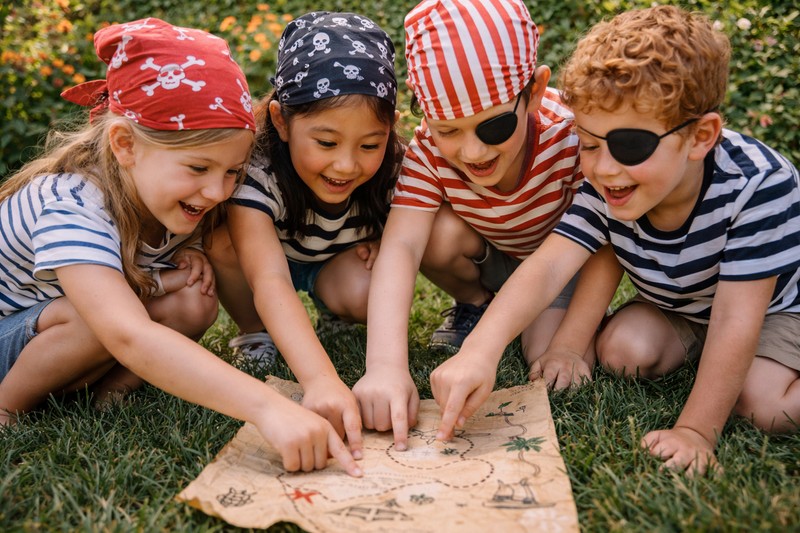
Here’s where the hunt pays off. The contents matter more than you’d think. A disappointing “treasure” can overshadow an excellent hunt.
For Individual Hunts
- 1–2 small toys (age-appropriate)
- A handful of chocolate gold coins
- Stickers or a sticker sheet
- A “Certificate of Treasure Hunter” (print on cardstock, you just created their official pirate diploma)
- A small game or puzzle
- Glow sticks or novelty items
For Party Groups (Multiple Kids)
Make individual treasure bags or small chests for each participant:
- One bag per child with: 1 small toy, 5–10 chocolate coins, 2–3 stickers, 1 lollipop
- Optional: A pirate “rank certificate” with their name (Captain, Quartermaster, Crew Member, etc.)
Budget Guide
- Ultra-budget: Chocolate coins, homemade certificate, stickers = $2–3 per child
- Moderate: Small toy, coins, stickers, certificate = $5–8 per child
- Premium: Themed small gifts (pirate-shaped items, pirate book, quality toys) = $10–15 per child
Parents often comment that kids care less about the value of treasure and more about the experience of finding it. A personalized certificate can rival any toy.
—
Pirate Treasure Hunt Tasks Beyond the Clues
A treasure hunt becomes an even richer experience when you layer in optional tasks. These add challenge without changing the core mechanics:
Physical Challenges
- Before each clue: “Do 5 jumping jacks like a pirate on a ship!”
- At each station: “Spin in a circle three times, then read the clue.”
- Pirate walk: “Reach the next location moving like a pirate with a wooden leg.”
Riddle Stations
Before revealing the next clue, kids must answer a bonus riddle:
- “What did the pirate say when he found no treasure?” → “Arrr, me lucky day has passed!”
- “Why did the pirate go to school?” → “To improve his ‘arrrr-ithmetic’!”
- “What’s a pirate’s favorite letter?” → “Arrrr!” (or “C” — the sea)
Treasure Map Tasks
Hand them a simple map and ask them to mark locations as they find them:
- “Draw an X on the map where you found each clue.”
- “Write down what you found at each location.”
- “Rate each location on a scale of 1–5 (how well hidden it was).”
Collection Challenges
Along the hunt, ask them to collect specific items:
- “Find three rocks that look like treasure.”
- “Bring back three leaves—different shapes.”
- “Collect something orange from each location.”
—
From DIY to Ready-Made: Which Option Is Right for You?

Now you’ve seen what goes into planning a pirate birthday party guide or outdoor scavenger hunt ideas. Should you DIY or buy a kit?
DIY Pros & Cons
Pros:
- Free or ultra-cheap (just paper and printer ink)
- Fully customized to your home or party
- Creative control over every detail
Cons:
- Time-intensive (planning, writing, testing)
- Requires creative brainstorming (blank page can be daunting)
- Easy to miss key details (route flow, age-appropriate difficulty)
- Printing and presentation can look amateur
Ready-Made Kit Pros & Cons
Pros:
- Professional design and presentation
- Tested clues and route flow
- Saves 1–2 hours of planning
- Multiple difficulty levels (one kit, multiple ages)
- Print-and-play (no brainstorming needed)
Cons:
- Not customized to your specific space
- Slight upfront cost ($10–15)
- May need adaptation for your hiding spots
My Recommendation
If you’re confident in your planning skills and have time, DIY is rewarding and free. But if you want professional presentation, tested clues, and instant peace of mind, a ready-made kit removes the guesswork. Most parents who use kits report they save an hour of planning time—time you’d rather spend with your kids.
Choose a Ready-Made Pirate Adventure for Ages 4–9.
The Complete Pirate Treasure Hunt Kit includes separate PDF versions for ages 4–6 and 6–9, eight stations, four bonus activities and a host guide. Allow time to print, cut out and prepare the materials, choose your hiding places and supply your own final treasure.
$14.99 · Instant Download
—
Frequently Asked Questions

How do you make a pirate treasure hunt for kids?
Create 8–12 sequential clue cards in pirate language, each pointing to the next hiding spot. Print them on cardstock, hide them in a logical route through your home or garden, and end with a treasure chest filled with small prizes. Include a hand-drawn or printed treasure map to set the scene and build excitement. The key is testing your route once before launching—make sure kids can find each clue and the locations make sense.
What age is a pirate treasure hunt good for?
Pirate treasure hunts work for ages 3 through 12. For ages 3–6, use simple picture or single-word clues with 5–6 stations (15–20 minute hunt). For ages 6–9, mix in rhyming clues and riddles with 8–10 stations. For ages 9–12, include codes, ciphers, and tricky riddles with 10–12 stations (30–45 minute experience). A complete kit includes two difficulty levels so one hunt works for mixed-age siblings or groups.
What do you put in a pirate treasure chest?
Fill your chest with gold coins (chocolate coins work great), small toys, stickers, a “Treasure Hunter Certificate” with the child’s name, and maybe a lollipop or small candy. For parties with multiple kids, create individual treasure bags so each child gets their own haul. The total value per child is typically $3–8. Parents often find that kids care less about the monetary value and more about the story of finding it—a personalized certificate can be just as meaningful as an expensive toy.
What hiding spots work for a pirate treasure hunt?
Indoor: Under the couch, inside the pantry, behind the TV, under the bed, in a closet, behind a door, inside a kitchen cupboard, under the dining table, on top of the fridge (with adult help), inside the toy chest. Outdoor: Under a rock, behind the big tree, in the sandbox, near a gate or fence, in a potted plant, under a garden bench, taped to a shed door, in a mailbox, buried under leaves, behind a garden hose. Mix safe, accessible spots with slightly challenging ones to keep kids engaged without frustration.
“My son wore his pirate hat for 3 days straight after this hunt. Best $14 I’ve ever spent.”
— Sarah M., verified buyer | Pirate Treasure Hunt
—
How long should a pirate treasure hunt last?
A solid hunt sweet-spots between 30 and 45 minutes for ages 5–10. Shorter than 20 minutes feels rushed; longer than 60 minutes risks energy collapse. Pad the middle with two 5-minute pirate games (Walk the Plank or Cannonball Toss) and you can extend to 90 minutes without losing engagement.
How do you make a treasure map look old?
Crumple the paper, stain it with cooled coffee or tea and let it air-dry completely. Lightly tear the edges and shade them with a brown pen for an aged finish without heat or flames. See the complete method in the “Make Your Own Treasure Map” section above; allow additional time for drying.
What pirate games can you play between clues?
Walk the Plank, Cannonball Toss (water balloons at chalk targets), Pin the Patch on the Pirate, Pirate Says (Simon Says), Treasure Map Memory, Knot-Tying Race, and Mermaid Tag. Drop one game every 3–4 clues to keep energy fresh. Full descriptions in “Walk the Plank & 6 More Pirate Games” above.
What’s the difference between a pirate treasure hunt and a regular scavenger hunt?
A regular scavenger hunt is a list of items to find or photograph. A pirate treasure hunt is a sequential clue-chain wrapped in a story: a buried treasure, a captain’s map, a crew of investigators. The narrative is the engine — same activity, very different child experience.
Explore More Hunt & Mystery Guides
- Detective Scavenger Hunt Guide — forensic activities and suspect lineups
- Caesar Cipher for Kids — free cipher-wheel PDF
- The Ultimate Scavenger Hunt Guide — the master playbook
- Birthday Games for Kids — 40+ games beyond hunts
- Spy Missions for Kids — agent-style cousin to pirate hunts
- Indoor Scavenger Hunt for Kids — rainy-day backup plan
Wrapping Up: Make Your Pirate Treasure Hunt Unforgettable
A well-executed pirate treasure hunt is more than a game—it’s a memory. Kids remember the feeling of discovery, the collaboration with friends, the treasure found at the end. They remember the music, the pirate language, the adventure.
You now have 30+ clues to choose from, a step-by-step setup guide, and the knowledge to adapt for any age or space. Whether you DIY or use a ready-made kit, the ingredients are simple: good clues, clear logistics, and a dash of pirate atmosphere.
The hardest part? Letting them experience the hunt without “helping” too much. Kids solve puzzles best when they solve them themselves.
Ready to launch? Start with the clues that match your kids’ ages, pick 7–10 hiding spots, and test your route once. Then hand over that first clue and watch the adventure unfold.
Hoist the Sails, Captain.
Use the 50+ free clues above, grab the printable Treasure Map Bundle, or skip planning and download the complete tested kit.
—