
Blog
Easter Scavenger Hunt for Kids: 50+ Clue Ideas (Ages 3-12) + Free Card Pack PDF
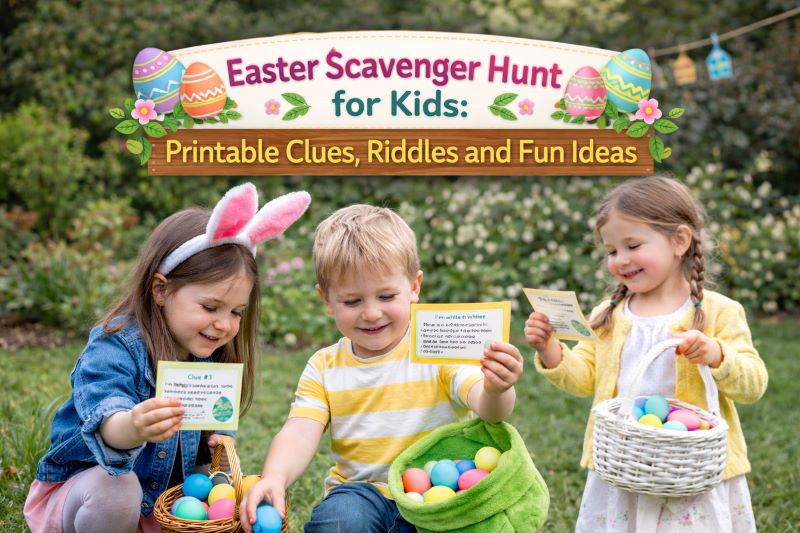
Easter Scavenger Hunt for Kids: Clues, Ideas & Complete Setup Guide
Last updated: April 2026 | Reading time: 12 min
This guide is based on years of designing Easter scavenger hunts for real families. Over 50 hunt formats have been tested with children of different ages to find what clues, themes, and setups work best indoors and outdoors.
An Easter scavenger hunt for kids is one of the most engaging ways to celebrate spring and create lasting family memories. Unlike a traditional egg hunt where children just spot eggs randomly, a scavenger hunt uses sequential clues that lead from one location to the next—building suspense and excitement until they discover the final Easter basket filled with prizes. In this complete guide, you’ll find 50+ real, tested clue ideas organized by age, setup strategies for both indoor apartments and outdoor gardens, and themed variations to make Easter morning unforgettable.

📥 Download the Free Easter Hunt Card Pack (30 Clues + Setup Sheet + Cert) →
Why an Easter Scavenger Hunt Is Better Than a Regular Egg Hunt
Traditional egg hunts have their charm, but they typically last only 5–10 minutes and end in chaos. Easter scavenger hunts offer several distinct advantages:
- Extended playtime: A structured hunt lasts 30–60 minutes, giving you a longer morning activity and reducing screen time.
- Educational value: Clues develop reading comprehension, problem-solving, and critical thinking skills—especially for ages 6 and up.
- Inclusive for all ages: You can tailor clue difficulty so toddlers and tweens hunt together successfully.
- Reduces injuries: Children follow a planned route instead of rushing chaotically across a yard, reducing falls and accidents.
- Memorable narrative: A themed hunt (treasure map, bunny detective, Easter quest) turns a simple egg hunt into an adventure story.
- Manageable for parents: You control pacing and know exactly where every egg/prize is, preventing lost items and disappointment.
- Replayable: Printable hunt kits can be used year after year or adapted for different holidays and locations.
In short: a regular egg hunt is a 10-minute race. An Easter scavenger hunt is an experience.
50+ Easter Scavenger Hunt Clue Ideas (Ages 3–12)
Here are proven clue examples organized by age group. Each clue is tested and immediately usable for Easter morning—just print and hide!
Ages 3–5: Picture & Object Clues (No Reading Required)
Young children need visual clues with simple objects they recognize. Adults read the clue aloud or use pictures.
- Clue #1: “Find where the bunny sleeps! [PICTURE: Bedroom]” → Hidden at child’s bed
- Clue #2: “Look where cold things live. [PICTURE: Refrigerator]” → Inside fridge (safe container)
- Clue #3: “Climb where you play. [PICTURE: Toy chest]” → In toy box
- Clue #4: “Find where plants drink water. [PICTURE: Watering can]” → Near potted plant
- Clue #5: “Look where ducks swim. [PICTURE: Bathtub]” → In/near bathroom
- Clue #6: “Find where socks hide. [PICTURE: Dresser]” → In drawer
- Clue #7: “Where do cars live? [PICTURE: Garage/driveway]” → Outside garage area
- Clue #8: “Find the place where you sit and eat. [PICTURE: Kitchen table]” → At table
- Clue #9: “Hop like a bunny to the soft chair. [PICTURE: Couch]” → Under couch cushions
- Clue #10: “Where does the sun come in? [PICTURE: Window]” → On windowsill
Ages 6–8: Rhyming & Riddle Clues
Children at this level enjoy wordplay and simple rhymes. These clues build reading confidence while remaining fun.
- Clue #1: “I have hands but cannot clap, look at me to check the time—check the clock on the kitchen wall!” → Kitchen clock
- Clue #2: “I’m cold inside but keep things hot, find me next to where you cook a lot!” → Oven or microwave
- Clue #3: “Spin me round and jump up high, look for eggs where kids play—that’s no lie!” → Play equipment or playground
- Clue #4: “I have leaves but I’m not a tree, find me hiding by the thing you use to see.” → Plant on windowsill
- Clue #5: “Four legs I have, no feet to run, find me in the place where homework gets done!” → Desk or table
- Clue #6: “I hold water but cannot drink, find me in the room with a sink!” → Bathroom
- Clue #7: “I shine so bright but I’m not the sun, find me where evening games are fun!” → Light fixture or lamp
- Clue #8: “Open me up and inside you’ll see, a list of books—find the library!” → Bookshelf
- Clue #9: “I swing but have no feet, find me where kids love to meet!” → Swing set or outdoor play area
- Clue #10: “Round and round I spin with sound, look for eggs at the merry-go-round!” → Carousel or spinning toy
- Clue #11: “I ring to call you to dinner time, come find your egg where bells chime!” → Front door or doorbell
- Clue #12: “I keep things cold through the day and night, find your prize and hold it tight!” → Freezer
- Clue #13: “Climb up my steps without a fear, find your egg at the top up here!” → Staircase
- Clue #14: “I have strings but make no sound until you play and spin around!” → Swing or toy with strings
- Clue #15: “Hop like a bunny, hop like a deer, find your next clue without a fear!” → Designated location in yard
Ages 9–12: Logic, Wordplay & Mystery Clues
Older children enjoy detective work, riddles with layers, and clues requiring observation skills.
- Clue #1: “The Easter Bunny is very confused—he hid three eggs in the same place but labeled them A, B, and C. A is not in the kitchen. B is not red. C is not under the bed. Your next clue is in the hiding spot. (Locations given separately)” → Child deduces logic puzzle
- Clue #2: “I have hands but cannot wave, a face but never crave. Found in a room that’s dark and cold, I’m called a bunny if you’re bold. Look for eggs near me!” → Stuffed bunny or decoration
- Clue #3: “Backwards, forwards, I look the same. Find me in the place with a frame. What am I? The next clue is above where you found me.” → Mirror (clue posted above mirror)
- Clue #4: “The Easter Bunny left a secret code: KTCHNI. Replace each letter with the one before it in the alphabet to decode. Find your next clue in that room!” → JSMBLJ decodes to… (puzzle varies)
- Clue #5: “Three colors of eggs hid by the Bunny. Red eggs = kitchen. Blue eggs = bedroom. Purple eggs = backyard. You found a blue egg. What room should you search next?” → Child reads parent’s planted riddle cards
- Clue #6: “I’m slippery and cold, but children love to slide down me in winter. In spring, find eggs near where I’d be in summer. What am I?” → Slide (outdoors)
- Clue #7: “The final clue rhymes with ‘duck’ and is a place where you learn. It’s not your home and not a store. Find the words that match: ___oo_” → School (if applicable)
- Clue #8: “I’m brown and furry but not a rabbit. I’m stuffed but don’t hold anything. Find your next clue under the one that’s your favorite!” → Teddy bear (child’s bed)
- Clue #9: “Unscramble: DNERAG. Go to this place and find where pretty things grow. Count three steps to your left, then look down!” → GARDEN
- Clue #10: “This clue is a math puzzle. 5 + 3 = 8. Go to the room on the 8th (or 3rd) step of the house. Your next clue is on the door!” → Calculated location
- Clue #11: “I have pages but no words. I hang on walls and show the days. Find where holidays are marked and look for the big red circle!” → Calendar
- Clue #12: “Something you wear to keep warm, but in spring it goes away. Find it in the closet and your next clue will play!” → Coat closet
- Clue #13: “I’m in every room but visible nowhere. I provide light when the sun goes down. Look for eggs near where I’m located!” → Light switch or fixture
- Clue #14: “The Bunny hopped to a place where plants live. Not inside, but outside—where you dig and grow things. Find the pink ribbon on a plant!” → Garden or planter box
- Clue #15: “I tell a story without words. I’m hung on walls and shows memories. Find your next clue behind something that makes you smile!” → Photo frame
Bonus Clue Templates You Can Customize
- “Where the magic happens” → Kitchen or living room
- “Where dreams come true” → Bedroom
- “Where water falls” → Bathroom/shower
- “Where you sit and think” → Study or office area
- “Where the bunny hides from rain” → Garage or shed
- “Follow your nose, it always knows—find eggs where flowers grow!” → Garden or plant area
- “Higher, higher, reach up high—find your egg near the sky!” → Upper shelves or high location
- “Go where it’s cool and things are frozen, your next clue is the one I’ve chosen!” → Freezer
- “Hop like a bunny to the place that’s green, find the best Easter prize you’ve ever seen!” → Outdoor area
- “In the place where toys all play, find your clue and don’t delay!” → Playroom or toy area

Easter Scavenger Hunt for Kids
Complete printable hunt with riddle clues, treasure maps, and setup guide. Just print and play — ages 3–9!
Download & Print → $14.99
Indoor Easter Hunt: Perfect for Apartment Life
Living in an apartment doesn’t mean skipping the Easter hunt. Many families with limited space host memorable hunts entirely indoors.
Best Indoor Hiding Spots
- Kitchen: Inside the spice cabinet, cereal box, behind the dish towel rack, in the fruit bowl (with fake fruit on top), under the sink (in a waterproof container), inside the oven (unlit), utensil drawer with a lid over the eggs
- Living room: Under couch cushions, inside decorative baskets, behind curtains, inside tissue box, under a blanket, inside picture frames (small eggs), under plant pots, on tall shelves
- Bedroom: Under pillows, in shoebox at bottom of closet, under the bed (in a box), inside a pillow case, behind a door, in the coat closet, under mattress corner
- Bathroom: Inside towel rack, under sink in drawer, medicine cabinet (with harmless items), inside bathtub or shower caddy, on the toilet tank, behind the bathroom door
- Hallway: On top of doorframes, inside light fixtures (plastic eggs only), under rugs, inside coat pockets, behind a mirror
Apartment Hunt Setup Strategy
Night before: Print clues, decide on 5–8 locations that form a logical path through your apartment. Avoid anywhere dangerous or private (bedroom closets belong to adults).
Morning setup: Hide clues at 7am, hide eggs/prizes at each location. Create a “START HERE” sign at the first location. Give each child a small bag or basket to collect their finds.
Timing: Indoor hunts typically take 20–30 minutes for ages 6–8, and 30–45 minutes for ages 9–12.
Pro tip: Use glow-in-the-dark plastic eggs if hunting before sunrise. Use different colored eggs for each child if there are multiple kids—this prevents fighting and makes cleanup easier.
Outdoor Easter Scavenger Hunt: Garden and Neighborhood
Outdoor hunts are classic Easter fun, especially in backyards and neighborhood parks. Here’s how to execute a safe, exciting outdoor hunt.
Best Outdoor Hiding Spots
- Garden/plants: Under plant leaves, in flower pots, inside a watering can, hanging from a garden stake with ribbon, in a birdhouse, under a rock, wrapped in moss, buried shallowly in soil (with waterproof containers)
- Yard structures: Under a picnic table, hanging from a fence post, inside a garden shed, on the deck or patio, inside a sandbox (buried lightly), under stairs, behind a gate
- Trees: In a low fork of branches, taped to a trunk (low, safe height), hidden in a tree house, under tree roots, hanging from a rope across a branch
- Neighborhood (with permission): Park benches, near a playground, mailbox area (if appropriate), community garden, local church grounds, neighbor’s driveway (with permission)
Safety Rules for Outdoor Hunts
- Set boundaries: Clearly mark the hunt area so children don’t wander into the street or neighbor’s property.
- Supervision: Assign an adult per 2–3 children for ages 5 and under, 1 adult per 4–5 children for ages 6+.
- Timing: Hunt in daylight hours (9am–3pm). Dusk hunts require glow eggs and flashlights.
- Weather check: Avoid wet grass if eggs are fragile. Place eggs in waterproof containers if rain is forecast.
- Allergen awareness: Some families hide nuts in eggs—verify no children have allergies before the hunt.
- Lost item plan: Take a photo of each hiding spot so you can help children if they get stuck or retrieve lost eggs later.
Outdoor Hunt Duration
Outdoor hunts typically take longer than indoor hunts due to walking distances. Plan for:
- Ages 3–5: 20–30 minutes
- Ages 6–8: 30–45 minutes
- Ages 9–12: 45–90 minutes (especially if you add puzzle challenges at each location)
Easter Treasure Hunt Themes Beyond the Bunny
While the Easter Bunny is traditional, creative themes add excitement and encourage role-play. Here are five proven themes:
1. Easter Detective Agency
Story: “The Easter Bunny’s basket went missing! You’re elite detectives hired to find it. Each location has a clue left by the culprit—solve them to find the basket.”
Clue format: Written as “Detective Notes” with suspect information, witness statements, and red herrings. Children follow logic to determine which location is next.
Finale: The “culprit” (parent in disguise) is waiting at the final location with the Easter basket, playfully “caught!”
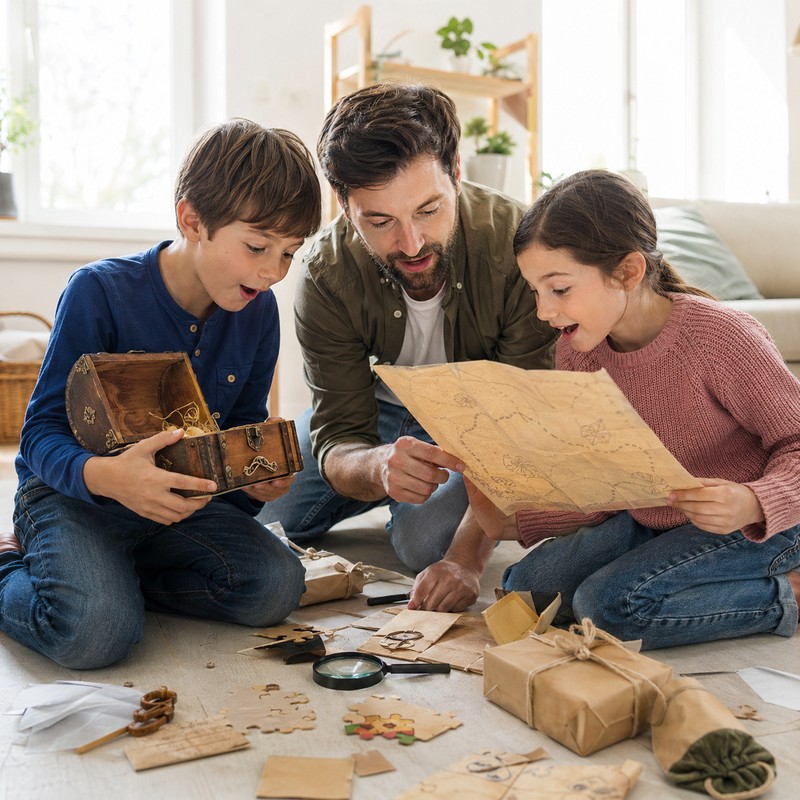
2. Treasure Map Quest
Story: “A pirate hid an Easter treasure before sailing away. He left a map. Can you follow it and claim the bounty?”
Clue format: Hand-drawn map with X marking each location. Clues are written as “treasure markers”—children dig or dig under marked spots.
Props: Toy compass, printed pirate flag, children wear bandanas or eye patches.
3. Easter Bunny’s Golden Eggs Challenge
Story: “The Easter Bunny hid special golden eggs, but each one is protected by a challenge. Solve the puzzle to earn the egg!”
Clue format: Each location has a small challenge—jump 10 times, spell “Easter,” sing a line of a song, solve a math problem. Only after completing it do children find the egg.
Bonus: Leaderboard with stickers for each challenge completed.
4. Rainbow Eggs Scavenger Hunt
Story: “The Easter Bunny painted eggs every color of the rainbow, but the colors got mixed up. Can you find all seven colors and return them to the bunny’s basket?”
Clue format: Each clue is colored to match the egg hidden there. Red clue leads to red egg, blue clue to blue egg, etc. Children organize the rainbow as they hunt.
Finale: Children arrange eggs in rainbow order in the final basket for a beautiful photo.
5. Easter Time Traveler
Story: “A magical bunny sent eggs through time! Travel to different eras to collect them—medieval castle, ancient Egypt, future space station, etc.”
Clue format: Each location is decorated to represent a time period. Clues are written in “period-appropriate” language (Old English, hieroglyphics simplified, space age terms).
Props: Cardboard castle entrance, Egyptian gold, aluminum foil spaceship.
Combining an Egg Hunt with a Scavenger Hunt
The most engaging Easter hunts blend both formats: scavenger hunt structure with eggs as treasures. Here’s how:
The Hybrid Model
- Stage 1 (Scavenger Hunt): Children solve 3–5 clues that lead them to different locations.
- Stage 2 (Egg Hunt): At the final location, the Easter basket is revealed, but eggs are hidden within a defined area (small garden section, living room only). Children do a quick egg hunt to fill their baskets.
- Stage 3 (Challenge): For older kids, eggs have point values. Blue eggs = 5 points, gold eggs = 10 points. First to reach 50 points “wins” a bonus prize.
Hybrid Clue Example
Clue #3: “The Easter Bunny hid a message in the garden. Find the pink flowerpot and read the note inside. It will tell you where to search for hidden eggs. You have 10 minutes to find as many as you can!”
(Parent hides a note in the pot saying “Find eggs under the bench, in the shed, and buried near the tree—25 eggs total hidden in those three spots.”)
This approach keeps younger children engaged with structure, while giving them autonomy to explore and “hunt” like traditional egg hunts provide.

“My kids talked about this Easter hunt for six months afterward. The clues kept them engaged, they learned to read the challenges themselves, and my 4-year-old felt included even though the riddles were for older kids. Best Easter morning ever.”
Frequently Asked Questions
15-Minute Quick-Start Setup
You don’t need craft hours or perfect handwriting to run a magical Easter hunt. Here is the fastest possible path:
- Print the free Card Pack PDF (one deck of 30 clue cards covers all 3 age tiers).
- Pick 6–10 clues that match your child’s age — picture clues for 3–5, rhymes for 6–8, riddles for 9–12.
- Walk through your space and assign each clue to a hiding spot. Number them in route order on the back.
- Hide in reverse: place the Easter basket first, then clue 10 → clue 9 → … → clue 1 in your hand.
- Hand kids the first clue while dressed in their Easter best. Photos guaranteed.
- End at the basket with a 10-second celebration — ring a bell, play a song, take the family photo.
Sample Schedules: 15-, 30-, and 60-Minute Easter Hunts
| Length | Clues | Best for | Tips |
|---|---|---|---|
| ⏱️ 15 min | 5–6 picture clues | Toddlers (3–5), early-morning hunt before breakfast | Hide in obvious spots. Cooperative. End at the basket on the kitchen table. |
| ⏱️ 30 min | 8–10 rhyme clues | Ages 6–9, traditional Easter morning | Mix indoor + outdoor stations. Add a mini-egg-hunt finale. |
| ⏱️ 60 min | 12–15 mixed riddles | Ages 9+, mixed-age sibling hunts | Include a logic puzzle and a cipher. End with a “Golden Egg” reveal. |
Themed Variations: Beyond the Standard Easter Hunt
- 🥕 Bunny Detective Hunt: The Easter Bunny got lost — solve clues to find his “missing tracks” and return him to his basket. Best for ages 5–9.
- 🥚 Golden Egg Mystery: 11 regular eggs + 1 golden egg hidden among them. The golden egg unlocks the grand prize. Ages 6–12.
- 🍫 Candy-Free Easter Hunt: Replace candy with small toys, stickers, coupons (extra screen time, choose dinner), or coins. Same fun, no sugar crash.
- 🌱 Garden Allergen-Aware Hunt: Use sealed individual snacks (allergy-safe) inside plastic eggs. List allergens on each egg label.
- 🎨 Pre-school Color Hunt: Find a colored egg for every rainbow color, plus a “bonus white” egg with the basket clue. Ages 2–5.
- 🐰 Reverse Egg Hunt: Older kids hide eggs for parents to find. Builds creativity and gives the adults a turn at the chase.
- 📚 Story-Based Hunt: Read The Tale of Peter Rabbit first, then hunt for objects from the story. Pairs storytime with adventure.
5 Easter Hunt Mistakes (And How to Avoid Them)
- Hiding chocolate eggs in the sun. Melted chocolate inside foil = ruined treat + ruined surface. Hide in shade or use foil-wrapped or plastic alternatives.
- Forgetting allergies. Always ask parents about food allergies before the hunt. Use color-coded eggs (e.g. yellow = nut-free) for mixed groups.
- Hiding too high. Kids should never need to climb. If a clue requires reaching up, place it ON a chair or step, not above adult eye level.
- No test-run. Walk every clue 5 minutes before the kids wake up. You will catch ambiguous riddles, knocked-over eggs, and pets that found one already.
- Skipping the basket reveal moment. The Easter basket at the end is the climax. Decorate it the night before, dim the lights, play a song. Make it a moment they remember.
Easter Scavenger Hunt FAQ
