

Blog
Spring Scavenger Hunt for Kids: 40+ Items, 10 Riddles & Free Printable
Last updated: May 2026 | Reading time: 14 min | 40+ items, 10 riddles, FAQ & free printable card pack
We love setting up spring scavenger hunts with our kids every March — it’s become a family tradition! This guide is based on years of hands-on experience designing and testing outdoor activities with children aged 3–12. Every idea below has been tried, refined, and kid-approved.
Spring is here, and there’s no better way to get kids outside exploring than a spring scavenger hunt for kids! After months of indoor play during winter, children are bursting with energy — and a nature-themed scavenger hunt channels that excitement into adventure, discovery, and learning.
In this guide, you’ll find 20+ spring scavenger hunt items, age-appropriate ideas for toddlers through tweens, original rhyming riddles, a free printable checklist, and step-by-step setup instructions. Whether you’re planning a backyard exploration or a park adventure, we’ve got you covered. For items that work in any season, see our complete nature scavenger hunt for kids.
📥 Download the Free Spring Scavenger Hunt Checklist Pack PDF (Ages 2–12) →
What Is a Spring Scavenger Hunt?
A spring scavenger hunt is an outdoor (or indoor) activity where children search for seasonal items like flowers, insects, birds, and signs of spring. Players use a checklist or follow riddle-based clues to find each item, checking them off as they go. Spring scavenger hunts combine nature exploration with problem-solving skills and are perfect for kids ages 2–12 at home, in the park, or at school.
15-Minute Quick-Start Spring Hunt
No prep? No problem. Here is the shortest possible spring scavenger hunt that still feels like a real adventure — works for ages 4–10 in any backyard or park.
- 0:00 — Grab the basics (2 min): a sheet of paper, a pencil, and a snack. That is it.
- 0:02 — Write 8 items (3 min): something yellow, something fuzzy, a bug, a sound, a smell, a leaf with a hole, a rock the size of an egg, a stick longer than your arm.
- 0:05 — Set the boundary (1 min): point to four landmarks. “Do not go past those.” Done.
- 0:06 — Hunt (8 min): kids race or stroll. You walk behind, saying “warmer/colder.”
- 0:14 — Finale (1 min): hand the snack out as “the spring treasure.” Two thumbs up.
From experience, this 15-minute version often becomes the kids’ favourite — short, snappy, no fancy printouts.
Why Spring Is Perfect for Scavenger Hunts
Spring might just be the best season for a scavenger hunt — and from our experience running these with dozens of families, here’s why:
- Nature is waking up: Flowers blooming, birds returning, butterflies appearing — there’s so much to discover that wasn’t there in winter
- Perfect weather: Not too hot, not too cold — kids can play outside comfortably for 30–60 minutes
- Natural learning: Children learn about plant life cycles, insects, weather patterns, and ecosystems without even realizing it
- Energy release: After winter indoors, kids need to move — a scavenger hunt gets them running, crouching, climbing, and exploring
- Easy setup: You don’t need to hide anything! Nature provides all the items — just bring a checklist
- Screen-free fun: A refreshing alternative to tablets and TV that the whole family can enjoy together
If you’re new to scavenger hunts, our complete scavenger hunt guide for kids covers the basics, rules, and 100+ ideas for every occasion.
Spring Scavenger Hunt Ideas by Age
From our experience testing these with children aged 3–12, age-appropriate design makes all the difference. Here’s what works best for each group:
Toddlers (Ages 2–3): Sensory Spring Hunt
Keep it simple, visual, and hands-on. Toddlers do best with picture-based checklists and just 5–8 items to find.
- Find something green (grass, a leaf, a stem)
- Touch something soft (a flower petal, moss)
- Listen for a bird singing
- Smell a flower
- Find a puddle
- Spot something yellow (dandelion, buttercup)
Tip: Walk with them and point things out. At this age, it’s about the experience, not completing the list.
Preschoolers (Ages 4–5): Picture Scavenger Hunt
Preschoolers can handle 8–12 items with picture clues. Add simple counting challenges to keep them engaged.
- Count 3 different types of flowers
- Find a worm or a bug
- Spot a butterfly or a bee
- Collect 5 different leaves
- Find a bird’s nest (look up!)
- Discover something that smells nice
- Find a rock shaped like something fun
School-Age Kids (Ages 6–9): Nature Detective Hunt
This age group loves a challenge! Use written clues, riddles, and classification tasks. They can work in teams or independently.
- Identify 3 different tree species by their leaves
- Find animal tracks or signs (footprints, burrows, feathers)
- Photograph 5 different insects
- Find examples of each season (something old from winter + something new for spring)
- Locate a plant growing through a crack in the pavement
- Spot a bird carrying nesting material
For more age-specific ideas, check out our forest riddles for children ages 4–12 — perfect for combining with a spring nature walk.
Tweens (Ages 10–12): Science Explorer Hunt
Make it educational and competitive. Tweens love challenges that feel grown-up and involve real science.
- Identify 5 plants using a plant identification app
- Find and photograph evidence of pollination
- Document the stages of a plant’s life cycle (seed, sprout, flower, fruit)
- Map all the different animal habitats in your area
- Record the temperature in sun vs. shade — what’s the difference?
- Create a nature journal page with sketches and observations
30+ Spring Scavenger Hunt Items to Find
Here’s our ultimate list of 40+ spring nature scavenger hunt items. Mix and match based on your location, the children’s ages, and what’s blooming in your area:
Flowers & Plants
- A yellow flower (dandelion, daffodil, or buttercup)
- A flower bud that hasn’t opened yet
- A patch of clover
- A tree with new green leaves
- A flowering bush or shrub
- Moss growing on a rock or tree
- A seed or seed pod
Animals & Insects
- A butterfly
- A ladybug
- A worm
- A bee visiting a flower
- A bird building a nest
- A squirrel
- A spider web with morning dew
Weather & Nature Signs
- A puddle from spring rain
- A rainbow (or make one with a garden hose!)
- A cloud shaped like an animal
- A shadow that looks funny
- Mud (bonus: muddy footprints!)
Bonus Challenges
- Something that smells like spring
- Something making a sound (birds, wind, water)
- Something smooth and something rough
- Something tiny and something huge
- Something that wasn’t here in winter
- A sign that an animal has been here (tracks, feathers, shells)
Sights, Sounds & Smells
- A robin or another spring bird
- The sound of running water (stream, drainpipe, fountain)
- A flower with more than three colors
- Something that has fallen from a tree (petal, twig, blossom)
- A pinecone, acorn, or other seed pod
Sky & Weather
- A contrail (line of cloud from a plane)
- A cloud that looks like food
- The wind moving leaves or grass
- Bright sun shining through leaves
- A patch of bare earth where seedlings could grow
Edible & Garden Finds (with adult)
- An herb you can smell (mint, rosemary, basil)
- A wild edible leaf (dandelion greens — adult to confirm)
- A vegetable seedling poking through soil
- A fruit tree blossom (apple, cherry, pear)
- A vegetable garden marker or label
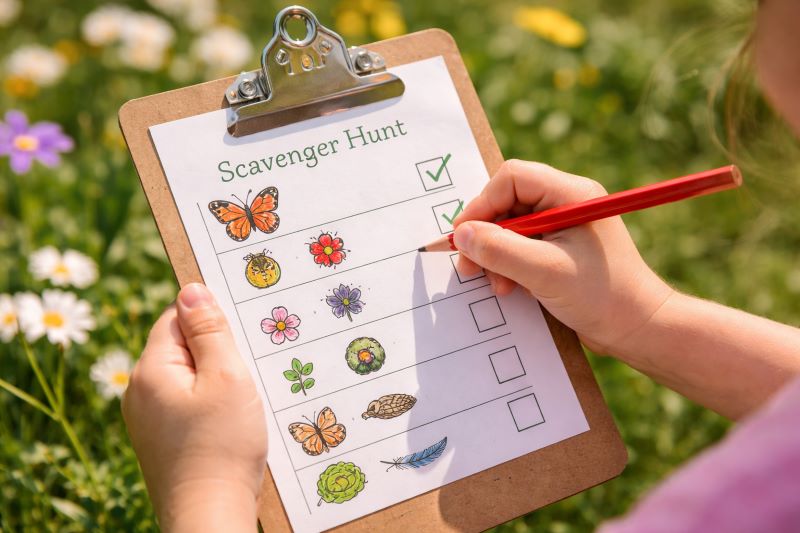
Pro tip from experience: Print this list, grab a pencil, and let kids check off or draw each item as they find it. Adding a small clipboard makes them feel like real explorers!
Free Printable Spring Scavenger Hunt Checklist
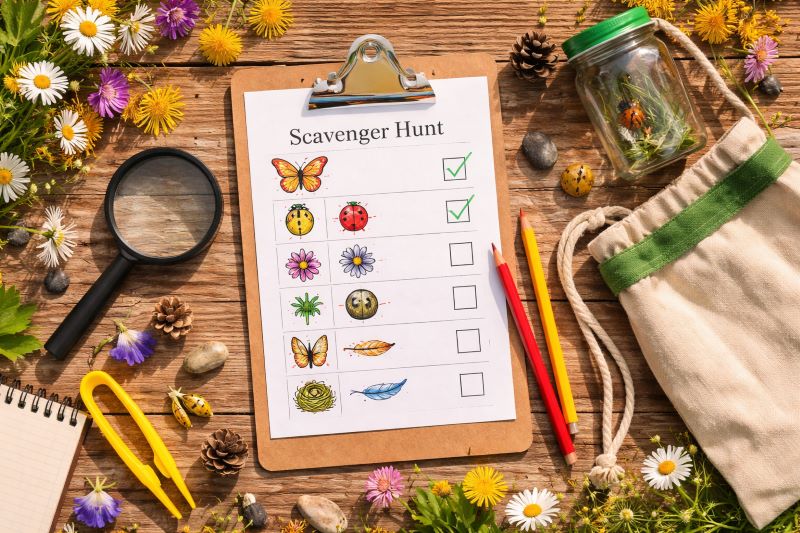
We’ve created a free printable spring scavenger hunt checklist you can download, print, and use right away. It includes picture clues for younger kids and written descriptions for older ones.
Free Spring Scavenger Hunt Printable
Download our ready-to-use checklist with 20+ spring items, picture clues, and space for kids to draw their discoveries.
Download Free Checklist Pack PDF
No signup required — just download, print, and play!
Want a fully designed, ready-to-play scavenger hunt kit with riddles, clues, and treasure maps? Check out our printable scavenger hunt kits — just print and hide!
Spring Scavenger Hunt Riddles & Clues
Riddles make any scavenger hunt more exciting! Here are 10 original spring-themed rhyming riddles you can use as clues. Each one leads to a common spring item. (For even more riddle ideas, visit our riddles for kids collection.)
Riddle 1 — Daffodil
I wear a golden trumpet crown,
I’m one of the first to come around.
After winter’s cold and gray,
I pop up to announce spring’s day!
Riddle 2 — Butterfly
I once was a crawler, slow and small,
I wrapped myself in a cozy shawl.
Now I flutter, bright and free —
Can you find and spot me?
Riddle 3 — Bird’s Nest
Twigs and grass, all woven tight,
A cozy home hidden out of sight.
Look up high in a tree above —
It’s a little house built with love!
Riddle 4 — Puddle
The rain came down, then went away,
But left a mirror on the ground to stay.
Jump in me with both your feet —
Splashy fun that can’t be beat!
Riddle 5 — Worm
I have no legs, no arms, no eyes,
I wiggle through the earth in disguise.
After rain, I come up top —
Squiggly, squirmy, I never stop!
Riddle 6 — Bee
I buzz from flower to flower all day,
Collecting sweetness along the way.
I wear a fuzzy yellow vest —
Of all the pollinators, I’m the best!
Riddle 7 — Rainbow
After rain and sunshine meet,
I paint the sky — a colorful treat!
Seven colors, an arching band —
The prettiest bridge across the land!
Riddle 8 — Ladybug
I’m tiny and red with spots of black,
I crawl on leaves — there and back.
Count my dots, if you dare —
I’m a lucky bug beyond compare!
Riddle 9 — Dandelion
First I’m yellow, bright and round,
The cheeriest flower that can be found.
Then I turn to a fluffy white ball —
Make a wish and blow! Watch my seeds fall!
Riddle 10 — Frog
I hopped out when the weather warmed,
Near the pond is where I’ve swarmed.
I croak and leap and catch a fly —
A green spring friend, can you spy?
How to use these riddles: Print each riddle on a card, place it at a station, and have kids solve the riddle to figure out what they’re looking for next. Chain them together for a riddle trail!
How to Set Up a Spring Scavenger Hunt
Setting up a spring outdoor scavenger hunt for kids is easier than you think. Here’s our tried-and-tested step-by-step process:
Step 1: Choose Your Location
Your backyard, a local park, a nature trail, or even your neighborhood all work perfectly. Walk the area first to make sure the items on your list can actually be found there. For more backyard-specific ideas, see our backyard scavenger hunt guide.
Step 2: Pick Your Format
- Checklist hunt: Hand out a list — kids find and check off items (easiest setup)
- Riddle trail: Use our riddles above as clue cards that lead from station to station
- Photo hunt: Kids take pictures of each item instead of collecting them (eco-friendly!)
- Collection hunt: Bring a bag and collect natural items to make a spring art project afterwards
Step 3: Prepare Your Materials
- Printed checklist or riddle cards
- Pencils or crayons for marking
- A bag or basket for collecting (optional)
- Magnifying glass (makes kids feel like real explorers!)
- Camera or phone for photo hunts
- Small prizes or a treasure at the final stop
Step 4: Set the Rules
- Stay within the boundary area
- Look with your eyes first, touch gently
- Don’t pick wildflowers (photograph instead)
- Put rocks and logs back where you found them
- Work together — it’s not a race!
Step 5: Add a Grand Finale
End with a small reward: a spring-themed snack, a certificate of completion, or a nature art project using collected items. From our experience, the “treasure” at the end doesn’t need to be big — kids are thrilled just to finish the hunt!
12 Themed Spring Scavenger Hunt Variations
Tired of plain checklists? Swap to a themed format. Pick the one that matches your child’s mood today.
| Theme | Best Age | Twist |
|---|---|---|
| Pollinator Patrol | 5–9 | Find 5 different pollinators — bee, butterfly, hoverfly, wasp, beetle. |
| Rainbow Hunt | 3–7 | One item for every color of the rainbow. |
| Sound Map | 6–10 | Sit still for 60 seconds. Note every sound. Then go find the source. |
| Alphabet Spring | 7–11 | Find one spring item starting with each letter A → Z. |
| Bug Bingo | 4–9 | 5×5 grid of insects. First line, then full card. |
| Wet & Dry | 3–6 | Find 5 wet things, 5 dry things — perfect for puddle weather. |
| Garden Gnome Rescue | 4–8 | Hide a small toy. Kids follow spring riddles to find it. |
| Photo Safari | 8–12 | Phone or instant camera. 15 themed shots — close-ups only. |
| Story Stones | 5–9 | Collect 10 nature items; arrange them into a story to tell. |
| Botanist Badge | 8–12 | Use a plant ID app. Identify 7 species. Earn the printed badge. |
| Earth Day Cleanup Hunt | 6–12 | Hunt + collect litter (with gloves). Tally bonus points. |
| Spring Five Senses | 3–8 | One item per sense — see, hear, smell, touch, taste (an herb). |
5 Mistakes Parents Make with Spring Hunts
- Too many items for too little time. 30 items + 20 minutes = frustration. Match item count to time: roughly 1 item per minute under age 7.
- No clear boundary. Kids drift. Show four landmarks before starting and repeat it: “If you can not see one of those, you have gone too far.”
- Forgetting weather backup. Spring weather flips fast. Have an indoor list pre-written for sudden rain.
- Skipping the celebration. Even a homemade “Junior Botanist” certificate triples the felt accomplishment. Five minutes of effort for a memorable finish.
- Mixed-age groups with one list. A 4-year-old next to a 9-year-old on the same checklist guarantees the older child finishes first and the younger one quits. Use two age tiers, same starting whistle.
Turn the Hunt into a Spring Project
Once the checklist is done, the learning does not have to stop. Three ways to extend the hunt into the rest of the afternoon:
- Nature journal page. Tape down a petal, a leaf, and a feather. Label them. Add a sketch of one bug they saw.
- Spring sound recording. Use a phone voice memo. 30 seconds. Save it as “Spring 2026 — Backyard.” Replay it in October.
- Seed planting. Use a yogurt pot, soil, and sunflower seeds. The hunt ends with planting something they will watch grow all summer.
Indoor Spring Scavenger Hunt Ideas
April showers don’t have to ruin the fun! Here are creative indoor spring scavenger hunt ideas for rainy days:
Spring Colors Hunt
Find objects around the house in spring colors: something pink, something green, something yellow, something light blue, and something purple. First one to find all five wins!
Spring Sounds Hunt
Play audio clips of spring sounds (rain, thunder, birds chirping, frogs croaking, bees buzzing) and have kids identify each one. Then find objects in the house that could make similar sounds.
Spring Word Hunt
Hide cards with spring-related words around the house (FLOWER, BUTTERFLY, RAINBOW, NEST, GARDEN). Kids find all the words and unscramble a secret spring message.
Spring Sensory Bins
Create bins filled with spring items: potting soil with plastic bugs, water beads with rubber ducks, dried flowers and leaves. Hide small treasures inside for kids to discover.
Virtual Nature Walk
Use a nature webcam or spring photos to create a “virtual scavenger hunt” — kids spot items in images or video feeds. Great for very rainy days!
Need more indoor inspiration? Our indoor scavenger hunt guide has 25 creative ideas and riddles that work perfectly on rainy days. Plus, our birthday games for kids guide has tons of indoor game ideas that can be adapted with a spring twist.

Easter Scavenger Hunt for Kids
Complete printable hunt with riddle clues, treasure maps, and setup guide. Just print and play — ages 3–9!
Download & Print → $14.99
 You Might Also Like