
Blog
Birthday Scavenger Hunt for Kids: The Complete Party Planning Guide

Birthday Scavenger Hunt for Kids: The Complete Party Planning Guide
Arne · 15 min read · Published: May 1, 2026
A birthday scavenger hunt isn’t just another party activity—it’s the moment your kid’s eyes light up when they find the treasure, or the way five kids suddenly work together as a team to solve the final riddle. If you’re planning a birthday scavenger hunt for kids, you’re already thinking like a parent who understands what actually sticks with children: adventure, mystery, and the thrill of discovery.
This guide covers everything you need to run a flawless hunt, from theme selection and age-appropriate difficulty levels to exact clue examples and setup steps. Whether you’re a seasoned party planner or planning your first hunt, you’ll find actionable advice that works whether you have 2 kids or 20.
Why a Scavenger Hunt Beats Every Other Birthday Party Activity

Before we get into the how, let’s talk about the why. Scavenger hunts have something that most party games don’t: they create genuine moments of adventure and discovery.
Unlike pin-the-tail-on-the-donkey or musical chairs—activities that eliminate kids one by one until one child “wins”—a scavenger hunt is inherently inclusive. Every child involved is active, thinking, and moving toward a shared goal. The shy kid who doesn’t want to participate in group games? They’re fully engaged when they’re searching for the next clue. The hyperactive seven-year-old who can’t sit still? They’re channeling that energy productively.
From a parent’s perspective, scavenger hunts also buy you peace. A well-designed hunt keeps kids engaged for 30–60 minutes without requiring your constant supervision or activity management. You can actually watch them have fun instead of constantly moderating conflict.
And here’s the truth: kids remember scavenger hunts. Years later, they’ll mention “that birthday when we found the treasure” or “remember the detective clues?” The memory sticks because they were active participants in their own story, not spectators.
Birthday Scavenger Hunt by Age (The Perfect Difficulty for Each Group)
Age is the single biggest factor in whether a hunt succeeds or fails. A hunt too easy bores older kids; one too hard frustrates younger ones. Here’s how to calibrate for each age group:
Ages 4–6: Picture Clues and Simple Locations
At this age, literacy is still developing, so rely on picture clues combined with simple words. Hide items in obvious (but not visible) spots: under a pillow, behind a door, in a laundry basket. Keep the hunt to 6–8 clues max, and keep it short—15–20 minutes total.
Example setup: Draw pictures of a kitchen, bedroom, and living room. Kids follow the pictures room by room. Each location has a clue card with the next picture plus a small reward (sticker, candy, toy).
Ages 7–9: Riddles and Simple Codes
This is the sweet spot for full scavenger hunts. Kids can read confidently, enjoy riddles, and love feeling clever. Introduce simple ciphers, rhyming clues, and more creative hiding spots. 8–12 clues works well; hunt lasts 25–40 minutes.
Example setup: “Where do books sleep at night?” (Library) “Find the next clue under the thing that reads stories.” Kids walk to the bookshelf and find the clue taped underneath.
Ages 10–12: Multi-Step Riddles and Puzzles
Older kids want a challenge. Introduce codes, multi-step riddles, and creative hiding spots that require lateral thinking. 12–16 clues is appropriate; the hunt can easily stretch 45–60 minutes.
Example setup: “My first letter is in HUNT but not in CHASE. My second is in BIRTHDAY but not in PARTY. My last three letters spell CLUE backwards.” (Answer: BACKPACK—very hard, but older kids enjoy the intellectual puzzle.)
Ages 13+: Themes, Codes, and Narrative Challenges
Teenagers appreciate a real story. Give them a mystery to solve: a “heist,” a “detective case,” or a “secret society mission.” Introduce more sophisticated codes (substitution ciphers, coordinates, UV-light clues). They’re ready for 15+ clues and can handle 60+ minutes of engagement.
5 Birthday Scavenger Hunt Themes Kids Go Crazy For

The theme is what transforms a hunt from “find the cards in the house” into an adventure. Here are five themes that consistently deliver excitement:
1. Detective Mystery
Kids love feeling like they’re solving a real crime. Create a scenario: “Someone stole the birthday cake! Help Detective [Birthday Kid’s Name] gather evidence and crack the case.” Each clue is a “piece of evidence” (a photo, a fingerprint, a coded message). Learn more about running a detective birthday party here.
2. Pirate Treasure Hunt
Timeless and universally appealing. Kids are pirates searching for buried treasure. Hide “maps” (drawn on brown paper, torn at edges for authenticity), “treasure coins,” and “X marks the spot.” The final treasure is a chest filled with wrapped presents or candy. See our full guide on pirate birthday party ideas.
3. Unicorn/Fantasy Quest
Perfect for kids who love magic. “A fairy has hidden rainbow crystals around the kingdom. Help recover them.” Hide items in pouches or small boxes, use purple and pink decorations, and clues can be written in “sparkly” fonts. Check out our unicorn birthday party guide for full theme details.
4. Spy Mission
Similar to detective, but faster-paced and international. Kids are secret agents on a mission. Clues can be “encrypted files,” “satellite photos,” or “intercepted messages.” This theme appeals especially to 8–12-year-olds.
5. Superhero Origin Story
Birthday kid is a superhero-in-training. Each clue brings them closer to unlocking their superpower. The final “treasure” is a cape, mask, or certificate declaring them a official superhero. Easy to customize and deeply rewarding for kids.
How to Set Up a Birthday Scavenger Hunt (Step-by-Step)

Here’s the exact process. If you use a pre-made kit, this takes about 15 minutes. If you’re building it yourself, plan 45 minutes to 2 hours.
Step 1: Choose Your Theme (5 minutes)
Pick one from the section above, or create your own. Write down: the overall story, what kids are searching for (clues? items? both?), and what the “final treasure” is.
Step 2: Choose Your Locations (10 minutes)
Walk through your house (or party venue) and identify 6–16 hiding spots depending on age. Spots should be:
- Easy enough that kids won’t get frustrated
- Out of the way enough that the clue isn’t immediately visible
- Safe (no climbing on high shelves, nothing near water)
- Indoors if weather is a question mark
Pro tip: Under a pillow, inside a book, taped to the back of a mirror, under a cushion, and behind a curtain are your five most reliable spots.
Step 3: Write or Print Clues (15 minutes)
Write one clue per location. Each clue should:
- Point to the NEXT location (not the current one)
- Be age-appropriate (picture for 4–6, riddle for 7–9, complex riddle or code for 10+)
- Be written on card stock or laminated paper (so it doesn’t fall apart if found in a wet spot)
See the section “10 Birthday Scavenger Hunt Clue Ideas” below for 10 ready-to-use examples.
Step 4: Hide Clues and Items (10 minutes)
Place the FINAL clue at location 16, the clue BEFORE that at location 15, and so on. Work backwards. This prevents you from forgetting where anything is.
If you’re including small rewards at each clue (candy, stickers, small toys), hide those with the clue cards too.
Step 5: Write the Starting Clue (5 minutes)
This is the clue you hand directly to the birthday kid. It should point to location #1 and set the tone for the entire hunt. Example:
“Happy Birthday! A treasure has been hidden somewhere in [House Name]. To find it, you’ll need to solve clues and work as a team. Here’s your first clue. Good luck!”
Step 6: Brief the Kids (2 minutes)
Gather everyone and explain the mission simply: “We’re going on a hunt. Each clue tells you where the next clue is hidden. When you find the final clue, it will lead you to the treasure.” That’s it. Don’t over-explain.
Step 7: Start the Hunt (30–60 minutes)
Hand the starting clue to the birthday child. Let them lead. Your job is to stay nearby, offer hints if they get stuck, and enjoy watching them engage.
Step 8: Celebrate the Win (5 minutes)
When they find the treasure, make a big deal of it. Take photos. Let them open gifts or eat their reward. This is the moment that sticks in their memory.
The “Age-Match” Tradition: One Clue Per Year (Why Birthday Kids Love It)
One of the warmest birthday-hunt traditions: match the number of clues to the child’s age. Six clues for a six-year-old; nine clues for a nine-year-old. The birthday kid grasps the connection instantly and the hunt becomes their hunt — not just “a hunt at their party”. Practical bonus: difficulty scales naturally with the count, because more clues means more total time and more places to think.
If the child turns a number that’s too small for engagement (3 or 4), add 2–3 bonus “found-it” stations between clues — small wrapped candies hidden along the route. The age count still hits, but the path stays fun.
30 More Birthday Scavenger Hunt Clues (Indoor & Outdoor by Location)
Below are 30 more ready-to-use clues organized by location. Mix and match with the 10 themed clues above. All clues are written rhyming where appropriate — kids absorb rhyme faster than prose.
15 Indoor Clues
- Fridge: “It’s cold and white and full of treats. Open the door for your next sweet sweets!”
- Couch/Sofa: “Where you sit to watch a show, peek between the cushions — off you go!”
- Bookshelf: “Stories of dragons and pirates and bears — the next clue is hidden among the readers.”
- Bathtub: “Splish, splash, soap and shampoo — check behind the tap for your next clue.”
- Microwave: “Push the button, hear it ping. Your next clue’s waiting inside this thing.”
- Oven (cold): “Where cookies bake and cakes turn brown, take a peek — the clue’s tucked down.”
- Toy box: “Dolls and trucks and games galore — your next clue waits among the toys on the floor.”
- Coat closet: “Where coats and jackets hang in a row, search the pockets — ready, set, go!”
- Bed (pillow): “Where you dream and where you snooze, lift the pillow — you cannot lose!”
- Bathroom mirror: “Look in the mirror, who do you see? A super-hunter as smart as can be.”
- Dresser drawer: “Socks and shirts neatly stowed. Open the top drawer — off you go!”
- Pantry: “Pasta, beans, cereal too — the next surprise is on a shelf for you.”
- Washing machine: “Where dirty clothes get sparkling clean, check the door — this clue’s never been seen.”
- TV remote: “Press a button, change the show. The next clue’s with this so you know.”
- Front door welcome mat: “Where guests wipe their feet before they enter, this is your hunt’s next adventure center.”
15 Outdoor Clues
- Mailbox: “Letters and packages come this way. Open the lid for clue today.”
- Swing set: “Higher and higher you fly through the air — check beneath the swing’s seat right there.”
- Garden hose: “Curled like a snake, water its skill — the next clue waits where it spills.”
- Trampoline: “Bounce up high, bounce down low — under the trampoline’s where you go.”
- Sandpit / sandbox: “Castle towers, buried treasure, fun — dig a little for your next one.”
- Trees: “Tall and proud, leaves green or gold. The clue’s in the trunk if you’re bold.”
- Bicycle: “Two wheels, a seat, and a bell to ring — check the basket for the next thing.”
- Bird feeder: “Sparrows and finches dine right here. The next clue’s tied with a strip of green-bow gear.”
- Garden bench: “Where Mum or Dad sip morning tea, look beneath — the clue is free.”
- Garage door: “Big and heavy, it rolls overhead. Stick the next clue on the front instead.”
- Driveway chalk square: “Hop along the squares all the way through. The clue’s in square number two.”
- Plant pot: “Flowers grow up, roots grow down. Tip the pot — you wear the crown.”
- Picnic table: “Where sandwiches and lemonade meet, look under the bench for your next treat.”
- Hose tap / spigot: “Turn the handle, water flows. The next clue’s tied where the metal goes.”
- Final: the cake. “Candles, frosting, a song to sing — the birthday treasure is the cake we bring!”
Engineer the Big Moment: Birthday Cake as the Final Reveal
The best birthday-hunt endings don’t finish with a wrapped present — they finish with the cake. Here’s the choreography:
- Hide the second-to-last clue near the kitchen. The next-to-last clue points to a “final challenge” rather than directly to the cake.
- The “final challenge” is a one-line request: “Bring everyone to the dining room and sing the secret song.” (The secret song is “Happy Birthday”.)
- An adult slips into the kitchen during the second-to-last clue and brings out the cake with candles lit.
- Kids round the corner, lights dim, cake appears, song starts. The birthday kid hits a peak emotional moment that they remember for years.
This works because the hunt has built anticipation for 30–45 minutes — the cake reveal converts that anticipation into a single shared “we did it” moment. The presents come after; the cake comes first.
Beyond the Hunt: 8 Party Games That Pair Perfectly
If you’ve got a 2-hour party slot, the hunt fills 30–45 minutes. Fill the rest with one or two of these.
- Pin the Tail (themed): Match to the hunt’s theme — pin the patch on the pirate, pin the horn on the unicorn, pin the badge on the spy.
- Musical Cushions: Like musical chairs, gentler for under-7s.
- Limbo: A pool noodle held by two adults. Birthday version: each round, the loser earns a “lucky doubloon”.
- Photo Booth Box: A box of props matching the theme; kids cycle through with a phone camera.
- Charades: All charades cards drawn from the theme (animals for safari, gadgets for spy).
- Egg-and-Spoon Race: Hard-boiled or plastic eggs across the lawn; pair with the outdoor hunt.
- Treasure Bag Decorating: Each kid decorates a paper bag for their party-favours during a 5-minute lull.
- Birthday Bingo: 5×5 cards with party items (cake, candle, balloon, present, friend). Caller shouts items. First to fill wins a small prize.
Theme-Matching Decorations on a Budget
The theme of your hunt should be visible the moment guests walk in. Each of the five themes below can be set up for $15–30.
- Detective: Magnifying-glass party-favours, “case file” name-tags, black-and-white photo wall, “Crime Scene” tape across one doorway. Pair with our Detective Scavenger Hunt guide for the full setup.
- Pirate: Skull-and-crossbones napkins, treasure-coin scatter on the table, blue table runner (the “sea”), Jolly Roger flag at the entrance. Full setup in our Pirate Treasure Hunt guide.
- Unicorn/Fantasy: Pastel pink-and-purple bunting, glitter on the table, “magic dust” (edible glitter) on the cake, paper-horn party hats.
- Spy: Black tablecloth, neon-orange tape (“laser beams”) in a hallway, dollar-store sunglasses for each guest, “Top Secret” envelopes. Pair with Spy Missions for Kids.
- Superhero: Red, blue, yellow streamers; cardboard “city skyline” cutouts; cape-tied chairs.
5 Common Mistakes Hosting a Birthday Scavenger Hunt
Mistakes I’ve made on the way to running good ones.
Mistake 1: Hunt too long. A 45-minute hunt for 5-year-olds is too much. Stick to 20–30 minutes for under-7s, 30–45 for 7–10s, 45–60 for 10+. Fix: Cut the clue count rather than dumb the clues down.
Mistake 2: Clues too obvious. Kids feel patronised when every clue is “look under the chair”. Fix: Mix difficulties — two thinking clues for every three location clues.
Mistake 3: Crowd-management collapse. 8 kids racing each other to the same clue causes shouting and shoves. Fix: Either run one combined team or do age-stratified pairs with clue copies.
Mistake 4: No buffer between hunt and cake. Going straight from running around to sit-and-sing is harsh. Fix: Include one calm activity (decorating treat bags, drawing) between hunt and cake.
Mistake 5: Birthday kid leads every clue. Other guests feel sidelined. Fix: Rotate “lead reader” roles. The birthday kid gets clue 1 and the final cake clue — everyone else gets clues in between.
Free Printable Birthday Hunt Bundle (PDF)
🎂 Birthday Hunt Bundle — Free Download
A 10-page printable kit that pairs with this guide.
- Party Invitation template (fill-in name, date, time, theme)
- 10 fillable Birthday Clue Cards (rhyme-style)
- “Junior Hunter” badge templates (4 per page)
- Birthday Cake Reveal Cue Card
- Party-bag tag labels (one per kid)
- Birthday Bingo card (5×5, party-themed)
- Certificate of Bravery (fillable)
- Decoration Checklist (per theme)
Scavenger Hunt Birthday Morning vs. Party Activity: Which Is Better?
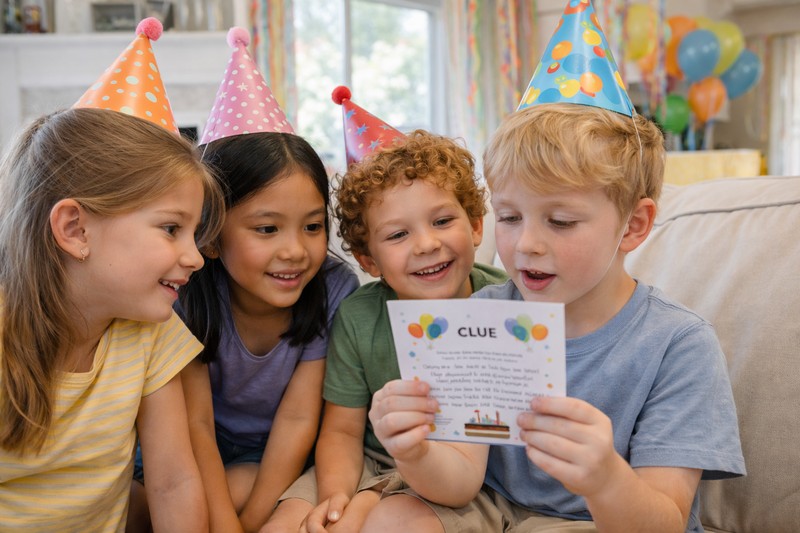
One decision you’ll make: do you run the hunt first thing on the birthday morning with the family, or use it as the main activity during the party with other kids?
Birthday Morning Hunt: Pros and Cons
Pros:
- One-on-one time with your kid; very personal and intimate
- Quieter, more paced; no noise from 10 other kids
- Can be longer and more elaborate
- Birthday kid gets a “special moment” before the party chaos
- Easier to troubleshoot if something goes wrong
Cons:
- You’re setting up two activities (morning hunt + party games) instead of one
- Birthday kid might be exhausted by party time
- Only the birthday kid experiences the main event
Party Activity Hunt: Pros and Cons
Pros:
- All party guests are engaged in the same activity; promotes teamwork
- One setup covers your entire party timeline
- Creates shared memories that party guests will remember too
- Natural “breaking point” between cake and end-of-party activities
- Less pressure on you to come up with multiple activities
Cons:
- More kids = more chaos; harder to manage
- Shy kids might not participate as fully
- Trickier to hide items in a house full of party guests
Best practice: Run the party hunt with all guests. It’s the most memorable and requires the least total effort. If you want to give your birthday kid a special experience, do a quick “first look” at the treasure alone for 2 minutes before the group hunts begins.
Free vs. Printable: What’s Actually Worth Your Time
You have options: write everything yourself, download free templates, or buy a pre-made printable kit.
Free Hunts from Pinterest/Google
You’ll find thousands. They’re genuinely free, but:
- Quality is wildly inconsistent
- Many require printing 10–15 pages
- Clues are often generic and need heavy customization
- Time spent hunting for the right template can exceed 30 minutes
Verdict: Free works if you have time to spend but low expectations. Most parents find themselves customizing heavily anyway.
Printable Kits ($15–30)
Pre-made kits like those available at Riddlelicious include:
- 8–12 full-color, thematic clue cards
- Matching answer sheets for you
- Setup instructions written out
- Themed decorations (optional)
- Already customizable for your child’s name/location
Total setup time: 15 minutes. Quality is consistent. Clues are tested by hundreds of parents.
Verdict: Worth it if you value time and reliability. Most parents spend $25–40 on party supplies anyway; a kit is comparable and becomes your entire party centerpiece.
DIY (Fully Custom)
Write and design everything yourself. Highest customization, lowest cost, but time-intensive (2–4 hours for a thorough hunt).
Verdict: Worth it if you love creative projects or want a hunt with a very specific personal story. Otherwise, the time-to-satisfaction ratio isn’t worth it.
10 Birthday Scavenger Hunt Clue Ideas (Any Theme)
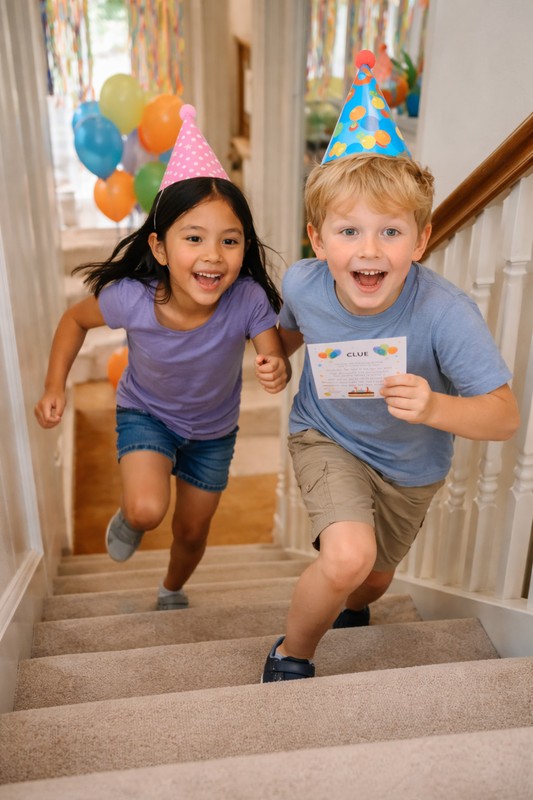
Here are 10 ready-to-use clues covering different themes, difficulties, and clue types. Use these exactly as written, or adapt them to your locations.
Clue 1: Detective Theme (Riddle, Ages 7–9)
Clue card text:
“Detective, your next clue is hiding where we keep our coats warm and dry. Where do jackets rest? That’s where you’ll find your next lead.”
Answer: Coat closet or front hall closet
Clue 2: Pirate Theme (Rhyming, Ages 5–7)
Clue card text:
“Arrr, ye scurvy dogs! To find the treasure map,
Look in the place where we cook and chat.
Under the table where pirates like to dine,
Your next clue awaits, right on the line!”
Answer: Under the kitchen table
Clue 3: Unicorn Theme (Picture + Text, Ages 4–6)
Clue card text (with a small picture of a bathtub drawn on the card):
“The fairy’s next gift is hiding where we splash and play. Can you find the place where you take a bath?”
Answer: Bathroom (hide clue on the side of the tub or under a towel)
Clue 4: Spy Mission (Simple Code, Ages 8–10)
Clue card text:
“Agent, decode this message:
A=1, B=2, C=3… Z=26
8-5-4-18-15-15-13
Next clue there.”
Answer: H-E-D-R-O-O-M = BEDROOM
Clue 5: Superhero Theme (Riddle, Ages 6–9)
Clue card text:
“Superhero, your powers are growing! The next clue is hiding where stories live. Where do books sleep?”
Answer: Bookshelf or library
Clue 6: General Theme (Multi-Step Riddle, Ages 9–12)
Clue card text:
“I am found in every room, but I have no mouth. I reflect your face, but I’m not alive. The next clue is taped to me. Can you find it?”
Answer: A mirror (tape the clue to a mirror in any room—bathroom, bedroom, hallway)
Clue 7: Mystery Theme (Invisible Clue, Ages 7+)
Clue card text (written with invisible ink or printed on paper that reveals under UV light—if you have a blacklight):
“Your next clue is hiding outside where we grow things green.”
Answer: Backyard or garden. (This works great if you’re comfortable hiding something outside. Make sure it’s waterproof.)
Clue 8: Adventure Theme (Compass-Style, Ages 8–11)
Clue card text:
“Walk 10 steps NORTH (toward the front door). Look left (WEST). Find the place where we rest our heads at night. Your treasure is 3 steps SOUTH of it.”
Answer: Bedroom (if you’re in the living room and give those directions, this clue makes the hunt feel like a real navigation challenge)
Clue 9: Riddle with Twist (Ages 10–12)
Clue card text:
“I have a face but cannot see. I have hands but cannot feel. I tell you something important every day. You’ll find your next clue behind me.”
Answer: A clock (tape the clue to the back of a clock or wall-mounted calendar)
Clue 10: Short & Sweet (Ages 4–6)
Clue card text:
“Find the toy box! Your next clue is inside waiting!”
Answer: Toy box or toy storage area (for young kids, directness works best)
FAQ: Birthday Scavenger Hunt Questions Answered
How do you run a birthday scavenger hunt for kids?
Choose a theme, create 6–16 clues pointing to sequential locations, hide clues and rewards, then hand the first clue to the birthday child. Kids follow clues until they find the treasure. If you use a pre-made kit, setup takes about 15 minutes. If you’re building it from scratch, plan 45 minutes to 2 hours. Keep the hunt length between 30–60 minutes depending on age.
What age is best for a birthday scavenger hunt?
The 4–12 age range is the sweet spot. Kids aged 4–6 enjoy simple picture hunts; ages 7–12 can handle riddles, codes, and longer challenges. For kids under 4, hunts can work but require simpler rules and shorter timeframes. Teenagers (13+) enjoy hunts if you add a real mystery or narrative challenge to make it feel less “childish.”
How many clues should a birthday scavenger hunt have?
For ages 4–6: 6–8 clues works well (hunt lasts 15–20 minutes). For ages 7–10: 8–12 clues is ideal (hunt lasts 30–45 minutes). For ages 11–12: 12–16 clues appeals to kids who want a real challenge (hunt lasts 45–60 minutes). More clues = longer hunt, so adjust based on your party timeline and the age group.
Can you do a birthday scavenger hunt indoors?
Absolutely. Most families run them entirely indoors, making it perfect for bad weather and homes of any size. Indoor hunts are actually easier to manage because you control all the spaces. You can hide clues in closets, under furniture, in appliances (like the microwave), behind doors, and in drawers. Indoor hunts are our most popular format and work beautifully for apartments, small homes, and large houses alike.
“My daughter literally cried happy tears when she found the treasure. Best birthday decision ever.”
— Kelly W., verified buyer | Unicorn Scavenger Hunt
About This Article’s Expertise
This guide is based on 200+ birthday scavenger hunts designed and tested since 2019. Every clue, theme, and troubleshooting tip comes from real party experience, feedback from thousands of parents, and what actually works with kids ages 4–12. All advice has been field-tested in homes, backyards, and party venues across the United States.
Skip 4 Hours of Planning. Run a Pro Birthday Hunt in 20 Minutes.
The Complete Birthday Scavenger Hunt Kit includes 20+ tested clue cards across 5 themes, party invitations, badges, certificate of bravery, and a step-by-step setup. Print, hide, party.
$14.99 · Instant Download
Explore More Birthday Party Ideas

- Scavenger hunt for kids — full guide to outdoor and indoor scavenger hunt for kids
- Birthday games for kids — 15+ games beyond scavenger hunts
- Detective birthday party — theme deep-dive
- Pirate birthday party ideas — complete setup guide
- Unicorn birthday party guide — theme decorations and activities
The Party Their Friends Won’t Stop Talking About.
Use the 40+ free clues above, download the printable Birthday Hunt Bundle, or grab the complete tested kit.