

Blog
Spy Missions for Kids: 8 Mission Types for a Complete Secret Agent Birthday Party
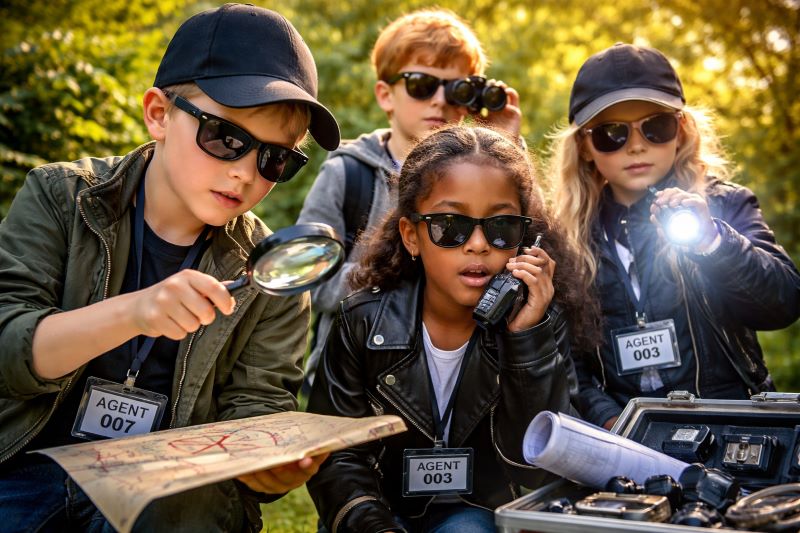
Last updated: April 2026 | Written by Arne, founder of Riddlelicious
About this guide: The tradecraft techniques here are derived from declassified CIA training materials (specifically the KUBARK Counterintelligence Interrogation manual, 1963, and the CIA’s public-domain “Intelligence in the War of Independence” series), the OSS Training Manual (1944), and open-source HUMINT/SIGINT methodology used in university intelligence studies programs. Everything is adapted for ages 8–15 — real concepts, party-safe execution.
Real intelligence work is nothing like the movies. It’s patient, methodical, and deeply psychological. The CIA’s actual recruitment and training program (called “The Farm” — Camp Peary, Virginia) focuses on three core skills that take years to master: observation without being observed, communication without being intercepted, and reading people accurately under pressure.
The Junior Agent Academy compresses those three skills into 8 missions. Each mission teaches one genuine tradecraft principle, scaled to what a birthday party can demonstrate. Pass all 8 and earn a Field Agent Dossier — a personalized classified folder with your code name, specialization, and handler’s commendation.
Mission Parameters
- Ages: 8–15
- Players: 4–20 (agent cells of 2–3)
- Duration: 80–95 minutes
- Location: Indoor preferred — outdoor works for surveillance missions
- Equipment: Cipher wheels, UV pens, magnifying glass, camera/phone, coded envelopes
- Skills: Observation, ciphers, surveillance, kinesics, dead drops, counter-surveillance, SIGINT, debrief

The Junior Agent Academy Setup
At arrival, each agent receives their Classified Dossier: an envelope stamped TOP SECRET containing their cover identity (code name + cover story — e.g., “Agent Falcon / Cover: exchange student”), their cell assignment, and Mission Brief #1. The handler (host) communicates exclusively in writing until Mission 5 — no verbal instructions. This forces agents to read carefully and builds the tradecraft mindset immediately.

Want a Printable Spy Scavenger Hunt?
Our Agent Scavenger Hunt includes 8 classified mission cards, cipher decoder, dead drop envelopes, and Field Agent Dossier templates — for ages 9–15, instant download.
The 8 Academy Missions
Surveillance — Kinesics and Baseline Behavior
Tradecraft principle: Kinesics is the study of body language as communication — a CIA field developed formally after Paul Ekman’s research on micro-expressions (involuntary facial movements lasting 1/25th of a second that reveal true emotions). Field agents are trained to establish a “behavioral baseline” for each target — how they normally sit, speak, and move — so deviations become detectable. Detecting deception isn’t about single signals but clusters of signals that deviate from baseline.
Mission: The handler presents 5 “suspect videos” (short clips or acted-out scenarios): 3 people telling the truth, 2 telling a lie. Agents observe without notes, then discuss behavioral clusters they noticed. After discussion, identify the two liars. Then: each agent “interviews” a partner with 3 questions, one of which the partner must lie in answer to. Can the agent detect the lie from behavioral cues alone? (Answer is revealed after prediction.)
Cipher Operations — Vigenère Encryption
Tradecraft principle: The Vigenère cipher (invented 1553, considered unbreakable for 300 years) uses a keyword to vary the shift of each letter — unlike the Caesar cipher, which uses the same shift throughout. To decrypt: you need the keyword. During WWII, the OSS used Vigenère variants for field agent communication because frequency analysis (the technique that breaks Caesar) fails against properly keyed Vigenère messages.
Mission: Each agent cell receives a Vigenère-encrypted message. The keyword is hidden elsewhere in the room (written in UV ink on an object they must find first). Decrypt the message — which contains the coordinates for their next mission location. Bonus challenge: encrypt a reply message to send back to HQ. Fastest correct decryption earns priority access to Mission 3.
Dead Drop Protocol — Covert Communication
Tradecraft principle: A dead drop is a prearranged location where an agent leaves information for a handler without direct contact. The locations chosen must be: publicly accessible (agent can visit without suspicion), with a clear “loaded/empty” signal visible from a distance (a chalk mark, a thumbtack, a piece of tape), and not under regular surveillance. The CIA’s most famous real dead drop was used by Aldrich Ames — he used a specific mailbox in his neighborhood as his signal site.
Mission: Each cell must establish a dead drop system: choose a location in the party space, create a signal protocol (loaded = paper clip on object; empty = no clip), and successfully pass a message to a second cell without verbal contact. The second cell must retrieve the message, decode it (simple substitution), and act on the instruction it contains. The handler monitors but does not participate. Success criteria: message delivered and acted on without direct contact or interception.

Counter-Surveillance — Detecting a Tail
Tradecraft principle: Counter-surveillance (detecting whether you’re being followed) is more important than surveillance in field tradecraft — an agent who doesn’t know they’re compromised is more dangerous than a blown mission. The CIA’s standard counter-surveillance technique involves a “surveillance detection route” (SDR): a preplanned route with choke points (narrow passages where a tail must follow closely) and “dry cleaning” spots (places where you can observe your back trail naturally — a shop window, a corner turn with a pause).
Mission: One agent follows a route around the party space. Another agent (the “tail”) attempts to follow without being detected. The walking agent has a counter-surveillance checklist: (1) window reflection check at station 2, (2) 45° turn with pause at station 4, (3) full reversal at station 6. Points for: tail correctly following undetected, walking agent correctly identifying the tail. Switch roles and compare scores.
SIGINT — Signal Interception and Analysis
Tradecraft principle: SIGINT (signals intelligence) involves intercepting and analyzing communications. Real SIGINT agencies (NSA, GCHQ) look for metadata patterns as much as content — who communicated with whom, when, how often, and from where reveals networks even when the content is encrypted. The Zimmermann Telegram (1917) — intercepted by British naval intelligence — was the decoded message that brought the US into WWI.
Mission: The handler distributes 8 “intercepted messages” — a mix of meaningful intelligence and deliberate noise (distractors). Agents must identify: (1) which messages form a connected sequence (by analyzing patterns in sender/receiver codes, not content), (2) what the metadata pattern reveals about the mission timeline, (3) which single message is the critical actionable intelligence. This mission tests analytical patience — the answer requires reading all 8 before concluding.
Covert Photography — Observation and Documentation
Tradecraft principle: Field documentation in the pre-digital era required miniature cameras (the Minox subminiature camera, 1.5 cm wide, was standard CIA issue). Modern field agents use smartphones but must practice “non-obvious photography” — appearing to browse a phone while pointing the camera accurately. The FBI’s definition of surveillance photography: document the subject, the environment, and the relationship between them in a single frame.
Mission: Each agent receives a list of 5 items to photograph around the party space without any other person noticing they’re doing it. One adult supervisor plays “the mark” — if the mark sees a phone pointed at them, the agent fails that photo. Technical challenge: photograph all 5 objects with one hand, without looking at the screen. Scoring: 5/5 undetected = full marks; each detection = −1. Fastest full-mark completion wins the mission.
Asset Recruitment — The MICE Framework
Tradecraft principle: CIA analysts use the MICE framework (Money, Ideology, Coercion/Compromise, Ego) to categorize why assets agree to work for foreign intelligence. Understanding human motivation is the most fundamental skill in HUMINT (human intelligence). Robert Hanssen (the FBI agent who spied for the Soviets for 22 years) was primarily motivated by Ego and Money. Kim Philby was motivated by Ideology. Most real-world assets are motivated by a mix of factors that shift over time.
Mission: Present 5 character cards (brief scenarios: a scientist who’s passed over for promotion, a diplomat who disagrees with their government’s policy, etc.). Agents analyze which MICE factor is the primary motivator for each character and what approach would most likely succeed in recruiting them as an asset. This is a group discussion mission — the handler facilitates, there’s no single correct answer. Scoring: teams that identify the same primary factor as the CIA training answer earn points.
Final Debrief — Mission Report
Tradecraft principle: Field debriefs follow a structured format: chronological events, contacts made, information gathered, security concerns, and assessment of intelligence value. A good debrief surfaces information the agent didn’t realize was significant. CIA debriefers are trained to ask open questions first (“Tell me everything from the beginning”) before specific questions — to avoid contaminating the agent’s memory with the debriefer’s expectations.
The ceremony: Each agent presents a 60-second verbal debrief of their most significant finding from the day’s missions. The handler asks one follow-up question. The Field Agent Dossier is then presented — a personalized folder with their code name, missions completed, and a commendation from the “Agency Director.” Award categories: Best Surveillance Analyst | Best Cipher Operator | Best Dead Drop Execution | Most Accurate SIGINT Analysis.
Age Calibration
Ages 8–9
Focus on cipher (Caesar, not Vigenère), dead drop (the physical hide-and-seek element), and surveillance detection route (very physical). Skip MICE framework and SIGINT metadata analysis. The dossier ceremony is the emotional highlight.
Ages 10–12
Full program with Vigenère cipher (provide the tableau). Kinesics discussion generates genuine debate. SIGINT pattern analysis is appropriately challenging without being frustrating. Counter-surveillance is the physical highlight at this age.
Ages 13–15
Add: decrypt the Vigenère message without the keyword (frequency analysis), research one historical real-world case study matching each MICE motivation, and write a full structured debrief report (1 page) using the actual CIA debrief format.
Download the Agent Scavenger Hunt
8 classified mission cards, Vigenère cipher wheel, dead drop envelope templates, and Field Agent Dossier — for ages 9–15, instant download.
Frequently Asked Questions
Is the lie detection mission ethical to teach kids?
The mission teaches the science of behavioral observation, not manipulation. Understanding that body language often contradicts verbal statements is a life skill — it helps kids recognize when adults are being dishonest with them, not just how to deceive others. Ekman’s research is taught in clinical psychology and law enforcement training for the same reason: awareness improves judgment. The party format emphasizes observation and discussion, not interrogation techniques.
How do you make the cipher mission not too hard?
Two options: (1) provide a full Vigenère tableau (the 26×26 letter grid) — this makes decryption mechanical rather than conceptual, and any age can do it with 10 minutes of patience; (2) use a 3-letter keyword (easier) for ages 8–10 and a 5-letter keyword for 11+. The tactical challenge is finding the hidden keyword first, not the decryption itself.
Spy Scavenger Hunt
$21.99 — View & Download
Sources & Further Reading
- CIA. “KUBARK Counterintelligence Interrogation” (1963) — declassified 1997 via FOIA (available at National Security Archive)
- Ekman, Paul. Telling Lies. W.W. Norton, 1985 — foundational kinesics and micro-expression research
- OSS Assessment Staff. Assessment of Men: Selection of Personnel for the Office of Strategic Services. 1948
- Wise, David. Spy: The Inside Story of How the FBI’s Robert Hanssen Betrayed America. Random House, 2002
- Vigenère cipher — National Cryptologic Museum educational materials (nsa.gov)