

Blog
Space scavenger hunt – 30 riddles and tasks for children
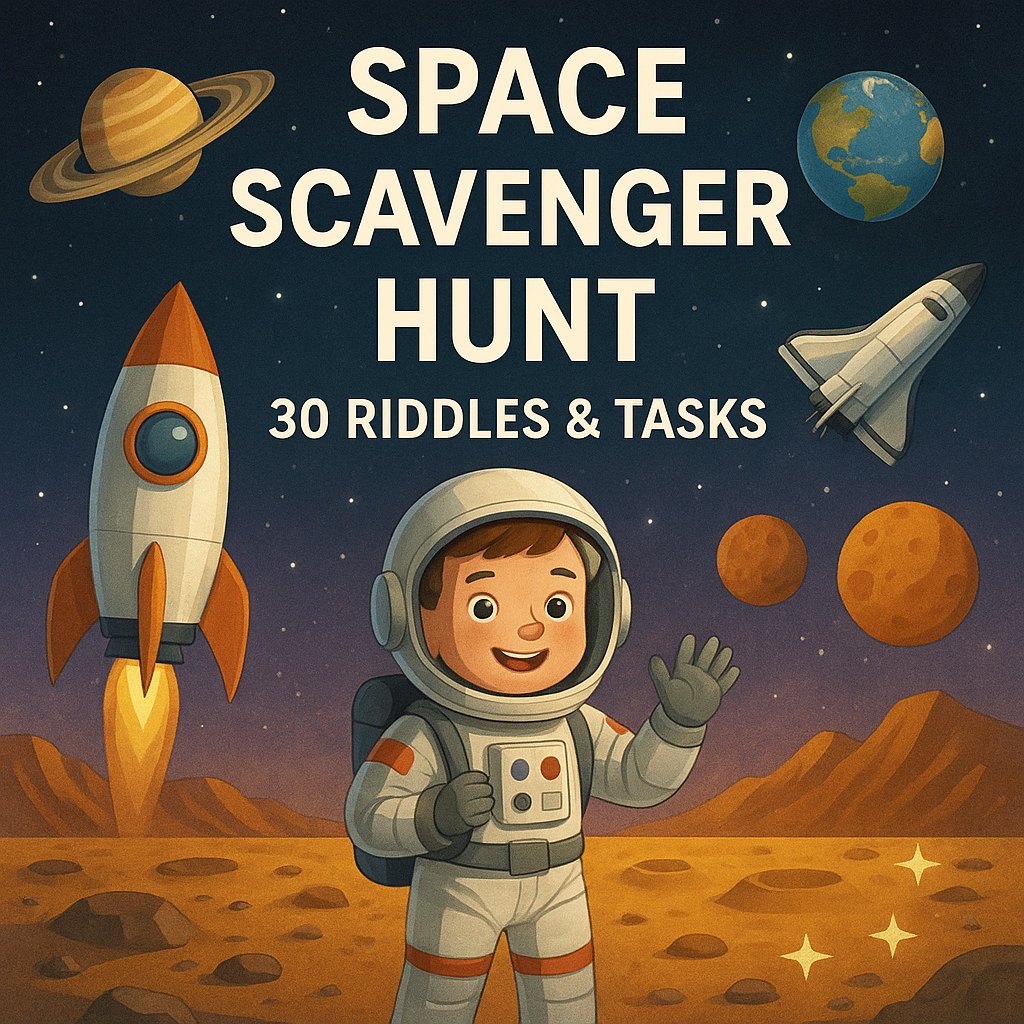
Space Scavenger Hunt – 30 Riddles and Fun Tasks for Kids
Last updated: April 2026 | Reading time: 5 min
This guide is based on years of hands-on experience designing and running scavenger hunts for kids of all ages. Every idea has been tested with real families to ensure maximum fun and engagement.
For your space-themed scavenger hunt, exciting riddles and playful challenges are the key to immersing kids in the world of astronauts, planets, rockets, and distant galaxies. Below you’ll find 30 creative riddles and tasks that you can easily integrate into your scavenger hunt adventure.
Planning a whole birthday party around these clues? Use our space party planning guide for mission-themed activities and ideas for connecting the hunt to the rest of your celebration.
Space Riddles & Tasks for Kids Ages 4–6
Riddle 1
Which planet is the largest in our solar system?
Answer: Jupiter
Riddle 2
I’m known as the Red Planet. What’s my name?
Answer: Mars
Riddle 3
Which planet is closest to the Sun?
Answer: Mercury
Riddle 4
I shine in the night sky and influence the tides on Earth. Who am I?
Answer: The Moon
Riddle 5
I’m round, big, and you live on me. What am I?
Answer: Earth
Riddle 6
I’m a bright star and the center of our solar system. What am I?
Answer: The Sun
Riddle 7
What do astronauts need to breathe in space?
Answer: A spacesuit
Riddle 8
What is the vehicle that carries astronauts into space called?
Answer: A rocket
Riddle 9
Which planet is famous for its rings?
Answer: Saturn
Riddle 10
What can you see in the night sky that is made up of many bright points?
Answer: Stars

Astronaut Treasure Hunt
Printable space scavenger hunt – explore the solar system clue by clue. Ages 3-9.
Download & Print → $14.99
Space Riddles & Tasks for Kids Ages 7–8
Riddle 11
Which planet is named after the Roman god of war?
Answer: Mars
Riddle 12
What is the invisible force that keeps us on Earth called?
Answer: Gravity
Riddle 13
Which planet is known as the Blue Planet?
Answer: Earth
Riddle 14
I’m a dwarf planet and was once considered the ninth planet. Who am I?
Answer: Pluto
Riddle 15
Which planet is famous for being tilted on its side?
Answer: Uranus
Riddle 16
How many planets are in our solar system?
Answer: Eight
Riddle 17
What do we call the time it takes Earth to rotate once?
Answer: One day
Riddle 18
What do we call the paths planets take around the Sun?
Answer: Orbits
Riddle 19
Which planet is the hottest in our solar system?
Answer: Venus
Riddle 20
Which planet has the tallest mountain in the solar system?
Answer: Mars (Olympus Mons)

Space Riddles & Tasks for Kids Ages 9–10
Riddle 21
How long does it take Earth to orbit the Sun once?
Answer: One year (365 days)
Riddle 22
Which planet is named after the Roman god of the sea?
Answer: Neptune
Riddle 23
How many moons does Mars have?
Answer: Two (Phobos and Deimos)
Riddle 24
What is a light-year?
Answer: The distance light travels in one year
Riddle 25
What do we call the bright streak that appears when a meteor enters Earth’s atmosphere?
Answer: A shooting star
Riddle 26
What is the largest object in our solar system?
Answer: The Sun
Riddle 27
What is a black hole?
Answer: A region in space with gravity so strong that nothing can escape — not even light
Riddle 28
Which spacecraft carried the first humans to the Moon in 1969?
Answer: Apollo 11
Riddle 29
How long does sunlight take to reach Earth?
Answer: About 8 minutes
Riddle 30
Which planet spins the fastest?
Answer: Jupiter
With these 30 riddles and tasks, your space-themed scavenger hunt becomes a truly exciting mission for kids ages 4–10. Each clue takes young astronauts deeper into space while teaching fun facts about our universe.
Space Scavenger Hunt: Fun Tasks & Challenges
- Collect the Stars: Find the hidden star stickers or paper stars scattered around the yard or indoor space. Each star reveals a clue that leads to the next mission.
- Rocket Launch Drill: Time for astronaut training! Kids crouch down, count down from 5, and jump as high as they can — just like a rocket blasting off.
- Discover the Planets: Search for hidden planets placed around the play area (painted balls, laminated planet cards, or foam planets). Once all planets are found, kids must arrange them in the correct solar system order.
- Zero-Gravity Obstacle Course: Move through a mini obstacle course as if you’re floating in space — slow, controlled, and weightless. Use pillows, ropes, chairs, or taped paths to create a fun “zero-gravity” experience.
- Collect the Asteroids: Look for small “asteroids” (crumpled aluminum foil balls or painted stones) hidden throughout the space. Kids must gather them in a basket before unlocking the next clue.
- Alien Greeting: Kids work together to invent a special alien greeting — a silly sound, a funny hand gesture, or a dance move. They must perform it to earn the next mission briefing.
- Moonwalk Challenge: Create a “moon surface” using pillows, mats, or stepping stones. Kids hop from pad to pad, pretending they are walking across the Moon’s low-gravity terrain.
- Constellation Puzzle: Kids receive a dotted constellation sheet and must connect the stars to reveal a well-known constellation such as Orion, the Big Dipper, or Cassiopeia.
- Find the Mars Photo: Planet pictures are hung around the area. Kids must locate the correct one — Mars — to move on to the next clue.
- Space Dance Party: End the adventure with a futuristic dance party! Play space-themed or electronic music while the kids dance like robots, aliens, or astronauts celebrating a successful mission.
These activities combine creativity, movement, and problem-solving — perfect for keeping kids engaged and excited throughout the entire space scavenger hunt. All tasks can be easily adapted to different age groups and group sizes.

You Might Also Like
- Riddles For Kids
- Scavenger Hunt For Kids
- Dinosaur Riddles for Kids
- Magical Riddles for Kids
- Birthday Scavenger Hunt Ideas
- Printable Space Scavenger Hunt
Sources & Further Reading
Discover More Riddle Posts!