

Space Party for Kids: Complete Guide + Free Printables
Last updated: May 2026 | Curated by Arne, founder of Riddlelicious
About this hub: Our Astronaut Treasure Hunt is one of our earliest products and has been used by thousands of families since 2019. The mission-control plan below is built from real space-themed parties we have run, plus the parts that worked best in Coffee with Charlotte, Party Like a Cherry and Goober Studio Prints’ space-party guides. The under-rated insight: space parties feel ordinary unless you commit to the “mission” frame — every activity gets named a “training exercise” or “test”, and that single shift makes the whole party feel like NASA day rather than “stickers and a cake”.
A space birthday party is the most science-rich theme you can run for kids 4 to 12 — it ties naturally to real planets, real rockets, real astronaut training. That gives parents and teachers a rare bonus: the kids actually learn something. And the visual palette (deep blue, silver, glow-in-the-dark) is one of the most dramatic to set up.
This hub gathers every astronaut and space resource on Riddlelicious — scavenger hunts, riddles, party plans, printable mission kits — plus a complete launch-to-landing plan for parents starting from zero. Skip straight to 8 best mission stations if you already have your launch site set up.
Space Party at a Glance
- Ages: Works for 4–12. Sweet spot is 5–9.
- Group size: 4–14 kids. Above 8, split into “Crew Alpha” and “Crew Beta”.
- Total runtime: 90–120 minutes including the launch ceremony.
- Prep time: 30–45 minutes if you use a printable kit; 2–3 hours from scratch.
- Budget: $0–$60. Silver/black craft paper goes a long way; glow-in-the-dark stars are the single best $5 spend.
- Indoor/outdoor: Indoor preferred — easier to dim the room for “space” atmosphere.
Why the “Mission” Frame Beats Generic Space Decor
Most online space-party guides list activities without a thread connecting them. Decorate. Eat space snacks. Maybe a piñata. The kids enjoy individual moments but the party does not feel like anything in particular.
Real astronaut training has a clear structure: candidates rotate through stations testing different physical and cognitive skills, earning sign-offs from instructors. We borrow that exact structure. Each child gets a “Mission Logbook” on arrival. Every activity is a “Mission Module” — they earn a stamp or sticker on completion. By the cake, every child has filled their logbook and earned “Mission Specialist” status.
This frame is what separates a forgettable space party from one the kids talk about for weeks. It costs nothing extra to add — just rename every activity and provide stamps.
Build Your Space Party in 5 Stages
Stage 1: Pick the Mission
One mission ties every activity together:
- Mission to the Moon — train, launch, walk on the moon, return safely. Works ages 4–9.
- The Mars Expedition — five training tests qualify for the journey. Each station passed brings the crew closer. Works ages 5–10.
- The Lost Satellite — a satellite has gone silent; find it before time runs out. Works ages 7–12.
- The Astronaut Scavenger Hunt — our printable version with riddle cards and a star-map.
Stage 2: Build Mission Control
Three visual elements:
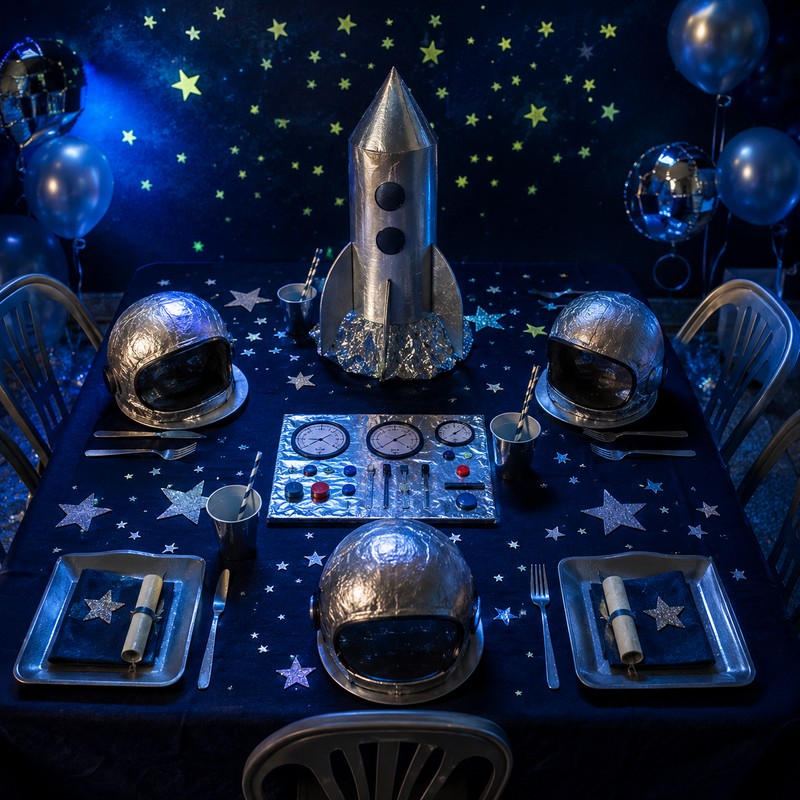
- “Space wall” — black or dark blue plastic tablecloth on one wall. Stick on glow-in-the-dark star stickers in a constellation pattern. Dim the room and the wall glows for an hour.
- Control panel — a cardboard cut-out with paper dials, painted buttons, and a “LAUNCH” button (a red plastic cup glued on). Place at the center of the activity zone.
- Mission Control sign — a piece of black paper with white-painted letters reading “MISSION CONTROL — TODAY: [Birthday Kid]’s Crew” — hangs above the snack table.

Stage 3: Outfit the Crew
Each crew member gets at arrival:
- An astronaut helmet — folded foil-paper bag with a clear plastic “visor” cut from a transparent folder
- A name patch — “CREW-MARS”, “CDR. LEO”, “PILOT MAYA”
- A small “Mission Logbook” — a stapled folded paper booklet with one page per station
- A small foil-paper “rocket pack” to attach to their back (optional, big hit)
Stage 4: Run the Mission Stations
Rotate through 5–6 of the 8 stations below. Each takes 8–12 minutes. After each station, the “Mission Commander” (you) stamps the crew’s logbook page. The stamp ritual is what makes the kids work hard at the next station.
Stage 5: Launch & Landing
Final 10 minutes: the whole crew counts down from 10 and “launches” the cardboard rocket. Every crew member receives a printable “Mission Specialist” certificate. Cake. Glow-stick goody bags for departure.
8 Best Space Mission Stations
Each station is built from at-home materials and runs in 10–12 minutes. Ordered easy → hard so younger crew members stay engaged early.
Helmet Assembly & Crew Naming
Age: 4+ · Time: 10 min
As crew arrive, each folds and decorates their helmet (foil paper + clear visor + stickers), receives their crew name patch, and signs the mission log. Sets the tone instantly — by the time the last guest arrives, the room is already a mission control.
Astronaut Training Obstacle Course
Age: 4+ · Time: 12 min
Backyard or living room. Set up: leap over “asteroid” pool noodles, crawl through a “wormhole” tunnel of chair-and-blanket, balance walk on the “gravity beam” (tape line), and finish with a one-foot landing in a hoop (the “moon zone”). Best with a stopwatch for older kids; everyone wins a stamp.
Straw Rocket Engineering
Age: 5+ · Time: 12 min
Each crew member builds a paper rocket that fits over a straw — body, fins, nose cone. After building, they blow through the straw to launch their rocket and see whose flies furthest. Real engineering lesson disguised as play; works for the widest age spread of any space activity.
Moon Rock Hunt
Age: 4+ · Time: 10 min
Wrap small rocks (or plastic-egg containers) in foil. Hide 5–10 around the yard or room. Each crew member must find at least one “moon rock”. Inside each: a small candy or sticker. Strongest with younger kids; pairs with the Astronaut Scavenger Hunt for older.
Planet Riddle Round
Age: 6+ · Time: 10 min
Read 8–10 planet/space riddles aloud — “I am the red planet. Robots have walked on me. Who am I?”. First crew to call out the right answer earns a star sticker. Three correct answers = “Astronomer” stamp on their logbook.
The Astronaut Scavenger Hunt
Age: 5+ · Time: 15 min
The biggest activity — a series of riddle cards lead the crew through a sequence of hidden clues to a final “satellite recovery” or “moon landing site”. Our printable Astronaut Treasure Hunt includes 8 stations, mission badges, star map, and certificates.
Galaxy Slime Lab
Age: 5+ · Time: 15 min
Each crew member mixes their own “galaxy slime” — glue + saline + glitter + tiny star confetti. Comes out swirly purple-blue and shimmery. Doubles as a take-home favor. Pre-mix the slime base the morning of; supervised, kids stir and add their own glitter.
The 10-9-8 Final Countdown
Age: All · Time: 8 min
The whole crew gathers around Mission Control. Big countdown — 10, 9, 8, 7… liftoff. The cardboard rocket is “launched” (lift it dramatically) and every crew member is awarded their printable “Mission Specialist” certificate. Cue cake.

Skip the Prep — Get the Astronaut Treasure Hunt
Our printable kit is the NASA-mission-style version of this format. 8 mission stations, riddle cards, mission badges, star map, and crew certificates. Print at home, play in 30 minutes.
Space Snacks & Mission Rations
- Rocket cake — a vertical cake decorated as a rocket; or a flat sheet cake with a piped rocket on it.
- “Moon rocks” — chocolate truffles rolled in white powdered sugar.
- Starry cupcakes — blue-frosted cupcakes with edible silver star sprinkles on top.
- “Astronaut food” — small foil packets labelled “MISSION RATION” with trail mix or fruit snacks inside.
- Planet fruit skewers — alternating round fruits (grapes, blueberries, melon balls) labelled with planet names on small flags.
- “Galaxy juice” — blue lemonade with a few drops of grenadine creating a purple swirl.
Decor That Reads “Space” in 10 Minutes
- Glow-in-the-dark star stickers on a dark wall — the single best $5 spend.
- Silver mylar balloons shaped as rockets/stars (Amazon $8 pack of 10).
- Black tablecloth + silver star confetti on the main table.
- Cardboard cut-out planets hanging from string at different heights — Saturn (with cardboard ring) is the show-stopper.
- One desk lamp behind blue cellophane for that “deep space” cool light. Dim every other light.
Free Space Resources on Riddlelicious
- Space Scavenger Hunt: 8 NASA Astronaut Training Challenges — pillar guide
- Space Scavenger Hunt: 30 Riddles and Tasks for Children
- Astronaut Treasure Hunt — Printable Product ($14.99)
- Scavenger Hunt for Kids: Ultimate 2026 Guide
- 50+ Scavenger Hunt Tasks & Challenges
- Themed Riddles for Kids: Planets, Countries, Animals
Coming Soon to This Hub
Get the newsletter to know when one drops.
- Astronaut Birthday Party: Complete Planning Guide + Mission Control Setup
- How to Make a DIY Cardboard Rocket for a Space Party
- Planet Riddles for Kids: 25 Brain Teasers About Our Solar System
- Space Snack Ideas: 8 Galaxy-Themed Treats Kids Will Reach For
- Astronaut Training Obstacle Course: 6 Mission Stations for Backyard or Gym
- Space Facts for Kids: 20 Surprising Truths About Stars, Planets and Moons
Frequently Asked Questions
What age is best for a space birthday party?
Five to nine is the sweet spot. Four-year-olds engage with the visual setup and the helmet decoration but cannot follow the multi-step scavenger hunt. Ten to twelve enjoy the science angle and the harder riddles more than the cardboard helmets.
Do I need to know real space facts to run this?
No. Our printable kit includes the planet facts, the riddle answers, and a short “Mission Commander script” with the talking points. You can run a NASA-themed party without knowing more space facts than the average 8-year-old.
How long should a space party run?
90 to 120 minutes total. Suggested split: 15 min helmet assembly, 60-75 min mission stations, 10 min countdown launch, 20-30 min cake and glow-stick free play.
Indoor or outdoor — which is better?
Indoor. The visual signal of “the room is dim, the stars glow, the walls are different” is half the experience. Outdoor parties lose the glow effect during daylight and the “mission control” framing weakens.
What is the cheapest space setup?
Under $25: glow-in-the-dark star stickers ($5), one roll of foil paper for helmets ($3), black plastic tablecloth as backdrop ($2), straw rockets from craft paper ($0). Add $15 if you want our printable Astronaut Treasure Hunt kit.
Can mixed-age groups (4-12) play the same stations?
Yes, with one rule: pair every under-6 with a “Mission Commander” partner from the older kids. The pairing makes the older kids feel important and ensures the younger kids do not get left behind on the harder stations like Straw Rockets and Riddle Round.
Sources & Further Reading
- Coffee with Charlotte — Kid’s outer space birthday party ideas
- Party Like a Cherry — Space Party Activities & Games
- Goober Studio Prints — 15 Outer Space Birthday Party Activities
- NASA — Astronaut Training Programs (referenced for the mission-station structure)
- European Space Agency — Education Kit: Space Adventures