

Blog
Space Scavenger Hunt for Kids: 8 NASA Astronaut Training Challenges for a Mission Birthday Party
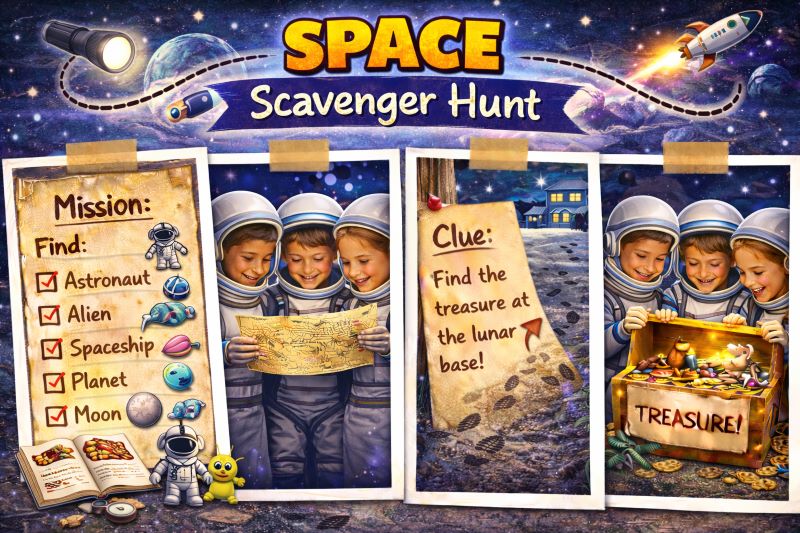
Last updated: April 2026 | Written by Arne, founder of Riddlelicious
About this guide: I’ve structured this hunt around NASA’s actual astronaut selection and training program — the same categories NASA uses to evaluate candidates: physical fitness, cognitive performance under pressure, technical problem-solving, teamwork, and adaptability. The eight stations here are scaled versions of real training challenges. Kids find it more exciting when the connection to real astronaut preparation is made explicit.
NASA’s astronaut selection process accepts fewer than 1% of applicants. But that process is public — NASA publishes exactly what they test for, how candidates are evaluated, and what the training involves. That transparency makes it perfect party material.
The Astronaut Selection Camp format puts every kid through the same 8-category evaluation that real astronaut candidates complete. Each station is labeled with the NASA competency it trains. At the end, every kid receives a personalized Mission Assignment based on their strongest performance category: Mission Specialist, Pilot, Flight Engineer, Science Officer, or Commander.
Quick Facts
- Ages: 6–12
- Players: 4–20 (crews of 3–4)
- Duration: 85–100 minutes
- Location: Backyard or indoor — most stations need minimal space
- Equipment: Blindfolds, building blocks, star charts, basic tools
- NASA competencies covered: Physical fitness, navigation, engineering, life support, teamwork, adaptability

The Astronaut Selection Camp Framework
Each crew receives a Candidate Dossier before the hunt: a photo ID card with their astronaut callsign, a competency rating sheet (one row per station), and their crew mission patch (a sticker they design at Station 1). The dossier is their official NASA evaluation record.
All 8 stations run simultaneously with crews rotating every 10–12 minutes. An adult “Flight Director” at Mission Control (the kitchen table or a dedicated spot) tracks time and issues “incoming transmissions” — bonus challenges or plot twists that real astronauts must respond to mid-task.

Want Printable Mission Cards and Dossier Templates?
Our Astronaut Treasure Hunt includes mission card set, candidate dossier template, star chart navigation puzzle, and life support scenario cards — instant download, print and launch.
The 8 Training Stations
Mission Patch Design (Pre-Mission Protocol)
NASA connection: Every NASA mission has a unique mission patch designed by the crew. The patch encodes the mission objectives, crew number, and symbolism meaningful to the team. Designing and wearing the patch is a real pre-mission ritual that establishes crew identity.
Task: Each crew has 5 minutes to design their mission patch on a paper circle. Required elements: crew name, mission number, at least one celestial body, and one symbol representing their specialty. Patches are worn for the rest of the party. At the end, vote on the best-designed patch.
This station runs at arrival, before the timed rotation begins.
Physical Fitness Evaluation
NASA connection: Astronaut candidates must pass a strict physical evaluation including cardiovascular endurance, strength, flexibility, and balance. ISS astronauts exercise 2 hours every day in space to counteract muscle and bone loss from weightlessness.
Task: A 4-test fitness circuit: (1) Balance beam walk — 5 meters on a tape line heel-to-toe, (2) Push-up test — max reps in 30 seconds, (3) Standing broad jump — distance measured from feet, (4) Wall sit — maximum hold time. Record best performance per event in the Candidate Dossier.
NASA rating: Each test scored 1–3 points. 10–12 total = Flight Candidate | 7–9 = Mission Ready | Under 7 = Conditional (needs training)
Navigation — Star Chart Reading
NASA connection: GPS doesn’t work in deep space. Astronauts and mission navigators use stellar navigation — identifying position relative to known stars — as a backup to electronic systems. On the Apollo missions, the astronauts manually confirmed their trajectory by sighting specific stars through an optical instrument called a sextant.
Task: Print 3 star chart segments (available free from NASA’s Night Sky Network). Each segment shows a constellation section with 2–3 stars labeled and 2–3 unlabeled. Teams must identify the unlabeled stars using a printed star catalog reference and then determine which constellation segment they’re looking at. Bonus: plot the Earth’s current position on an inner solar system map using today’s date and orbital period data.
Rating: 2+ constellations correctly identified + Earth position plotted = Navigation Certified
Engineering — Habitat Repair Under Pressure
NASA connection: ISS crew members regularly repair habitat systems — life support equipment, electrical components, and structural elements — often in cramped conditions or while wearing pressurized gloves that reduce dexterity. NASA’s “gloved dexterity test” is a standard astronaut evaluation: complete a technical task while wearing thick rubber gloves.
Task: Teams wear thick rubber or work gloves and must complete: (1) Thread a nut onto a bolt, (2) Plug in 3 labeled connectors in correct sequence, (3) Fold and seal a space ration package (a zip-lock bag works), (4) Write their callsign legibly on a label. Time the whole sequence. Repeated with and without gloves — record the time difference.
Rating: Completed all 4 tasks gloved in under 90 seconds = Engineering Specialist | Under 2 minutes = Mission Ready

Life Support — Emergency Protocol
NASA connection: ISS crew members train extensively in emergency response: fire protocol, pressure loss response, and medical emergency procedures. Each crew member must know the exact sequence of actions for any emergency scenario. Drills are run regularly because there’s no 911 to call in orbit.
Task: Give each crew a 6-step emergency procedure card (a fictional scenario: “CO2 scrubber failure — follow protocol”). One step is intentionally out of order. Teams must identify the error, correct the sequence, and “execute” the procedure by performing the physical actions described (e.g., “close valve A, open valve B, report to Mission Control”). Time pressure: 4 minutes to detect, correct, and execute.
Rating: Found the error AND completed the protocol in under 4 minutes = Life Support Qualified
Communication — Encrypted Transmission Decode
NASA connection: All communications between ISS and Mission Control are transmitted through a relay system and include error-correction protocols. When signal quality degrades, crews work with partial transmissions — reconstructing missing data from context. Astronaut communications also follow precise protocols (callsign first, message type, content) to ensure clarity when audio quality is poor.
Task: Each crew receives a “degraded transmission” — a message with every 4th word replaced by a blank. The message describes a mission critical situation and contains a question that requires answering. Teams must fill in the blanks using context, then transmit their answer using the correct radio protocol: “[Callsign] to Mission Control — [message type] — [content] — over.”
Rating: Correct blanks + correct radio protocol format = Communications Specialist
Science — Microgravity Experiment Design
NASA connection: Approximately 40% of ISS crew time is spent on scientific research. Many experiments are specifically designed to test how microgravity affects physical and biological processes: fluid behavior, crystal growth, combustion, plant growth, and human physiology. Astronauts design, execute, and report on experiments during their missions.
Task: Give each crew a “Research Brief” describing an observation made on the ISS (e.g., “water droplets in microgravity form perfect spheres”). Teams must (1) explain the physics reason this happens on Earth vs. in space, (2) design a simple Earth-based experiment to demonstrate the underlying principle (water surface tension), and (3) predict what would change in microgravity. Judges (adults) evaluate the scientific reasoning of the prediction.
Rating: Correct physics explanation + valid experimental design = Science Officer Qualified
Final Mission: Docking Simulation
NASA connection: ISS docking requires precise three-dimensional navigation under extreme conditions. The entire crew cooperates: a pilot controls approach, engineers monitor systems, a science officer tracks relative position, and a commander gives final docking authorization. No single person can do it alone — it’s the definitive teamwork test.
Task: A 4-person crew relay. One kid is blindfolded (the “pilot” relying on instruments). Their teammates give only verbal coordinates: “forward 2 steps, left 1, stop.” The goal: guide the pilot to pick up a specific object (the “docking package”) from a 12-object grid without touching anything else, then bring it to the “airlock” (a designated spot). All crew members rotate: each gets one turn guiding and one turn as pilot.
Award categories: Most Precise Navigator | Best Physical Fitness Score | Fastest Life Support Protocol | Best Mission Patch Design | Most Creative Experiment
Decoration Ideas
- Mission Control station: A table covered in printed “system status” readouts, a countdown timer, and a microphone for the Flight Director — the physical center of the party atmosphere
- Solar system scale model: Print planet discs at scale and tape them across your yard or room — kids are always shocked by how far Neptune would be at true scale
- ISS floor plan: Print a labeled ISS module map — kids recognize modules by name by the end of the party
- Constellation ceiling: Stick-on glow stars in actual constellation patterns — label each one
- Mission briefing board: A whiteboard listing crew names, mission objectives, and a countdown to launch time
Snacks
- Dehydrated “space food”: Freeze-dried fruit pouches (available at most grocery stores) — explain this is how food is actually preserved for long missions
- Galaxy cake: Marbled blue, purple, and black buttercream with star sprinkles — add a small fondant rocket on top
- Oxygen tank water bottles: Label water bottles as “O2 Supply — Mission Critical” — kids keep these at their stations throughout the hunt
- Asteroid belt snack mix: Rocky road mix (nuts, marshmallows, chocolate chips) served in a bowl labeled “Belt 2.3 — Asteroid Field”
Age Calibration
Ages 6–7
Focus on fitness, mission patch, and docking simulation (which is fun regardless of age). Skip the star chart navigation and experiment design — replace with simpler planet identification from pictures.
Ages 8–10
Full program as described. Communication decode works well at this age. Navigation star chart takes 8–10 minutes but generates genuine engagement. Gloved engineering task is the consistent hit.
Ages 11–12
Add: calculate orbital period from semi-major axis (simplified Kepler’s third law), compute gravity on other planets relative to body weight, and require written hypothesis with null hypothesis for Station 7.
Download the Astronaut Treasure Hunt Kit
Mission cards, dossier templates, star chart puzzles, life support scenario cards — ages 6–12, instant download, ready to launch.
Frequently Asked Questions
Do I need any special equipment for the space theme?
No expensive purchases needed. The most impactful props are free printables (NASA star charts, ISS floor plan, solar system scale diagram) combined with simple household items (rubber gloves, a blindfold, a stopwatch). The “space food” snack option (freeze-dried fruit) is the one item worth buying — it costs about $3–5 per pack and consistently gets the biggest reaction from kids.
What if we have fewer than 4 kids per crew?
The docking simulation (Station 8) can run with 2-person crews — one navigator and one pilot, swapping roles. Adjust the fitness circuit to be individual rather than team-scored. The communication decode and star chart stations work for any group size, including solo participants.
How do I handle kids who want to be the commander/pilot every time?
The rotation structure in Station 8 enforces role sharing. For other stations, assign roles by crew lottery at the start of each station — draw cards from a shuffled deck. This removes negotiation entirely and actually speeds up transitions between stations.
Sources & Further Reading
- NASA Astronaut Selection Program — nasa.gov/astronauts/how-to-become-an-astronaut
- NASA Night Sky Network — Star Chart resources — nightsky.jpl.nasa.gov
- ISS Research Program — nasa.gov/international-space-station/research
- NASA Human Research Program — Bone density loss in microgravity data
- Apollo Mission Training Documentation — NASA Technical Reports Server