
Blog
Scavenger Hunt for Large Groups: How to Run It with 20–100 Kids (Without Chaos)

Arne · 16 min read · Published: May 25, 2026
Scavenger Hunt for Large Groups: How to Run It with 20–100 Kids (Without Chaos)
Running a scavenger hunt for large groups sounds exciting on paper — but the logistics can be overwhelming. When you have 30, 50, or even 100 kids in your care, a poorly planned hunt descends into chaos: kids wandering aimlessly, some finishing in 10 minutes while others are still searching, teams arguing over clues, and you spending all your energy managing the crowd instead of enjoying the hunt.

The good news: scavenger hunts for large groups are absolutely manageable if you use the right format and structure. After running hundreds of scavenger hunts in schools, birthday parties, and community events, I’ve learned exactly what works and what doesn’t. The key is understanding how to divide kids into teams, choose a hunt format that prevents bottlenecks, and use tools (like printable kits) that scale without adding stress.
In this guide, you’ll learn the proven strategies for running smooth, fun scavenger hunts with groups of any size — from 20 to 100+ kids.
The Challenges of Large-Group Scavenger Hunts (And How to Solve Them)

Before we get to solutions, let’s name the real problems that emerge when you scale a scavenger hunt:
Challenge 1: Bottlenecks at Stations or Clue Locations
When 40 kids are all hunting for the same item at the same location, chaos happens. Everyone arrives at once, there’s crowding, arguments over who found it first, and things get lost or damaged.
Solution: Use a station rotation system where each team moves to a different station at different times. Or, if space allows, create multiple copies of clue locations so multiple teams can hunt simultaneously.
Challenge 2: Uneven Pace — Some Teams Finish in 5 Minutes, Others Take 30
Fast teams get bored. Slow teams feel rushed. Managing the energy of 50 kids at wildly different completion rates is exhausting.
Solution: Use a timed station rotation (each team spends 10 minutes at a station, then rotates). This keeps everyone on pace regardless of speed, and eliminates winners-and-losers competition (which often demoralizes slower teams).
Challenge 3: Lost or Forgotten Clues
With dozens of kids, you’ll inevitably lose clues, have teams read clues incorrectly, or have kids forget instructions. Reprinting on the fly becomes your job.
Solution: With printable clue kits, you can print 10, 20, or 50 copies in advance. Each team gets their own set. No sharing, no confusion, no reprinting mid-event.
Challenge 4: Supervision and Safety
Large groups need more eyes. With 50 kids spread across multiple areas, you can’t watch everyone at once.
Solution: Divide supervisors by zone or station. Use a station-based format where all kids move as a group between stations, keeping them visible. Set clear boundaries for where kids can search.
Challenge 5: Cost and Material Prep
Ordering 30 different printed hunt kits is expensive. Hand-writing clues on 50 cards takes hours.
Solution: Buy one digital scavenger hunt kit, then print as many copies as you need for the cost of paper and ink. One $14.99 kit works for 5 kids or 100 — no per-team fee.
Team Structure: How to Split Large Groups Effectively
The first tactical decision: how many kids per team?
Ideal Team Sizes by Group Context
| Group Context | Ideal Team Size | Why |
|---|---|---|
| Birthday party (homogeneous age) | 4–6 kids | Enough people to share tasks; small enough everyone stays engaged |
| School classroom (mixed abilities) | 3–5 kids | Fewer kids means less exclusion; easier for quieter kids to contribute |
| Summer camp (large group, competitive) | 6–8 kids | Builds team culture; large enough to split tasks (some searching, some solving) |
| Community event (100+ kids) | 5–7 kids | Manageable groups; each team still feels like they own their hunt |
The “Buddy System” for Mixed-Age Groups
In mixed-age or mixed-ability groups (like a school with grades 1–3 together), pair strong readers with weaker ones. Older kids read clues; younger kids search. This keeps engagement high and prevents anyone from feeling left behind.
How to Divide Groups Fairly
If you have 45 kids, divide into 9 teams of 5. If you have 52 kids, do 10 teams of 5–6. Avoid “last kid left over” scenarios — kids notice and feel bad about it.
Pro tip: Let kids self-select teams if possible (friends stick together), then adjust by moving one or two kids to balance sizes. Kids are happier hunting with friends.
Simultaneous vs. Sequential: Which Format Works for Large Groups?
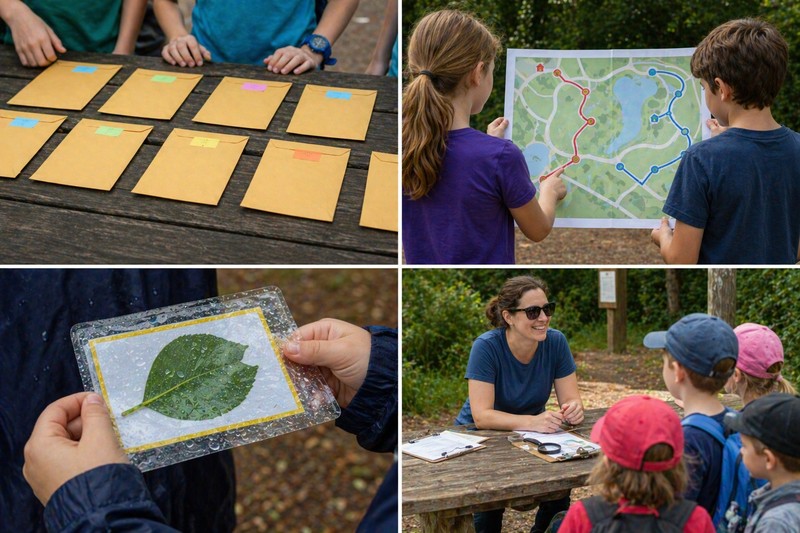
Two main formats exist for scavenger hunts. For large groups, one is far superior.
Simultaneous Hunt (All Teams Start at Once)
How it works: All teams receive the same clue list, start at the same time, and race to complete all clues and reach the treasure. Teams scatter to different locations.
Pros: – Exciting, competitive atmosphere – Takes 20–40 minutes (faster) – Feels more like a “real race”
Cons for large groups (MAJOR): – Creates bottlenecks: all 8 teams arrive at location #3 at the same time – Supervisors can’t be everywhere — safety risk – Fastest team reaches treasure in 15 minutes while slowest teams aren’t done in 45 – Managing winners/losers with 50+ kids = complaints and tears
Station-Based Hunt (Teams Rotate Through Stations)
How it works: Set up 6–8 stations around your space. Each station has an activity (solve a puzzle, find hidden items, answer riddles). Teams start at different stations and rotate every 10 minutes. After 60–80 minutes, all teams complete all stations in a different order.
Pros for large groups (IDEAL): – No bottlenecks — each station handles one team at a time – Even pacing — timed rotations mean everyone finishes together – Everyone stays engaged the whole time – Supervisors know exactly where to be – No “losers” feeling — everyone completes the same hunt – Works perfectly for 20–100+ kids
Cons: – Slightly less competitive/exciting (but can add point systems to fix this) – Requires more setup (stations, timers) – Takes longer (60–90 minutes vs. 30–40)
For any large group (30+ kids), station-based is the clear winner. It’s the format used by schools, summer camps, and corporate team-building events for exactly this reason.
Station-Based Scavenger Hunts for Big Groups
Here’s how to build and run a station-based hunt that keeps 40–100 kids engaged and safe.
Step 1: Design Your Stations
Create 6–8 stations. Each station should take about 10 minutes to complete. Mix activity types:
- Puzzle/Riddle Station: Teams solve a riddle to get a code (example: “I have a spine but no bones. What am I?” Answer: A Book. Code: 8-BOOK)
- Scavenger Station: Find 3–5 hidden items in a designated area, write them down
- Physical Challenge: Complete a task (stack cups, balance blocks, jump rope 20 times) to earn a code
- Trivia/Knowledge Station: Answer questions about your school/venue/topic to get a code
- Search Station: Find a hidden envelope or object that contains the next clue
- Creative Station: Draw something, write a story, or solve a visual puzzle
Sample Station Layout for a School Gym + Hallway (40 kids, 8 teams of 5)
GYM (2000 sq ft):
  Station 1 (North corner): Riddle puzzle + whiteboard (Supervisor: Ms. Jones)
  Station 2 (Center): Hide-and-seek items list (Supervisor: Mr. Lee)
  Station 3 (South corner): Balance beam physical challenge (Supervisor: You)

HALLWAY (outside gym):
  Station 4: Trivia questions (Supervisor: Parent volunteer)
  Station 5: Hidden envelope in trophy case (Supervisor: Parent volunteer)
  Station 6: Creative drawing puzzle (Supervisor: Aide)

OUTDOOR SPACE (if available):
  Station 7: Scavenger items in grass/trees (Supervisor: Volunteer)
  Station 8: Final treasure station — all teams end here (Supervisor: You)

TIMELINE:
- 00:00 - 10:00: Teams at stations 1, 2, 3, 4, 5, 6, 7 (rotating groups)
- 10:00 - 10:05: Bell rings, teams move to next station
- 10:05 - 10:15: New round
- ... repeat 8 times
- Final 5 minutes: All teams converge on Station 8 (Treasure!)
Step 2: Create Clue Cards for Each Station
Print a laminated card for each station explaining the activity. Example:
STATION 2: Hidden Treasures
Find these 5 items hidden in the Gym:
□ A blue ribbon
□ A tennis ball
□ A picture of a lion
□ A pencil with no eraser
□ A red button
Checklist all 5, then move to your next station at the bell!
Step 3: Print Team Clue Sheets
Each team gets a personalized clue sheet with their path through the stations. This way, not all teams hit Station 1 first — they rotate.
Team A starts at Station 1, Team B at Station 2, Team C at Station 3, etc. This prevents crowding.
Step 4: Run the Hunt
- Gather all teams. Assign each team a starting station and give them their clue sheet.
- Set a timer for 10 minutes. Review instructions: “When the bell rings, move to your NEXT station on your sheet.”
- Ring the bell every 10 minutes. Teams move immediately.
- Keep an eye on stations — if a team finishes early, have them do a bonus task (draw a picture, stretch, review what they learned).
- After round 8, all teams meet at the Treasure Station for a final wrap-up and reward.
Handling Common Issues
What if a team can’t find all 5 hidden items? At the end of the round, a supervisor quietly shows them where item 4 was. The goal is fun, not torture. Move on.
What if a team is disruptive? A supervisor talks to them privately: “You seem frustrated. Let’s figure out this puzzle together.” Most behavior issues are actually frustration or boredom.
What if a supervisor is late to a station? Have a backup volunteer pre-assigned for every station. Stations never run without supervision.
Large Group Hunt for Birthday Parties

Birthday party scavenger hunts have a different vibe than school hunts — more celebratory, less structured.
Best Format for Birthday Parties
For a birthday party with 20–40 kids, use a relay station hunt where teams work together on activities that build toward a final treasure.
Timeline (2–2.5 hours total):
- 30 min: Arrival, cake, presents
- 60 min: Scavenger hunt (station-based or relay)
- 20 min: Final treasure reveal, games, wind-down
Sample Birthday Party Scavenger Hunt (30 kids, 5 teams of 6)
THEME: Pirate Treasure Hunt
Teams: 5 pirate crews, each with a team name (The Kraken Hunters, Black Beard’s Rivals, etc.)
Stations:
1. **Riddle Room** — Solve pirate riddles to get a code
2. **Buried Treasure** — Dig in a sandbox for a hidden map piece
3. **Pirate Challenge** — Walk the plank (balance beam) to unlock next clue
4. **Message in a Bottle** — Find a hidden bottle with a riddle inside
5. **Final Treasure** — All crews meet to combine map pieces and open the treasure chest
Treasure Contents: Candy, small toys, temporary tattoos, stickers (birthday party classic)
Why it works for parties: Cooperative (teams work toward shared treasure), theme-driven (pirates are cool), short enough to not bore tired kids, lots of excitement at the end.
Pro Tips for Birthday Party Scavenger Hunts
- Always include a quieter team member who might be shy — don’t force participation on non-hunters
- Make the treasure shareable (everyone gets candy) not competitive (one team wins, others lose)
- Have a backup activity if you finish early (card games, chalk drawing outside)
- Send parents home with a printable “Scavenger Hunt Memories” sheet they completed during the hunt
Large Group Hunt for Schools and Classrooms
School scavenger hunts serve an educational purpose in addition to being fun. They work best when integrated into lesson plans.
Station-Based Hunt Aligned to Learning
If you’re a teacher with 25–35 kids, you can run a scavenger hunt during a single class period or as a special event. The key is making stations educational while still fun.
Example: Science Class Scavenger Hunt (4th Grade, 28 kids, 7 teams of 4)
THEME: Animal Habitats
Stations (inside classroom + hallway):
1. **Pond Habitat** — Find pictures of 5 pond animals
2. **Forest Habitat** — Answer trivia about forest animals
3. **Desert Habitat** — Solve riddles about desert survival
4. **Ocean Habitat** — Identify sea creatures from descriptions
5. **Mountain Habitat** — List animals that live in cold climates
6. **Grassland Habitat** — Match animals to their food sources
7. **Final Station** — Build a habitat terrarium (all teams together)
Outcome: Kids learn 20+ animals and their habitats without it feeling like studying. They move around (burns energy), stay engaged (competitive points optional), and reinforce concepts (multiple exposures).
For a Classroom Scavenger Hunt
- Keep it short: 20–30 minutes max during a class period. Longer = chaos.
- Station independence: Each station should be self-explanatory. You can’t supervise 7 stations at once.
- Grade the hunt: Use it as a formative assessment. Did kids find the right answers? This tells you what they understood.
- Printable kits are lifesavers: Print clue sheets ahead of time, distribute, run hunt. Zero prep during the event.
See our guide on classroom scavenger hunt ideas for more educational formats.
The Printable Advantage: One Kit, Unlimited Players
Here’s the game-changer for large groups: printable scavenger hunt kits.
What Is a Printable Scavenger Hunt Kit?
A digital PDF that includes:
- Clue sheets (ready to print)
- Station cards
- Answer sheets
- Optional: certificates, badges, scorecards
You buy it once, download it, then print as many copies as you need. Cost: $14.99. Copies needed: unlimited.
Why Printables Scale Perfectly for Large Groups
- No waste: Print exactly as many sets as you have teams. No leftover materials.
- Instant updates: Found a typo? Edit the PDF and reprint. No waiting for a new shipment.
- No per-team fees: Unlike ordering 30 printed kits from a company, one digital purchase works for 5 teams or 50 teams.
- Easy to modify: Customize clues for your venue, school, or party theme.
- Reusable every year: Buy once, use for your birthday party again next year, or share with friends.
Cost Comparison: Printable vs. Pre-Printed vs. DIY
| Option | Cost for 30 Teams | Time to Prep | Quality |
|---|---|---|---|
| Printable Kit (buy once, print 30 copies) | ~$20–25 (kit + paper/ink) | 30 min | High — professional design |
| Pre-Printed (30 kits shipped) | $150–300 (per-kit cost) | 1 week wait + shipping | High — glossy, laminated |
| DIY (hand-write clues) | $0–5 (just paper) | 6+ hours | Low — inconsistent handwriting |
Verdict: Printables are the sweet spot — cheap, fast, professional, and scalable.
How to Choose a Printable Kit
Look for kits that include:
- Clear instructions for supervisors
- Age-appropriate difficulty (not too easy, not impossible)
- Variety in clue types (riddles, searches, puzzles, physical tasks)
- Flexible format (works indoors or outdoors, school or home)
- Good reviews from people who’ve used it with large groups
A outdoor scavenger hunt kit works just as well for groups as indoor ones — you just need space.
Frequently Asked Questions
Q: How do you run a scavenger hunt for a large group of kids?
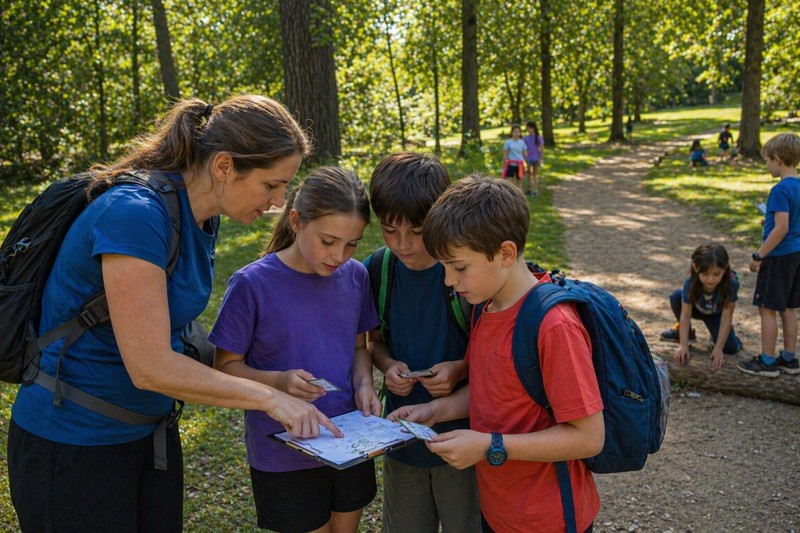
A: Divide kids into teams of 4–6. Use a station-based format where each team visits stations in a different order — this prevents bottlenecks. With printable kits, you can print multiple copies of each clue set for each team. One PDF purchase = unlimited teams. Rotate teams through stations every 10 minutes, and supervise each station with an adult. After 60–90 minutes, all teams complete the hunt at the same time with no waiting.
Q: What’s the best scavenger hunt format for 30+ kids?
A: Station rotation. Set up 6–8 stations around your space (gym, school, backyard, park). Each station has a 10-minute activity (solve riddles, find hidden items, physical challenges, etc.). Teams start at different stations and rotate every 10 minutes. After 8 rotations, all teams have been to all stations and the hunt is complete. This keeps pace even, prevents crowding, and ensures every child stays engaged the entire time.
Q: Can you run a scavenger hunt with 100 kids?
A: Yes, absolutely. Divide 100 kids into 15–20 teams of 5–7 kids each. Use the station-based format with more supervisors (you’ll need 8–10 adults total). Have multiple copies of each station available if space allows, or run two separate hunts with 50 kids each at different times. The beauty of printable kits is that one purchase works for unlimited teams.
Q: How long should a large-group scavenger hunt last?
A: Plan for 60–90 minutes total including instructions, warm-up, the hunt itself, and wrap-up. If you use 8 stations with 10-minute rotations, the hunt itself takes 80 minutes. Add 10 minutes for setup/instructions and 10 minutes for celebration/treasure reveal = 100 minutes total.
Q: What if some kids are much slower than others?
A: Use timed station rotation so all teams move together. This way, speed doesn’t matter — everyone stays on pace. If a team finishes a station early, they do a bonus activity (draw, stretch, answer extra questions). If they’re still working when time’s up, they move anyway and can return to finish later if they want. This removes pressure and keeps energy high.
Q: Should large-group scavenger hunts be competitive or cooperative?
A: For groups under 20, competition (one team wins) can be fun. For 30+ kids, consider a cooperative format where all teams work toward a shared goal (finding the treasure together, earning points for their grade/classroom, etc.). This keeps every child feeling included, not like a loser. You can add point systems, leaderboards, or small prizes for all teams without creating resentment.
Running a Scavenger Hunt? Here’s Your Checklist
- Decide on format: Station-based (recommended for 30+ kids) or simultaneous (only if small group + wide-open space)
- Calculate team sizes: 4–6 kids per team is ideal
- Choose or create clue kit: Printable, DIY, or pre-printed
- Scout your location: Identify 6–8 stations, note hazards
- Recruit supervisors: One adult per station minimum
- Print materials: Clue sheets, team assignments, station cards
- Test the hunt: Walk through one station yourself to catch issues
- Set a timer: Use a bell, whistle, or phone alarm for rotations
- Run the hunt: Explain rules, send teams to starting stations, ring bell every 10 min
- Celebrate: Announce results, hand out certificates, debrief
One Kit. Unlimited Players. One Purchase.
Print as many copies as you need. Works for 20 kids or 100 — same $14.99 price.
Instant Download · Print Unlimited Copies · 4.8/5 from 323+ Reviews
Browse Hunt Kits →

“We used your station-based format for our school field day with 120 kids across 3 grades. Everyone stayed engaged, no one got hurt, and we actually finished on time. The parents loved it. I’m using the same setup next year.”
Scale It to Any Size Group

One printable kit works for 5 kids or 500 — same price, unlimited reprints.
Browse All Hunt Kits →Starting at $14.99 · Instant download · Print at home · Unlimited reprints
Related Reading
- Classroom Scavenger Hunt Guide — Educational hunts for schools
- Outdoor Scavenger Hunt Ideas — Use parks and nature for hunts
- Birthday Party Scavenger Hunt — Theme ideas and celebration tips
- Scavenger Hunt for Kids — Age-appropriate challenges