
Blog
Scavenger Hunt for 7 and 8 Year Olds: The Perfect Age for Real Adventures

Scavenger Hunt for 7 and 8 Year Olds: The Perfect Age for Real Adventures
Arne · 23 min read · Published: May 27, 2026
Ages 7 and 8 are magical years for scavenger hunts for 7 year olds. Kids at this age can read independently, follow multi-step clues, solve simple riddles, and sustain focus for 45 minutes to an hour. They’ve outgrown the purely physical hide-and-seek style hunts and are now capable of handling real mystery-solving. This is the sweet spot where a well-designed scavenger hunt becomes unforgettable—challenging enough to feel genuinely exciting, but not so complex that frustration kills the fun.

Whether you’re planning a birthday party, a rainy-day activity, or a family adventure in the backyard, this guide covers everything you need to design and run scavenger hunts that will keep 7 and 8 year olds engaged, laughing, and coming back for more.
Why Ages 7–8 Is the Sweet Spot for Scavenger Hunts
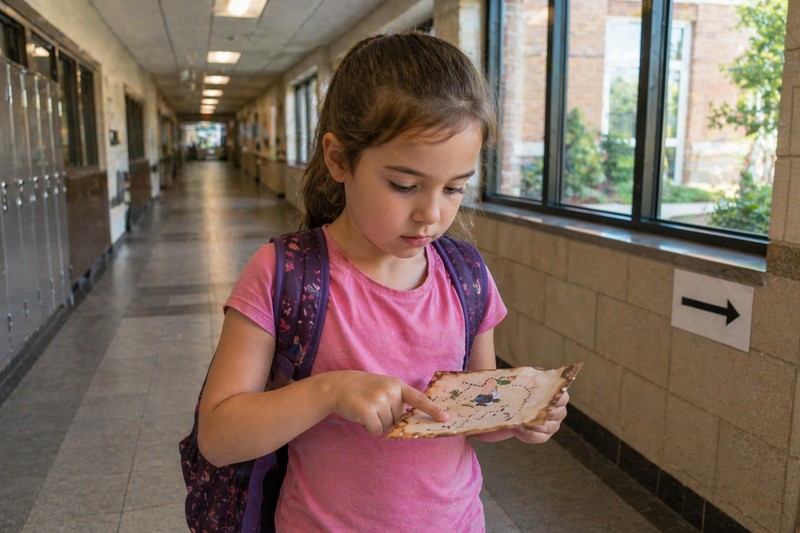
Between ages 6 and 9, something shifts in how children play and solve problems. At 5 or 6, many kids need physical movement and very direct instructions. By 10 or 11, they want complexity and narrative depth. But at 7 and 8? That’s when the balance tips.
This age group is developing what child psychologists call “concrete operational thinking”—they can understand rules, follow a sequence of steps, and work toward a multi-part goal. They love being the detective, the adventurer, or the treasure-seeker. They want to feel grown-up and capable, but they still get excited about simple rewards (stickers, small toys, coins) and silly humor.
From our experience running hundreds of hunts with this age, we’ve noticed something consistent: kids at 7–8 are incredibly motivated by agency. They don’t want to be told where to go; they want to figure it out. A well-designed clue makes them feel smart. And when they solve it? That surge of “I did it!” is visible on their face.
The practical reality is also in your favor. By 7, most kids can read at a level that allows for 3–5 word clues and short sentences. They can handle basic spatial reasoning (“under something red”) and simple wordplay (“What do you call a sleeping bull? A dozer”). And crucially, they’ll stay on task for 45 minutes to an hour without losing interest—long enough for a real adventure, short enough that energy doesn’t completely crash.
What 7 and 8 Year Olds Can Handle (Developmentally)
Understanding what’s developmentally appropriate is key to designing hunts that work. Here’s what our testing with real families shows:
Reading & Comprehension
By age 7, most kids are solid independent readers (think chapter books like Junie B. Jones or early Diary of a Wimpy Kid). They can handle:
- Clues with 10–20 words
- Simple rhymes and wordplay
- Straightforward instructions like “Find the clue under the couch cushion”
- References to familiar objects and routines
By age 8, reading gets more confident. Kids can follow longer clues, understand puns, and handle more complex language. The sweet spot for 8 year olds is clues with a bit of personality and humor built in.
Logic & Problem-Solving
At 7–8, kids are beginning to think in sequences and can handle cause-and-effect. They can solve:
- Simple riddles (“I have a face and two hands but no arms or legs. What am I?” = a clock)
- Picture codes (matching pictures to letters or numbers)
- Basic anagrams (rearranging letter tiles, especially with only 3–5 letters)
- Finding patterns (“What comes next: red, blue, red, blue, ___?”)
- Simple ciphers if you show them the key (like a number-to-letter grid)
What’s crucial: they need to understand the “rule” immediately. A cipher that requires remembering how it works across multiple clues will frustrate most 7 year olds. Stick to one puzzle type per clue.
Physical Capability & Range
At this age, kids are coordinated and energetic. They can:
- Climb (carefully supervised) to retrieve items from higher shelves
- Search through drawers and under cushions independently
- Navigate multiple rooms or even a yard
- Carry a clipboard or collection bag for the full duration of a hunt
However, they’re still not immune to fatigue. A hunt with 12 stations should take 45–60 minutes. Anything longer, and energy drops. Also, avoid anything requiring tools or heavy lifting; if it’s too difficult to access, they’ll get frustrated.
Attention & Focus
Most 7–8 year olds can sustain focus on a fun activity for 45 minutes to an hour. This is roughly the length of a TV episode or a school period, and they’ve built tolerance for that. However:
- If you string together 15+ clues with long walking distances between them, attention will wane
- A “reward station” (like a snack break or small prize reveal) halfway through helps reset focus
- Variety in clue types keeps engagement high (riddle, then picture code, then physical search, then simple math)
Social & Emotional Considerations
At 7–8, kids are starting to worry about being wrong or doing something “babyish.” This means:
- Make sure clues are challenging enough to feel smart, but not so hard that the hunt stalls
- If running a group hunt, balance solo problem-solving with teamwork moments
- Celebrate the hunt itself (the adventure, the atmosphere, the teamwork), not just the end treasure
- Avoid anything embarrassing or that singles out a child for struggling
30+ Clue Ideas for Ages 7–8
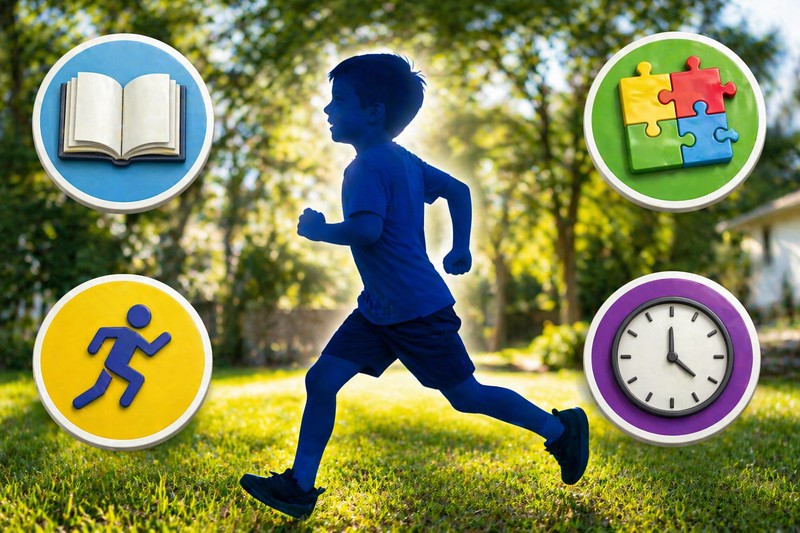
Here are proven clues and riddles that work beautifully for this age group. They strike the balance between challenging and solvable, and many can be adapted to your specific environment:
Classic Riddles
- “I have a face and two hands but no arms or legs. What am I?” Answer: A clock. (Look near the clock for your next clue.)
- “I have a tail but I’m not an animal. What am I?” Answer: A kite. (Check the place where you’d fly a kite.)
- “I get wetter while I’m drying. What am I?” Answer: A towel. (Search near the bathroom towel rack.)
- “What has a head and a tail but no body?” Answer: A coin. (Look in a piggy bank or coin jar.)
- “What has hands but cannot clap?” Answer: A clock or watch. (Check a timepiece.)
- “I have keys but no lock. What am I?” Answer: A piano or keyboard. (If you have these, place a clue there.)
- “What starts with ‘P’, ends with ‘E’, and has thousands of letters?” Answer: A post office or mailbox. (Leave a clue in or near the mailbox.)
- “What can run but never walks?” Answer: Water. (Hidden near a sink, bathtub, or hose.)
Directional & Visual Clues
- “Find something red and round.” (Vague on purpose; makes kids search.)
- “Look inside the one with the lid.” (Works with containers, boxes, drawers.)
- “Where does the family keep warm on a cold day?” Answer: Fireplace or heater area.
- “Find the place where we keep games and toys.” (Toybox, game closet, shelf.)
- “What’s the coldest place in the house?” Answer: The freezer. (Tape a clue inside a plastic bag and stick it on the freezer.)
- “Look under the thing you use to sit.” (Under a chair, couch, stool.)
- “Find the biggest door in the house.” (Often the front or garage door.)
- “Where do you sleep?” (Search the bedroom.)
Picture & Symbol Clues
- Draw a simple picture of a tree → “Find your next clue near this place.” Kids hunt for anything tree-related: backyard tree, tree-print pillow, plant.
- Draw a bathtub → “Your next clue is here.”
- Draw an apple → “Look in the kitchen where this grows.”
- Draw a bed → “Find the place where you sleep.”
- Draw a sun with rays → “Look outside in the sunny spot.”
- Draw a car → “Check the garage.”
Rhyming Clues
- “A place to rest your weary head, look here to find what’s underneath your bed.”
- “Something cold and sweet to munch, look here for your after-hunt lunch.” (Freezer or fridge.)
- “Where bubbles dance and water flows, that’s where your next clue goes.” (Bathtub or sink.)
- “Round and red, hangs from a tree, find your next clue by this sight you see.” (An apple or picture of a tree; works in kitchen.)
- “Jump and hop and have a ball, find your next clue by the tallest wall.” (Outside or near a wall in the house.)
- “Open me up and look inside, that’s where your next clue hides.” (Refrigerator, closet, mailbox.)
Math & Logic Clues
- “2 + 3 = ___. Find the clue in the room number that matches the answer.” (Room 5.)
- “Count the legs on a chair. Now count that many steps forward. Your clue is there.”
- “What’s 10 – 6? Go to bedroom ___ for your next clue.” (Bedroom 4.)
- “A cat has 4 legs. A spider has 8. If you put them together, how many is that? Go to room ___.” (Room 12.)
Word Clues & Wordplay
- “What do you call a sleeping bull?” Answer: A dozer. “Look in the garage where we keep the ___.”
- “What’s the opposite of ‘hot’? Go to the ___.” (Kitchen fridge, bathroom, etc.)
- “A __ is something you wear on your foot.” (Shoe. “Look inside a shoe.)”
- “STOP is to red light as GO is to ___ light.” (Green. “Look for something green.”)
Combination Clues (Physical Search + Riddle)
- “Find something you eat with a spoon. Your next clue is hidden there.” (Cereal box, yogurt container, etc.)
- “Find something that plugs into the wall. Look behind it for your clue.” (Lamp, microwave, etc.)
- “Go to the room with the bathtub. Inside, find something that floats.” (Rubber ducky, etc.)
- “Find the place where we keep our shoes. Look inside the biggest one.”
Scavenger Hunt Integration Clues
If you’re doing a themed hunt, tie clues to the theme:
- Detective theme: “The suspect hid the treasure in the room with the most books. Check there.”
- Pirate theme: “Yo-ho-ho! Find the place where we keep shiny things. (Kitchen: utensil drawer, pans, or a mirror.)”
- Jungle explorer theme: “Find the greenest thing in the house. (A plant.)”
- Space theme: “Go to the room that’s the highest up in the house. (Upstairs, attic, or tallest shelf.)”
Best Themes for 7 and 8 Year Old Hunts
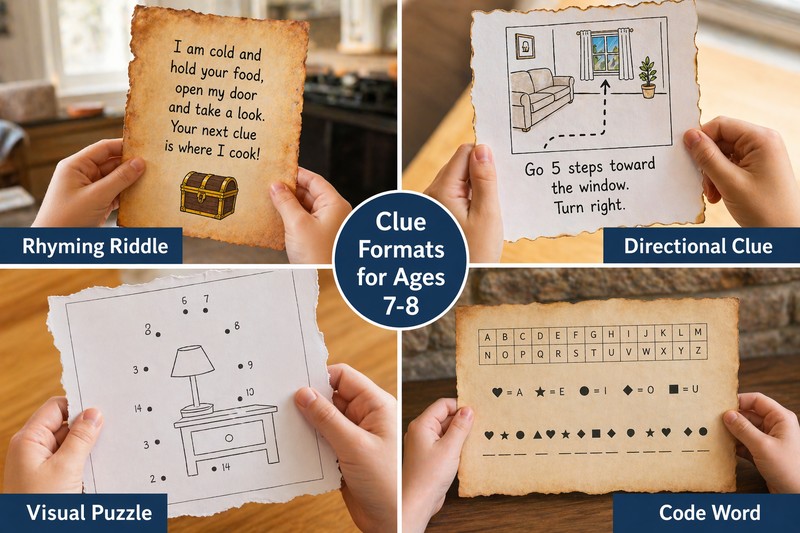
Themes add atmosphere and excitement. Here are the ones that resonate most with this age group:
Detective Mystery
Kids love feeling like a detective or investigator. The setup: a “crime” (missing treasure, stolen item, mystery to solve), clues scattered around, and the “detective” must piece it together to catch the culprit or find the treasure. This works brilliantly because it gives purpose to the hunt.
Example: “The museum’s ruby has been stolen! Detective, you must follow the thief’s trail of clues to recover it before midnight.”
Why it works: Kids get to feel smart and capable. Riddles and logic puzzles fit naturally. The narrative keeps energy high.
Pirate Treasure Hunt
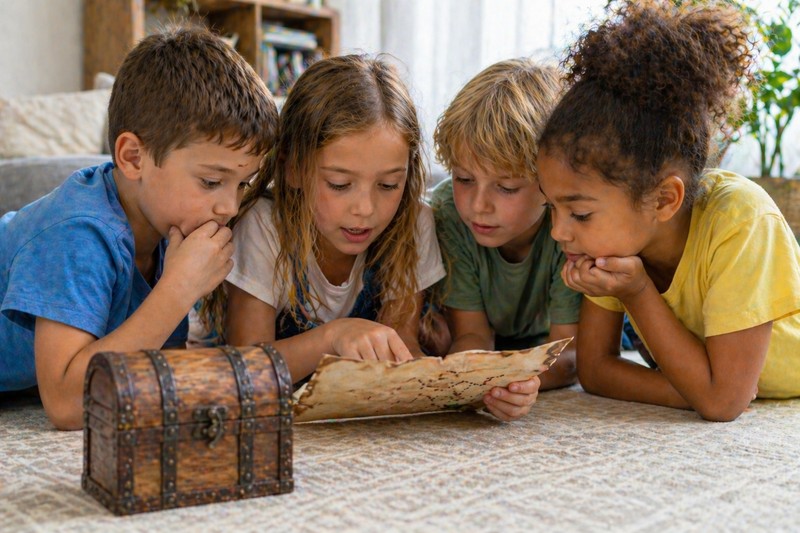
Classic, timeless, and kids this age still love the pirate aesthetic. X marks the spot, buried treasure, maps—it all feels adventurous without being babyish.
Example: “Ahoy, mateys! The legendary pirate Captain Kiddos buried treasure somewhere in the [house/yard/neighborhood]. Follow the map and clues to dig it up.”
Why it works: Physical search + imagination + a clear goal (find the treasure). You can hand out a hand-drawn or printed map at the start.
Jungle or Safari Explorer
Similar to pirates but with a nature angle. Kids “explore” the house or yard as if it’s a jungle, finding “exotic creatures” (toys, pictures) or collecting “specimens.”
Example: “You’re a wildlife explorer. Find the five animals hidden in the jungle (the house) and collect clues from each one. The final clue reveals where the treasure awaits.”
Why it works: Combines search with learning. Works great with pictures of animals or stuffed toys as waypoints.
Birthday Party Quest
A general adventure theme without specific pirate/detective overlay. Clues lead to different rooms or stations, each with a small challenge or reward.
Example: “Your birthday adventure begins! Visit each room, solve the challenge, collect a piece of the map, and at the end, you’ll find the grand treasure.”
Why it works: Flexible. Lets kids stay engaged throughout a party. Each station can have a different activity (solve a riddle, answer a trivia question, play a quick game).
Spy Mission / Secret Agent
Kids this age often love the idea of being spies or secret agents. The hunt becomes a “covert mission.”
Example: “Agent, your mission: Retrieve the classified documents hidden in the safe house. Your spy watch (a printed clue card) contains the coordinates. Good luck—and don’t get caught!”
Why it works: Feels grown-up and cool. You can add props (sunglasses, a “mission briefing” card, walkie-talkies if you have them).
Haunted House / Ghost Hunt (October/Seasonal)
For a spookier hunt (without being too scary), a ghost or haunted-house theme adds atmosphere. Clues come from “friendly ghosts” or “clues left by a mysterious visitor.”
Example: “The friendly ghost left clues throughout the house. Find them all to unlock the treasure before the clock strikes midnight.”
Why it works: Adds a layer of suspense and fun. You can dim lights slightly or use Halloween decorations. Still fun for kids who aren’t into scary stuff.
Around-the-World Adventure
Each room or station represents a different country or location. Kids “travel” through their house visiting Paris, Egypt, Japan, etc., solving location-specific puzzles.
Example: “You’re a world traveler. Visit each country’s station (marked on your passport). Collect a stamp by solving the clue, and once you’ve visited all 5 countries, you’ll discover the treasure.”
Why it works: Educational element (kids learn flags, landmarks). Gives clear progression. Easy to customize for a group hunt.
Birthday Party Scavenger Hunt for This Age Group
If you’re hosting a birthday party for a 7 or 8 year old, a scavenger hunt is one of the best ways to keep everyone engaged and happy. Here’s how to run one effectively:
Duration & Timing
For a full birthday party, plan 45–60 minutes for the hunt itself. If you have 1–2 kids, this is the main event. If you have a group (4–8 kids), the hunt fills a natural chunk of party time and gives kids something structured to do.
Pro tip: Schedule the hunt 30–45 minutes into the party, after kids have arrived and settled. This gives them time to eat a snack and cool down from the initial excitement, so they can focus.
Group vs. Solo Hunt
For 1–2 kids: A solo hunt works beautifully. They get to be the star and solve clues independently or with a parent following along.
For a group (3+ kids): Consider these options:
- One team hunt: All kids solve clues together, moving as a group. Great for 4–6 kids. Everyone shares the excitement.
- Two teams: Split into two groups, each following a slightly different path (or the same path in sequence). Add a light competitive element (“First team to the treasure gets the first pick of the prize pile”). Works for 6+ kids.
- Individual hunts with same treasure: Each kid gets a personal set of clues, but everyone ends at the same treasure location. Each solves independently; all celebrate together. Best for 8+ kids.
Setting Up the Treasure**
The final treasure should be:
- Age-appropriate: Small toys ($1–2 each), stickers, bookmarks, coins, or small candy.
- Quantity: One prize per child. Even if they’re hunting together, make sure everyone goes home with something.
- Visible but not obvious: Hidden well enough to be exciting to find, but not so hidden that they’ll miss it after 5 minutes of searching.
- Thematic: If running a pirate hunt, the “treasure” might be gold coins (chocolate coins work!) and jewels (plastic or painted rocks). A detective hunt might end with a “solved case file” and badges for each child.
Prize Alternatives**
If you’re not doing physical prizes, the “treasure” could be:
- A note revealing a surprise activity (ice cream, movie, game time)
- A code that unlocks a door or box with cake/treats inside
- A certificate naming them “Honorary Detective” or “Pirate Captain”
- Access to a special game or activity reserved for the end of the party
Difficulty Calibration for a Group
If you have mixed ages or abilities in your group:
- Make clues accessible to the youngest/least experienced, but add depth for older kids (e.g., a riddle with a hint available).
- Have one or two adults or older siblings stationed at tricky clues to provide hints if needed.
- Use a mix of clue types so everyone can solve at least some clues independently.
Backup Plans
Bad weather, a clue lost, or unexpected chaos? Have a backup:
- Keep one clue hidden as a “wildcard” in case you need to skip a step.
- If running the hunt outside and it rains, have an alternate “indoor” clue path ready.
- If a child is struggling significantly, have a “hint card” ready or move them to the next clue to keep momentum.
Difficulty Guide: What’s Just Right vs. Too Easy or Too Hard

The sweet spot for a 7–8 year old is a hunt where about 70% of clues are solved independently and 30% require a small hint or discussion. If kids solve every clue instantly, they’re bored. If they can’t solve most, they’re frustrated. Here’s how to gauge it:
Too Easy Clues (Signs Your Hunt is Underwhelming)
Example: “Go find something blue.”
Why it’s too easy: There’s no puzzle. It’s just a search. A 7 year old will find a blue object in 20 seconds and lose interest.
Example: “Your next clue is under the couch.”
Why it’s too easy: No thinking required. They’re just following a command.
Example: Clues using complex language they can’t read independently.
Why it’s too easy: Well, actually, this is too hard. But if all your clues require adult reading, kids don’t get the satisfaction of solving it themselves.
Signs you’re in “too easy” territory:
- Kids complete a clue in under 30 seconds
- They’re not talking about the puzzle or discussing the answer
- Enthusiasm visibly drops between clues
- They’re rushing through the hunt instead of savoring it
Just Right Clues (The Goldilocks Zone)
Example: “I have hands but cannot clap. Find your next clue near me.”
Why it’s just right: A simple riddle. Kids know the answer (or can figure it out in 30–60 seconds). It makes them feel smart. They run off to find the clock/watch with a sense of purpose.
Example: “Find the place where we keep our shoes. Look inside the one that’s the biggest. Your clue is there.”
Why it’s just right: Two-step instruction. Step one: find the shoe area. Step two: identify the biggest shoe. They can do both without help, but there’s enough logic to feel like they’re solving something.
Example: “The next clue is hidden in the room where you eat breakfast. Look on the highest shelf.”
Why it’s just right: They know where they eat breakfast. Looking on the highest shelf adds a small challenge (maybe they need to stretch or ask for help, which is fine). It’s not too vague, but it’s not spelled out either.
Signs you’re in the “just right” zone:
- Kids pause to think for 30–90 seconds
- You see “aha!” moments when they figure it out
- They solve 70–80% of clues without help
- Their energy remains consistently high
- They’re talking and laughing throughout
- They move quickly between clues but aren’t rushing
Too Hard Clues (Frustration Territory)
Example: “What’s a 5-letter word that rhymes with ‘bat’ and means a tool used in baseball?”
Why it’s too hard: At 7–8, wordplay this complex is tough. The answer is “bat,” but they might not see the connection quickly. They’ll get frustrated.
Example: A cipher that requires remembering a key across multiple clues.
Why it’s too hard: 7 year olds can’t reliably hold that much information in working memory while solving a puzzle.
Example: “Find the next clue in a place associated with the 4th letter of the alphabet.”
Why it’s too hard: This requires alphabet knowledge + spatial reasoning + object association. Too many steps.
Example: A riddle with an obscure or trick answer they wouldn’t know.**
Example: “I am always coming but never arrive. What am I?” (Answer: Tomorrow.)
Why it’s too hard: The wordplay is too abstract. They’ll guess randomly and feel defeated.
Signs you’re in “too hard” territory:**
- Kids give up after 2–3 guesses and ask for the answer
- You see visible frustration or tears
- They skip clues or lose motivation
- They’re asking “Is this right?” constantly (seeking reassurance)
- Energy drops noticeably; they stop engaging
How to Adjust in Real Time
If you’re running a hunt and realize a clue is too hard, you have options:
- Provide a hint: “Think of something you use to tell time” (for the clock riddle).
- Offer a choice: “Is the answer A) a clock, B) a car, or C) a door?” This keeps them solving (choosing) without giving up.
- Move them along: “That’s tricky. Here’s a hint that’ll help: it’s something cold in the kitchen.” If they’re still stuck in 2 minutes, move them forward with a smile.
- Revisit the clue later: Come back to it after they’ve solved other easier ones. Sometimes context helps.
The goal isn’t perfection; it’s enjoyment. A hunt where they need one or two hints is better than one that’s 100% independent but less fun.
Detective & Pirate Hunt Kits — Ages 6–9
Designed for exactly this age — readable clues, solvable riddles, 60-minute adventures.
Instant Download · Print at Home · 4.8/5 from 323+ Reviews
Browse Ages 6–9 Kits →
“We did the Detective Hunt for my daughter’s 8th birthday with four kids. I was worried it might be too easy or too hard, but the clues were perfectly calibrated. Each kid solved most of them independently, but when someone got stuck, there was just enough in the wording to give them the ‘aha’ moment without me actually saying the answer. The kids were chattering and laughing the whole time. Best party activity we’ve done. Two other parents have already asked me which kit we used!”
Frequently Asked Questions

Q: What is a good scavenger hunt for 7-year-olds?
A: At 7, kids can read clues independently and solve simple riddles. Great hunts for this age include detective mystery hunts, pirate treasure hunts, and adventure themes with 8–12 stations. They can handle code-breaking if it’s simple (like a picture code or numbered alphabet). Look for clues that feel like puzzles—not just “find something blue,” but “Find the place where we keep our shoes. Look inside the biggest one.” The hunt should take 45–60 minutes. A quality birthday scavenger hunt at this age balances independence with just enough challenge to feel exciting.
Q: How many clues should a scavenger hunt for a 7-year-old have?
A: 8–12 clues is ideal for ages 7–8. Enough to make it feel like a real adventure, but not so many that energy drops at the end. If each clue involves 5–10 minutes of thinking and traveling, you’re looking at 45–120 minutes total. For a single child or a small group, aim for the higher end. For a large birthday party group, 8–10 clues keeps things moving and prevents restlessness. Remember, a hunt with 20 clues and short distances between them can feel tedious. A hunt with 10 clues spaced thoughtfully throughout the house or yard feels epic.
Q: Can a 7-year-old run a scavenger hunt for other kids?
A: With adult supervision, yes! Many 7 year olds love the idea of being “the hunt master.” However, they’ll need help planning and hiding clues beforehand. They might also need a reminder to give hints rather than just the answers. It’s a great way to build leadership and creativity.
Q: What if my child solves all the clues too quickly?
A: If clues are being solved in under 30 seconds each, they’re too easy. Next time, add a layer of complexity: instead of “Find the kitchen,” try “Find the place where we keep cold things. Your clue is on the second shelf.” You can also introduce code-breaking, simple math riddles, or a themed narrative that requires reading and understanding a story. Another option: add physical challenges between clues (run to the tree and back, hop 10 times, etc.) to extend the hunt and increase engagement.
Q: Is a scavenger hunt good for teaching?
A: Absolutely. Hunts naturally teach problem-solving, reading comprehension, spatial reasoning, and persistence. If you incorporate themes (jungle explorer, world travel), kids learn about different places and cultures. Math-based clues reinforce addition and subtraction. Hidden history or science facts in clues make learning feel like a game. The key is weaving educational content into clues so it feels like fun, not schoolwork. This is one reason scavenger hunts for tweens and younger kids are so effective—they’re engaging enough that kids forget they’re learning.
Q: How do I make a scavenger hunt less scary for anxious kids?
A: Start with safe, well-lit spaces (avoid dark basements or overly hidden areas). Give them a map or a parent/buddy to follow along. Make clues straightforward rather than spooky. Use bright stickers or markers to highlight starting locations. You can also theme the hunt as a “treasure search” rather than a “mystery hunt”—it feels less ominous. Check in frequently and celebrate progress. An anxious child often just needs reassurance that they’re doing great.
Q: What are good rewards for the end of a scavenger hunt?
A: At this age, small trinkets and treats work well: stickers, bookmarks, small toys ($1–2), coins, or candy. Some families skip physical prizes and instead reveal a surprise activity—ice cream, a movie, or extra playtime. For a birthday party, you might give each child a small “treasure” (even if hunting together) so everyone leaves happy. Avoid prizes that create major inequities; a $5 toy given to one kid and a $0.50 sticker to another will cause hurt feelings.
Q: Can I adapt a scavenger hunt for a small apartment?
A: Yes! A smaller space just means a shorter hunt. Instead of 12 clues, use 6–8 and space them across different rooms. Hide clues in unexpected places within the same room (on top of the door frame, behind a curtain, inside a pillow case). You can also use vertical space: shelves, window sills, closet tops. Or expand outdoors: a small patio, balcony, or nearby park. The key is maintaining variety in clue locations so it doesn’t feel repetitive.
Q: Should I use the same clues for multiple hunts?
A: You can, but kids often remember the answers. If running a second hunt for the same child, change the locations or update the answers. If you’re using the same hunt for different groups (like a template), it works fine. Many families save hunts and reuse them the following year with younger siblings. The novelty of the hunt (the experience, the adventure) matters more to kids than having brand-new clues each time.
Q: What’s the difference between a scavenger hunt for kids and a scavenger hunt for toddlers?
A: Toddlers (ages 2–4) need short, very simple hunts with visual clues (pictures, bright colors) and quick rewards. Hunts for 5–6 year olds add some reading and slightly more complex hiding. At 7–8, hunts introduce riddles, multi-step clues, and longer durations. By the time kids hit tweens (9–11), they can handle elaborate themes, codes, and hours-long adventures. Each age has different cognitive abilities and attention spans.
Give Them an Adventure Built for Their Age
Kits calibrated for 7–8 year old reading level and attention span.
Browse Ages 6–9 Kits →Starting at $14.99 · Instant download · Print at home · Unlimited reprints

