

Blog
Detective Birthday Party: Complete Host Guide + Free Mystery Kit (Ages 6-12)

Last updated: May 2026 | Reading time: 17 min | Complete planning timeline, 12 games, decorations, food, FAQ & free Host Kit PDF
This guide is based on five years of designing detective scavenger hunts for families and testing them at dozens of real birthday parties. Every recommendation has been validated with kids aged 6–12.
A detective birthday party isn’t just another kids’ party theme — it’s an experience that turns a living room, backyard, or classroom into an investigation headquarters where children become the heroes of their own mystery. Over the past five years of designing detective scavenger hunts for families, I’ve seen how the right mystery can capture kids’ imagination for hours, keeping them engaged, thinking critically, and having genuine fun without screens.

The beauty of a detective party is that it works for mixed ages, it scales from intimate gatherings to larger groups, and it doesn’t require fancy hired entertainment or elaborate props. What it does require is a clear plan, a compelling mystery, and some thoughtful touches that make kids feel like real investigators.
This guide walks you through everything — from the moment you send invitations to the final “case closed” celebration. Whether you’re planning your first detective party or refining your approach, you’ll find practical, tested strategies that actually work with real kids.
📥 Download the Free Detective Birthday Host Kit PDF (Ages 6–12) →
5-Minute Detective Party Quick Setup
You have one evening to pull this together. Here is the absolute minimum that still gives you a real detective party, without buying any specialty supplies.
- Print 8 clue cards from the free Host Kit PDF (or write them on index cards). Each card points to the next location.
- Hide them in order. Start at the front door; end at the cake table or treasure box. Walk the route once to confirm flow.
- Set up Detective Headquarters. One table with a clipboard, two magnifying glasses (dollar store), a suspect-list printout, and a roll of black-and-yellow tape across one doorway.
- Make detective badges. Paper circles, kids’ names in marker, safety pins. Hand out as guests arrive.
- Mission briefing (30 seconds). “The birthday crown has vanished. You are the detectives. Start at the front door. Solve all 8 clues and recover the crown before cake time.”
That’s it. 5 minutes of setup, 60 minutes of party. Everything below extends and polishes — but this minimum version has worked at every party we’ve tested it at.
Why Detective Parties Are Having a Moment (And Deserve to)

Detective-themed parties have exploded in popularity over the last few years, and there’s good reason. In a world where kids spend significant time consuming content passively, a detective party asks them to do something rare: think actively, collaborate, and solve problems in a physical space with their peers.
The detective theme works because it’s inherently interactive. Unlike a superhero party where kids wear costumes and observe, or a princess party with passive entertainment, a detective party puts children in the driver’s seat. They have agency. They’re not watching a story unfold — they’re unfolding it themselves. This psychological shift is powerful.
There’s also the element of mystery and secrecy, which appeals to kids aged 6 through 12. Puzzles, codes, hidden clues, and the satisfaction of “solving” something feels sophisticated and grown-up to children, which is deeply appealing. Parents appreciate it too, because detective parties encourage critical thinking, teamwork, and problem-solving in a format that feels like pure play.
From a practical standpoint, detective parties are remarkably flexible. You don’t need to hire a professional actor or event planner. You don’t need elaborate set pieces or costly decorations. The mystery itself — the story, the clues, the investigation — is the main attraction. Everything else enhances it, but doesn’t make or break the party.
Detective Birthday Party: Theme, Decorations & Setting the Scene
The setting of your detective party matters more than budget. You’re aiming to create an atmosphere where kids feel like they’ve stepped into a mystery. This doesn’t mean expensive decorations; it means intentional choices that reinforce the detective theme.
Color Palette: Stick to classic detective colors: black, white, gray, and deep red or burgundy. These colors feel sophisticated and mysterious without being dark or scary. Use black and white striped police tape across doorways or around the investigation HQ. Scatter red string between clue locations to suggest “connecting the dots.” This visual language cues kids that something mysterious is happening.
The Investigation HQ: Designate one space as the official detective headquarters — typically where kids gather before the mystery begins. This can be a dining table, a cardboard “office” you’ve set up, or simply a section of the room marked with tape and a sign that reads “Detective Headquarters.” On the table, scatter items that suggest investigation: a magnifying glass or two (dollar store), a clipboard with a case file, wanted posters, evidence bags (sandwich bags), a suspect list, and a mission briefing sheet. Kids naturally gravitate toward these props and start getting into character.
Clue Stations: If your mystery involves finding hidden clues (which most do), mark each location subtly. A small flag, a piece of colored tape, or a number can indicate where something is waiting to be discovered. Some parents use glow sticks or neon tape if it’s an evening party or darker environment.
Music & Ambiance: Play instrumental detective or spy thriller music in the background — think classic film noir or heist movie soundtracks. This costs nothing if you use YouTube, and it dramatically shifts the atmosphere. Dim the lights slightly if it’s daytime by closing blinds, which adds to the mood without making it uncomfortably dark.
Suspect Display: Create a simple poster or whiteboard that lists the suspects in your mystery — maybe “Detective Daisy,” “Officer Ollie,” or “Burglar Betty” — with a brief description or silly illustration of each. Kids love having a visual reference, and it makes the mystery feel like a real case they’re investigating.
The Core Activity: Running a Mystery Scavenger Hunt

The centerpiece of most detective parties is a mystery that kids solve by finding clues, usually in a scavenger hunt format. This is where your detective party truly lives or dies. A strong mystery keeps kids invested for the entire party; a weak one falls apart after 20 minutes.
The anatomy of a working detective mystery for kids is straightforward: a simple crime scenario, a small set of suspects, clues that lead logically from one to the next, and a satisfying reveal. Common scenarios include a stolen jewel, a missing person, a code that needs cracking, or a treasure that’s gone missing.
The Crime Scenario: Describe the “crime” in a way that’s engaging but not frightening. “The birthday child’s prized crown has been stolen” works perfectly. “A mysterious code message arrived by mail” creates intrigue. “The birthday treasure has vanished” is simple and classic. The key is that the scenario should matter to the kids — it should feel like something they care about solving.
Clue Design: Each clue should point to the next location or the next step. If you’re using a birthday scavenger hunt guide, this structure is built in. But if you’re creating your own, follow this pattern: Kids find clue #1 (hidden in a specific location). Clue #1 tells them where to find clue #2 (“Look where you eat breakfast”). Clue #2 points to clue #3, and so on, until they reach the final revelation or prize location.
Difficulty Calibration: Match clue difficulty to the kids’ ages. For 6-8 year-olds, clues should be quite direct: “Find the next clue under the kitchen sink.” For 9-12 year-olds, you can introduce simple codes (number substitution), riddles, or UV-light-only messages. The satisfaction comes from solving something that’s challenging but achievable — never so hard that kids feel frustrated.
The Finale: Don’t let the mystery just end with finding the last clue. Have a conclusion. Maybe kids find the “stolen” item, unmask a suspect (in a funny way), or solve a final puzzle that confirms they’ve cracked the case. This gives closure and makes the whole experience feel complete. A detective scavenger hunt guide with a pre-built finale saves enormous time here.
Backup Plan: Have one or two extra clues hidden as backups in case kids find the main clues too quickly. Kids’ problem-solving speed is unpredictable; it’s better to have material ready than to have 30 minutes of party left with nothing to do.
5 Detective Party Games Beyond the Scavenger Hunt
While the mystery scavenger hunt is the centerpiece, good detective parties include other activities that maintain the theme and keep the energy up during transitions or downtime.
1. Suspect Interrogation Game: Assign one child (or an adult) as a suspect. The other kids have two minutes to ask yes-or-no questions to figure out if this person committed the “crime.” This works brilliantly as an icebreaker when kids first arrive and as a way to build investment in the mystery. Even shy kids usually participate because the format is low-pressure.
2. Code-Breaking Challenge: Present kids with a simple coded message and challenge them to crack it before the scavenger hunt begins. You might use number substitution (A=1, B=2) or a Caesar cipher. The message might be something like: “The first clue is hidden under the [coded] in the [coded].” This warms up their detective mindset and builds confidence.
3. Detective Training Course: Set up a mini obstacle course or a series of stations where kids train to become official detectives. Include: a magnifying glass station (find small hidden objects), a memory game (remember details from a crime scene photo shown for 10 seconds), a fingerprint station (kids make their own prints with washable ink and compare), and a disguise station (try on various hats and props). This is perfect if you want a more active party or if your mystery ends early.
4. Mystery Dinner (Age 9+): For older kids, combine the mystery with dinner. Each course is served with a clue. Kids eat, solve, move to the next location. This paces the party naturally and makes snack breaks feel integrated rather than separate.
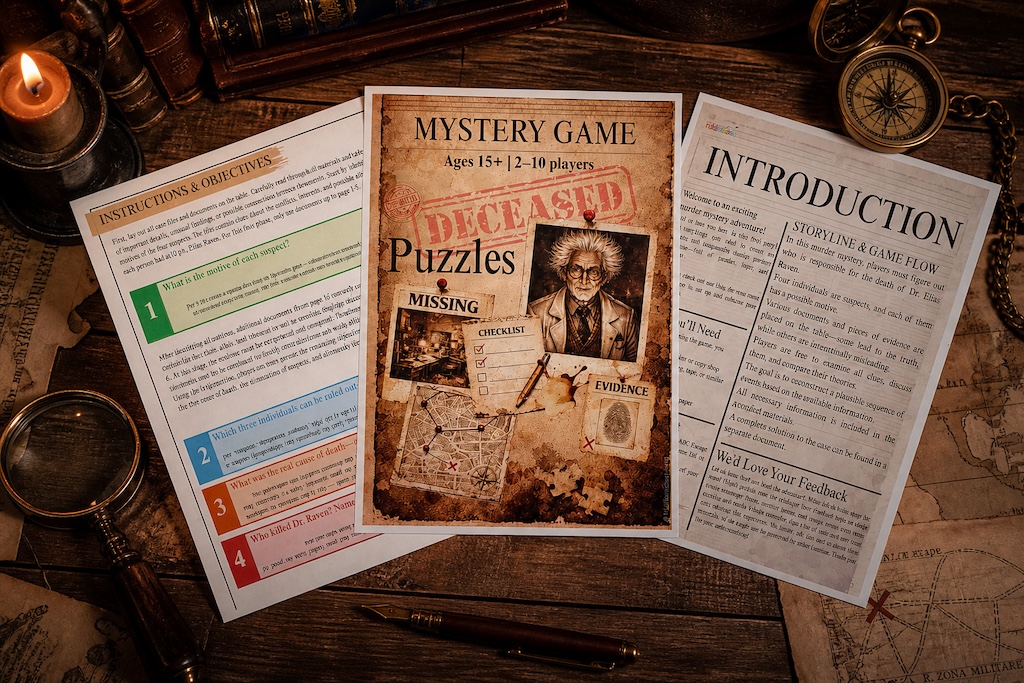
Want a ready-made mystery-dinner script?
Our Printable Murder Mystery Game includes character roles, plot reveals, and a host script — scaled for teens at a sleepover or the older-kids table.
5. Lineup Identification Game: Before the party, brief 3–5 adults (or older kids) to play suspects. Have kids individually meet each suspect for 30 seconds, learning details. Later, kids must identify suspects by description. This adds a fun interactive element and gives kids ownership of the investigation process. It’s similar to an escape room birthday party where multiple interactive elements create the full experience.
Detective Party Food Ideas (That Look Like Evidence)

Food at a detective party should be fun and thematic without requiring culinary expertise. The goal is to make normal party foods feel like they belong in a mystery investigation.
Evidence Snacks: Label simple snacks as “evidence.” A bowl of goldfish crackers becomes “Suspect’s Favorite Snack.” Pretzels are “Broken Evidence Sticks.” Apple slices are “Case Files (Red Alert).” Cheese cubes are “Golden Evidence Blocks.” This minimal labeling makes kids smile and keeps the theme alive during snack breaks.
Detective-Themed Treats: Serve foods that fit the theme without much work. “Magnifying Glass” cookies (round sugar cookies with a clear hard candy “lens” in the center), “Clue Card” sandwiches (cut into puzzle-piece shapes), “Suspect” cupcakes with detective hats made from fondant or paper. Or simply buy regular cupcakes and add a little magnifying glass topper from the dollar store.
The “Evidence Bag” Lunch: If your party runs through lunch, serve sandwiches or wraps in small paper bags labeled as “Evidence.” Kids eat directly from their evidence bag, which feels more fun than eating from a regular plate and maintains the theme.
Drinks with Names: Serve apple juice as “Suspect’s Red Herring Juice” and water as “Clear Case Clue Water.” A punch bowl labeled “Investigation Station” encourages self-service and keeps parents from being drink distributors.
The Culprit’s Cake: The birthday cake can be simple but thematically decorated. A sheet cake with a “Crime Scene” design (black and white stripes, a magnifying glass outline in icing), or a cake shaped like a question mark. Or keep it minimal: a regular cake with a magnifying glass or detective badge topper. The theme is in the presentation, not the complexity.
Dietary Flexibility: Have clear, non-themed snack options for kids with dietary restrictions. Label them simply and without fanfare. The goal is inclusion, not forcing every single food item into the detective theme.
Invitations: Turning the Party Invite into a Mission Briefing
The first opportunity to set the tone for your detective party comes before guests even arrive — in the invitation. A well-crafted invite sets expectations, builds excitement, and gets kids mentally prepared for the mystery ahead.
Physical vs. Digital: Detective party invitations work especially well as physical objects rather than emails. A printed card that looks like a case file or a “secret mission briefing” will be kept and reread by kids, building anticipation. If you must use digital invites, design them to look like official documents — a “Detective Agency Recruitment Letter” or “Confidential Mission Briefing.”
Format Ideas: Print invitations that mimic official paperwork. “Top Secret: Detective Needed for Party Investigation” at the top. Include the date, time, location (with a clue if it’s a rented space: “Meet at the warehouse at [address]”). Add a line like “Bring: Your detective mind, comfortable clothes for investigating, and a spirit of adventure.” Ask kids to come dressed in detective attire: trench coat, fedora, magnifying glass, or detective badge (which you can provide, even a paper badge).
What to Tell Parents: In the parent section of the invite, include brief details: “Children will participate in a mystery scavenger hunt that involves finding clues around [the space]. The game takes 60–90 minutes. Please dress your child in comfortable investigating clothes.” This sets expectations and prevents parents from sending kids in fancy clothes they can’t move in.
The Mystery Teaser: Include a small teaser about the mystery: “A crown has gone missing at the Detective Academy. Can you solve the case?” This primes kids and gets them thinking about the mystery before they arrive. It’s the difference between kids being surprised by a theme when they arrive (which can feel random) versus them being mentally prepared (which builds investment).
Customization for the Birthday Child: Mention the birthday child in the invitation in a special way. “Detective [Birthday Child’s Name] has asked for your help solving the mystery of [the case].” This makes it personal and shows that the party is about honoring them, not just running a generic activity.
What to Put in the Detective Party Goodie Bag

Goodie bags give kids something to take home and extend the detective party experience beyond the day itself. Keep the theme consistent and the prices reasonable.
Essential Items: A plastic or cardboard magnifying glass (dollar store), a small notepad for “case notes,” a pencil or pen with a detective badge. These cost 50–75 cents per item and are instantly recognizable as detective-themed.
Game & Puzzle Items: A small detective-themed puzzle book, a mini logic puzzle game, or a code-breaking workbook. These can be sourced inexpensively from party supply stores or Amazon. Kids who enjoyed the mystery scavenger hunt often love taking home more puzzles to solve at home.
Creative Supplies: Include ingredients for kids to make more detective games. A few sheets of cardstock, a stamp pad for making fingerprints, stickers of magnifying glasses or badges, and a printable “Create Your Own Mystery” template (which you provide as a PDF in the bag).
Sweet Treats: Add a small bag of candy or a chocolate bar labeled “Detective’s Fuel” or “Case-Closed Chocolate.” This doesn’t have to be elaborate — a few pieces of candy in a branded sticker-sealed bag feels special.
The Detective Badge: Include a personalized detective badge with the child’s name and the party date. You can print these on cardstock, laminate them, and attach a safety pin. Kids wear these proudly and remember the party every time they see them.
A Keepsake Photo or Card: Include a small printed photo from the party (if you took group photos) or a hand-written thank-you note from the birthday child. This personal touch transforms a goodie bag from a transaction into a memory.
Complete Timeline: Detective Party Plan from Invite to Finale

A detective party that runs smoothly requires planning, but not chaos. Here’s a realistic timeline for hosting one, whether it’s a 90-minute party at home or a 2-hour party at a rented space.
4 Weeks Before Party: Choose your mystery (design your own or use a printable kit). Finalize guest list. Send invitations. Start gathering supplies and thinking about decorations. Design any custom clues, codes, or suspect lists.
2 Weeks Before Party: Confirm RSVPs. Finalize the mystery details. Print all clues, case files, and mission briefing documents. Scout your party location and identify where clues will be hidden. Create a detailed map or checklist of clue locations so you don’t forget where you hid something. Prepare goodie bag contents.
1 Week Before Party: Double-check that you have all supplies (magnifying glasses, badges, evidence bags, decorative tape, mystery materials). Prepare any food that can be made ahead. Confirm adult helpers understand their roles (someone to manage the scavenger hunt, someone to supervise food, someone to handle the finale). Print backup copies of all mystery materials in case of spills or lost clues.
2 Days Before Party: Decorate the party space. Hide all clues in their designated locations. Walk through the entire mystery from start to finish to ensure it flows logically and that all clues are findable. This is crucial — a hidden clue that’s too hidden will kill the momentum.
Day of Party — 30 Minutes Before Start: Do a final walkthrough of clue locations. Set up the detective headquarters with case files, magnifying glasses, suspect lists, and initial briefing materials. Play background music. Make sure bathrooms are prepped. Greet early arrivals and give them something low-key to do (a code-breaking challenge or a magnifying glass scavenger task in the headquarters).
Party Start Time: Gather all kids. Welcome them as newly recruited detectives. Present the mystery scenario: “A crown has been stolen from the Detective Academy. The police need your help investigating. You have until [end time] to solve the case. Here’s your mission briefing.” Hand out the case file to each child or each team. Explain the rules: respect the space, work together, find clues in order, come back to headquarters when you’ve finished.
During the Scavenger Hunt (60–90 minutes depending on kids’ ages): Supervise loosely. Walk the hunt route periodically to ensure no one is stuck or lost. If kids are moving too quickly, gently slow them down by having them solve a puzzle before moving to the next clue. If they’re moving too slowly, offer a hint without revealing the answer. The goal is to keep momentum steady.
Finale (Final 15–20 minutes): When kids have solved the mystery and recovered the “stolen item” or identified the culprit, gather everyone back at detective headquarters for the finale. Announce: “The case is closed! Detective [names], you have successfully solved the mystery!” Hand out detective badges and goodie bags. Take a group photo. Cut cake. Let the celebration wind down naturally.
After Party: Send thank-you messages to parents. Include a photo or two from the party. Consider asking parents to share which part their child enjoyed most — this feedback is gold for your next party.
Skip the Planning — Print & Play in 15 Minutes
Three ready-made printable kits for every age and energy level. Each one includes the full story, clue cards, suspects, setup guide, and finale.

Instant Download · Print at Home · 4.8/5 from 323+ Reviews · Unlimited Reprints
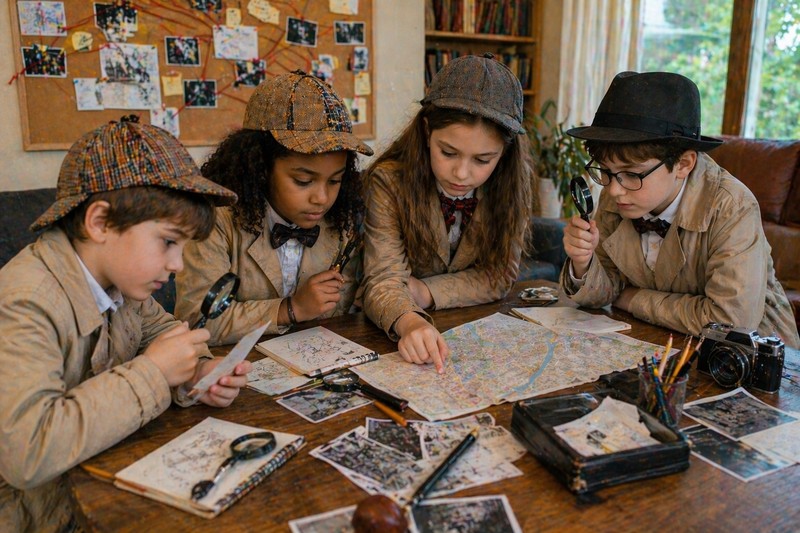

“I was nervous about hosting a detective party with eight kids in my house, but the kit made it so simple. I printed everything, hid the clues the night before, and the kids were completely absorbed for 90 minutes. Parents asked me what I did to keep them so engaged. Honestly, it was the mystery. They didn’t notice time passing.”
Frequently Asked Questions About Detective Birthday Parties
8 Mistakes First-Time Detective Party Hosts Make
- Mystery is too easy. If kids solve it in 10 minutes, you have 50 minutes of nothing left. Add at least one cipher or coded clue per 10 minutes of intended play.
- Mystery is too hard. The opposite kills it faster. Test the entire chain with one kid beforehand; if they cannot solve a clue in 3 minutes with one hint, simplify it.
- No backup clues. A clue gets lost, eaten, or torn. Print two spare clue cards for each station and have them in your pocket.
- Adults solving for the kids. Parents hover and blurt out answers. Give parents a job (snack station, photo duty) so they stop hovering near the hunt.
- Mixed-age teams with no balancing. A 6-year-old paired with a 12-year-old means the older child solves everything. Split into two age tiers and run parallel hunts.
- Forgetting the finale. Kids find the last clue, then… nothing. Always plan a 5-minute conclusion: unmask the culprit, recover the crown, hand out detective badges.
- Too much theming, too little structure. A perfectly decorated room with no clear sequence falls flat. Structure first (the mystery), decoration second.
- Skipping the test run. The host walks the entire hunt before guests arrive. Five minutes saves you the embarrassment of a missing clue mid-party.
Adapting the Detective Party for Different Ages
| Age | Clue type | Hunt length | Best mystery |
|---|---|---|---|
| 6–7 | Picture + simple sentence | 30 min | “Missing teddy” — kids find a stuffed animal hidden by clues |
| 8–9 | Rhyming riddles + 1 number cipher | 45 min | “Stolen crown” — recover the birthday crown with cake-time deadline |
| 10–11 | Caesar cipher, UV-ink message, observation tests | 60–75 min | “Cracked case” — identify which of 4 suspects committed the crime |
| 12+ | Multi-layer ciphers, fingerprint matching, witness interviews | 90 min | “Mystery dinner” — clues served with each course, killer revealed at dessert |
For more cipher and clue formats by age, our Caesar cipher guide and spy missions for kids guide both pair perfectly with this party theme.

For the 9–15 crowd: go full spy mission.
Our Spy Scavenger Hunt trades the birthday-crown story for a secret-agent recruitment mission — multi-layer ciphers, dossiers, and a full briefing kit.
Related Party Themes That Use the Same Setup
If the detective theme isn’t a perfect fit for your child, four other themes use almost identical infrastructure (clue cards + headquarters + finale):
- Birthday Scavenger Hunt — straight clue hunt, no mystery wrapper
- Murder Mystery Party — same detective skills, scaled up for ages 10+
- Spy Missions for Kids — espionage twist with ciphers and dossiers
- Scavenger Hunt for Kids (Pillar Guide) — 100+ ideas for any age
Beyond the Party: Detective Themes Year-Round

A detective party doesn’t have to be a one-time event. Kids who enjoy detective mysteries often want more of them. If your child has fallen in love with the detective theme, there are natural extensions.
You can run birthday games for kids with detective themes throughout the year. Host a detective game night for your child’s friends. Create indoor scavenger hunt ideas with mystery elements for rainy days. Use detective story elements for homework breaks or as rewards.
The skills that detective mysteries develop — observation, logic, collaboration, problem-solving — are exactly the skills that make learning fun. Parents I’ve talked to notice that kids who regularly solve mysteries become better readers, more patient with complex problems, and more willing to work together with peers.
A single detective birthday party often sparks an interest that lasts well beyond the party day.
Ready to Solve the Case?
Everything you need for an unforgettable detective party — print and play in 15 minutes.
Starting at $14.99 · Instant download · Print at home · Unlimited reprints

