

Blog
Teen Scavenger Hunt Ideas: Creative Missions for Ages 13–17

Teen Scavenger Hunt Ideas: Creative Missions for Ages 13–17
Arne · 15 min read · Published: May 29, 2026
Teenagers don’t want to hunt for plastic eggs or clues hidden in obvious places. If you’re looking for teen scavenger hunt ideas that actually hold their attention, you’re dealing with a different level entirely. At ages 13–17, they crave autonomy, social engagement, and challenges that respect their intelligence.

This guide covers eight proven formats for teen scavenger hunts — from photo missions that leverage their phones to mystery investigations that rival escape rooms. We’ve tested each one with real teen groups and tracked what keeps them genuinely engaged versus what makes them roll their eyes.
Planning a Teen Hunt: What Makes It Work (and What Kills It)

The most common mistake adults make? Designing “teen” hunts that are just scaled-up versions of hunts for 8-year-olds. Teenagers recognize patronization instantly, and it kills their investment.
What actually works with this age group:
- Independence. Teens want to solve problems without hand-holding. Vague clues frustrate them; overly explicit instructions bore them. The sweet spot? Clues that require actual deduction or knowledge to decode.
- Social dynamics. At 13–17, peer experience matters as much as the activity itself. Hunts that encourage teamwork, friendly competition, or funny moments create memories.
- Their skills and interests. Leverage what they’re already doing — photography, technology, music, trivia about pop culture. A clue that requires recognizing a lyric or finding an Easter egg on social media feels relevant, not forced.
- Real stakes or rewards. Bragging rights, prizes that appeal to teens (not toys), or the prestige of winning matter. Abstract “fun” alone isn’t usually enough.
- Respect for their time. A well-designed hunt should take 2–4 hours, not drag on all day. Teens have short windows before school, sports, or other commitments.
What kills engagement:
- Puzzles that are too easy (they solve it in 30 seconds, then wait bored)
- Clues that feel random or don’t make logical sense
- Activities that separate the group or exclude certain people
- Setups that scream “my parent made this” (cutesy wordplay, juvenile themes)
- Hunts that ignore safety or require them to do something genuinely risky or illegal
Best Teen Scavenger Hunt Formats
Not all hunts are created equal. The format you choose shapes the entire experience.
Linear vs. Non-Linear: Linear hunts follow a set path (Clue A → Clue B → Clue C). These work well for groups who need structure and for outdoor city hunts. Non-linear hunts let teams find clues in any order, which speeds up gameplay and works better for large groups or competitive formats.
Themed vs. Open-Ended: A themed hunt (spy mission, heist, apocalypse scenario) gives context and makes weird tasks feel purposeful. Open-ended hunts are simpler to design but rely more heavily on intrinsic puzzle appeal.
Timed vs. Untimed: Timed hunts add pressure and urgency, which teens often enjoy. Untimed hunts are less stressful and better for mixed-ability groups. The sweet spot is a hybrid: an overall time limit with optional speed bonuses.
Location-Based Considerations:
- Home or Small Venue: Perfect for birthday parties or small gatherings. Easier to hide items securely and monitor safety.
- School or Campus: Requires pre-approval but leverages familiar geography. Works well for team-building or end-of-year events.
- Outdoor City/Neighborhood: High impact and memorable, but requires careful planning around traffic, weather, and parental permission.
- Hybrid (Indoor + Outdoor): Gives variety and appeals to different preferences.
- Virtual/Fully Online: Necessary for remote groups but requires different puzzle types (screenshot challenges, Zoom components, online research).
Photo Scavenger Hunt for Teens: Creative and Social
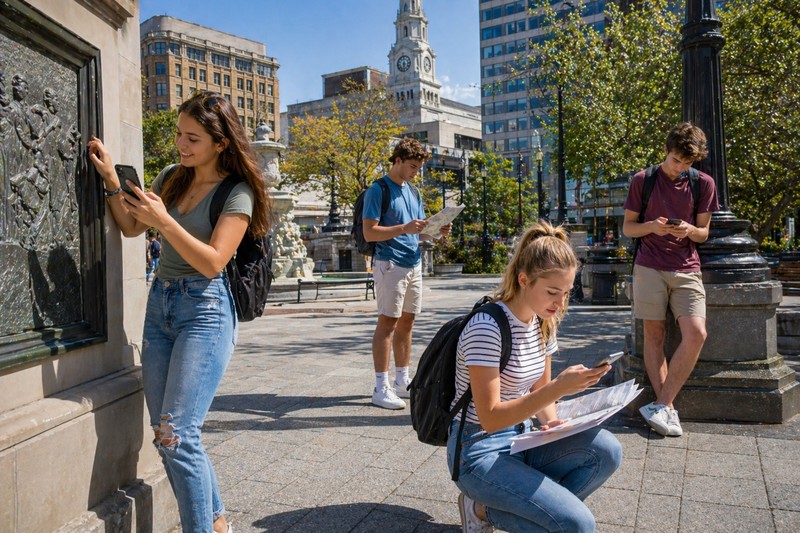
Photo hunts work brilliantly with teenagers because they’re already equipped with high-quality cameras (their phones) and they’re naturally inclined to document and share.
Why Photo Hunts Work for Teens: They combine competition with creativity. Instead of finding a physical item, teens photograph themselves or their environment completing a task or finding a specific location. The results are inherently social — they’re generating shareable content, which appeals to this age group.
Photo Hunt Prompt Ideas (20+ Specific Challenges):
- A selfie with an unusual shadow cast on your face
- Your group making the most dramatic “dramatic entrance” pose (think movie poster)
- A photo of something that’s exactly 3 feet tall (teams must measure)
- Proof you’ve visited 5 different storefronts in the downtown area
- A candid shot of a stranger (with permission) doing something interesting
- Your team spelling out a word using your bodies (aerial view required)
- A photo of the oldest visible business sign in your area
- Your group doing the “most ridiculous” pose in a public place (points for nerve)
- A photo of something simultaneously red AND blue
- Proof you’ve all tried something on a restaurant’s menu in 30 minutes or less
- A picture of the strangest street name you can find
- Your team recreating a scene from a movie/show (be specific)
- A close-up of a texture you’ve never photographed before
- A photo of your group at the exact coordinates you’re texted
- Proof you’ve made a new friend (photo with them)
- A picture of something that makes light interesting (reflection, refraction, shadows)
- Your team’s interpretation of the emotion “triumph”
- A photo from inside a building you’ve never been to before
- Evidence of a “before and after” moment (same location, different angle, 15 minutes apart)
- A selfie that includes 8+ people (requires strategy to fit everyone)
Game Mechanics for Photo Hunts: Teams submit photos via a shared link (Google Drive, Discord, or Instagram private story). You judge afterward based on creativity, proof of completion, and difficulty level. Award points not just for finding/doing the task but for creativity of execution. The best photo hunts balance “easy to understand” (so teams don’t waste time) with “hard to do creatively” (so it’s not boring).
Mystery Investigation Hunt: The Teen-Level Version
Mystery hunts treat the scavenger hunt like a detective story. Instead of “go find the red flag,” it’s “find evidence that the butler is lying about his alibi.” Teens love this format because it combines puzzle-solving with narrative.
Structure of a Mystery Investigation Hunt:
Start with a scenario: A theft, a missing person, a coded message, or a strange conspiracy. Teams are given an initial clue or briefing, then they hunt for evidence that either proves or disproves theories. The “locations” or “stations” contain clues embedded in characters, documents, or puzzles.
Example Setup: “Local historian claims a time capsule is hidden somewhere in the park. Three people have information about it, but all three are lying about some detail. Find the inconsistency in their stories, and you’ll know where to dig.” Teams might:
- Interview three NPCs (friends, parents, or hired actors) and record their testimony
- Cross-reference details with clues hidden around the park
- Piece together the true location of the capsule
- Solve one final puzzle to extract the “prize” (a letter, the next clue, evidence that solves the mystery)
Creating Mystery Depth: The power of mystery hunts is that the same location can hold multiple clues with different meanings depending on what you’re investigating. A photograph, a torn letter, a recording, or a physical object can all serve as evidence. Teenagers appreciate hunts where some clues are red herrings or require interpretation — it makes them feel like real detectives.
Difficulty Calibration: Mystery hunts can scale from straightforward (find 5 clues, match them to 5 suspects, eliminate the guilty party) to genuinely complex (decode a cipher, cross-reference timelines, spot a logical contradiction). For ages 13–17, aim for the middle-to-upper range. They’re capable of sophisticated thinking, but don’t make the puzzle require specialized knowledge they wouldn’t have.
Outdoor City Scavenger Hunt for Teens

A city or neighborhood scavenger hunt gives teens freedom, real-world navigation challenges, and a sense of exploration that feels grown-up.
Logistics and Safety First:
- Define the Boundary: Clearly mark the area teams can roam. Use streets, landmarks, or a map grid. No going into private property without permission.
- Technology Check: Ensure every team has a phone with GPS and a way to contact you (group chat, WhatsApp, or a group number). Establish a check-in schedule.
- Group Size and Supervision: For ages 13–14, have teams of 3–4 with a parent or trusted adult nearby (within shouting distance, not shadowing). Ages 15–17 can handle more autonomy, but a safety rule applies: at least 2 teens per team, and regular check-ins.
- Emergency Protocols: Beforehand, go over what they do if they get lost, if someone’s injured, or if they encounter a safety issue. Have a meeting point and a phone number.
- Time Limits: Most city hunts should run 90–120 minutes, depending on the area size and clue density.
Clue Types for City Hunts:
- Photo Proof: “Find the statue of [person] in Riverside Park and get a selfie with it.” (Easy to verify, builds engagement.)
- Information Gathering: “Ask a barista at three different coffee shops what their most popular drink is. Bring written confirmation.” (Encourages social interaction, creates real-world navigation.)
- Coordinate-Based: Text them GPS coordinates. They arrive and find a clue in a sealed envelope. This works if you’ve pre-placed items.
- Observation-Based: “There’s a building downtown that was completed in 1987. What color is its main door?” (Rewards exploration and attention to detail.)
- Riddle-Location Hybrids: “Where do people go to borrow books without paying? Find the tallest shelf and photograph the spine of any book published before 1980.” (Library = obvious, but the puzzle adds depth.)
Competitive Dynamics: For outdoor city hunts, competition works well. Award points based on speed (first team to check in), accuracy (correct answers), and creativity (best photo, most interesting completion method). The leaderboard should update in real-time if you’re using a shared doc, so teams can see who’s ahead.
Virtual/Online Scavenger Hunt for Remote Teen Groups
Not all teens can meet in person. Virtual hunts eliminate geography but require different puzzle types and engagement strategies.
Why Virtual Hunts Can Work: They’re actually great for large groups, they’re accessible regardless of mobility or family situation, and they can be asynchronous (teams complete tasks over a few days) or synchronous (real-time via Zoom).
Virtual Hunt Components:
- Browser-Based Puzzles: Embed a riddle or puzzle in a shared Google Doc. Teams solve it to unlock the next clue.
- Timed Challenges: “You have 10 minutes to find a household item that starts with each letter of the word TREASURE.” Screen share to show your findings.
- URL/Website Hunts: “Go to [domain] and find the hidden word in the footer. Enter it here.” (Requires pre-setup, but very effective.)
- Zoom Scavenger Hunt: “Everyone get a blue object, a photo of yourself from age 8, and something that makes you happy. Fastest team to appear on screen with all three wins a point.”
- Social Media Hunts: “Find the Instagram post from [brand/account] that mentions [word]. Tell us the caption.” (Requires teens to actually explore content.)
- Trivia with Evidence: “Name the capital of Estonia. Screenshot the Wikipedia page to prove it. Five points for correct answer + screenshot, three points if you call out someone cheating.”
Keeping Virtual Hunts Engaging: The lack of physical presence means you need stronger narrative threading and more frequent team interaction points. Include moments where teams present or share (which builds investment) and keep the pacing tight — don’t let anyone zone out for 15 minutes waiting for their turn.
Teen Birthday Scavenger Hunt Ideas
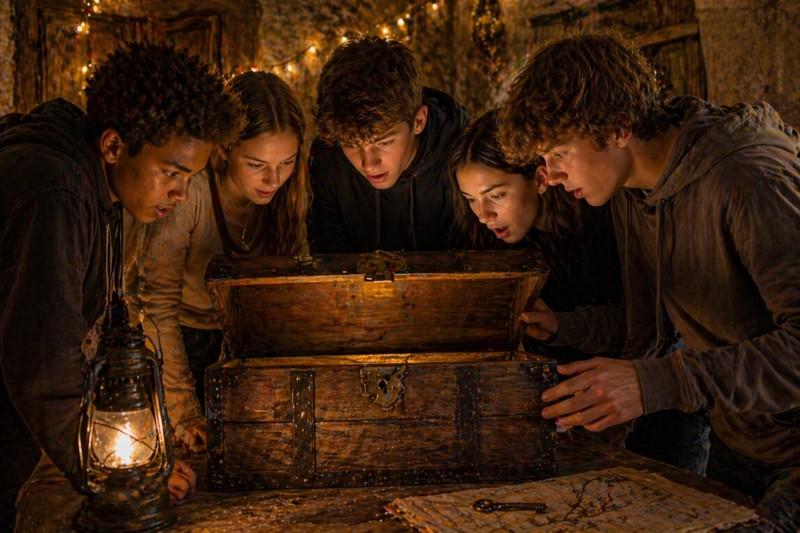
Birthday hunts are special because they combine the excitement of an activity with the personal significance of celebration.
Birthday Hunt Themes That Resonate:
- Heist Movie Vibe: Teams are thieves planning a “heist” (fictional, of course). Each clue is a piece of the plan (blueprints, alibis, equipment locations). The “final job” is a physical puzzle or challenge at the end.
- Survival/Zombie Apocalypse: Dark, fun, and perfect for edgy teen humor. Clues are scattered throughout a location, and teams must “survive” by gathering resources in the correct order.
- Detective Case: The birthday teen (or a friend) goes “missing.” Friends must solve the mystery to find them. (Great for surprise parties.)
- Time Travel or Dimension Jump: Each clue is from a different “era” or “dimension.” Teams collect artifacts and piece together what happened. Works especially well if you have different rooms or outdoor zones.
- Talent Show / Battle of the Bands Variant: Hunts that end with teams performing (singing a clue, acting out a scene). Less traditional, but memorable for creative teens.
Personalizing the Birthday Hunt: Include inside jokes, references to the birthday teen’s interests, or tasks that reference their friend group’s history. A clue that says “Go to where you first met [friend’s name] and find the next clue” creates emotional resonance beyond the puzzle itself.
Prize Considerations: For teens, avoid cheap plastic toys. Consider: concert tickets, gift cards (Amazon, Spotify, local restaurants), experiences (movie pass, arcade tokens), or group prizes (ice cream run, pizza party). The status of winning often matters more than the actual prize, but don’t make the prize feel thoughtless.
From Scavenger Hunt to Murder Mystery: Leveling Up
Once teens have done a few scavenger hunts, they’re ready for something more sophisticated: a murder mystery game. This is the natural evolution of puzzle-based entertainment at this age.
Why Murder Mysteries Appeal to Older Teens: They’re less about hunting and more about problem-solving, role-play, and narrative. Teens get to step into a character, interrogate “suspects,” find “evidence,” and piece together a story. It’s intellectually engaging and socially immersive.
Key Differences from Scavenger Hunts:
- Narrative First, Puzzles Second: The story drives the engagement, not just the activity.
- Role-Play Element: Participants assume characters and interact with each other in character.
- Accusation and Resolution: The game culminates in a finale where teams make an accusation and the truth is revealed.
- Replayability: A good murder mystery game can be run multiple times with different outcomes (different people can be the “real” murderer depending on who you suspect).
- No Game Master Needed: Unlike traditional murder mysteries that require a host to run everything, modern printable games are self-contained. Teens run the investigation themselves.
How to Transition a Scavenger Hunt into Murder Mystery-Style Play: If you’ve been running hunts at a birthday party or event, add a mystery narrative wrapper. Instead of “find the clues in order,” reframe it as “investigate a crime.” Each clue is evidence. Each location is a crime scene. The puzzle to unlock the next location is an interrogation, a code-breaking exercise, or examining forensic details.
The Riddlelicious Murder Mystery Game does exactly this — it’s designed so that teens run the investigation themselves, finding suspects, interpreting evidence, and reaching a conclusion. No adult game-mastering required.
The Murder Mystery Game — Ages 15+
The ultimate teen party game. No game master needed — they run the investigation themselves.
⚡ Instant Download · 🖨️ Print at Home · ⭐ 4.75/5 Stars
Get the Murder Mystery Game →
Frequently Asked Questions

Are scavenger hunts fun for teenagers?
Absolutely — when the challenge level is right. Teens respond well to mystery investigations, photo hunts (with their own phones), city exploration hunts, and murder mystery-style experiences. Simple treasure hunts aimed at younger kids won’t cut it — complexity and independence are key. The difference between a boring teen hunt and an engaging one often comes down to whether the tasks feel age-appropriate and whether teens feel trusted to complete them with minimal supervision.
What is the best scavenger hunt for a teen birthday?
For ages 13–17, a murder mystery investigation (like our Printable Murder Mystery Game) is the gold standard. It’s sophisticated, socially engaging, and teens take it surprisingly seriously. Photo hunts and outdoor city missions are also great for teen parties. The key is choosing a format that aligns with your group’s interests (artistic, competitive, mystery-focused, outdoorsy) and the venue (home, neighborhood, city).
How long should a teen scavenger hunt last?
Most successful teen hunts run 90–180 minutes. Anything shorter feels rushed; anything longer risks boredom or fatigue. Photo hunts and mystery investigations can take 2–3 hours if the narrative is strong. Outdoor city hunts typically run 90–120 minutes due to travel time and the physical nature of the activity. Virtual hunts can be shorter (45–90 minutes) if they’re synchronous, or spread over multiple days if they’re asynchronous.
Do we need a game master or host for a teen scavenger hunt?
Not always. Simple hunts (photo, outdoor, online) can run with a facilitator who just tracks progress and judges submissions. Mystery investigations benefit from someone managing clue distribution and ensuring teams stay on track. Full murder mystery games are specifically designed to run without a game master — the teens themselves become the investigators. However, having an adult present for safety, to answer logistics questions, and to judge tricky scenarios is always a good idea.
What safety precautions matter for outdoor teen hunts?
Always establish a defined geographic boundary, ensure every team has a phone and a way to check in, set clear time limits, and require teams to have at least 2 people. For younger teens (13–14), have an adult nearby. Older teens (15–17) can have more autonomy if they’re sensible, but you should know their whereabouts and have an emergency protocol in place. Brief everyone on what to do if they get lost, injured, or feel unsafe.

“My daughter’s 16th birthday party used the Murder Mystery Game, and it completely changed the vibe. The kids were genuinely invested, actually working together, and asking detailed questions about the suspects and evidence. It felt sophisticated — not childish — and that made all the difference. They’ve asked to do it again with different friends.”
Level Up to Murder Mystery
The ultimate teen party experience — sophisticated, immersive, no adult game-mastering needed.
Get the Murder Mystery Game →Starting at $14.99 · Instant download · Print at home · Unlimited reprints

