
Blog
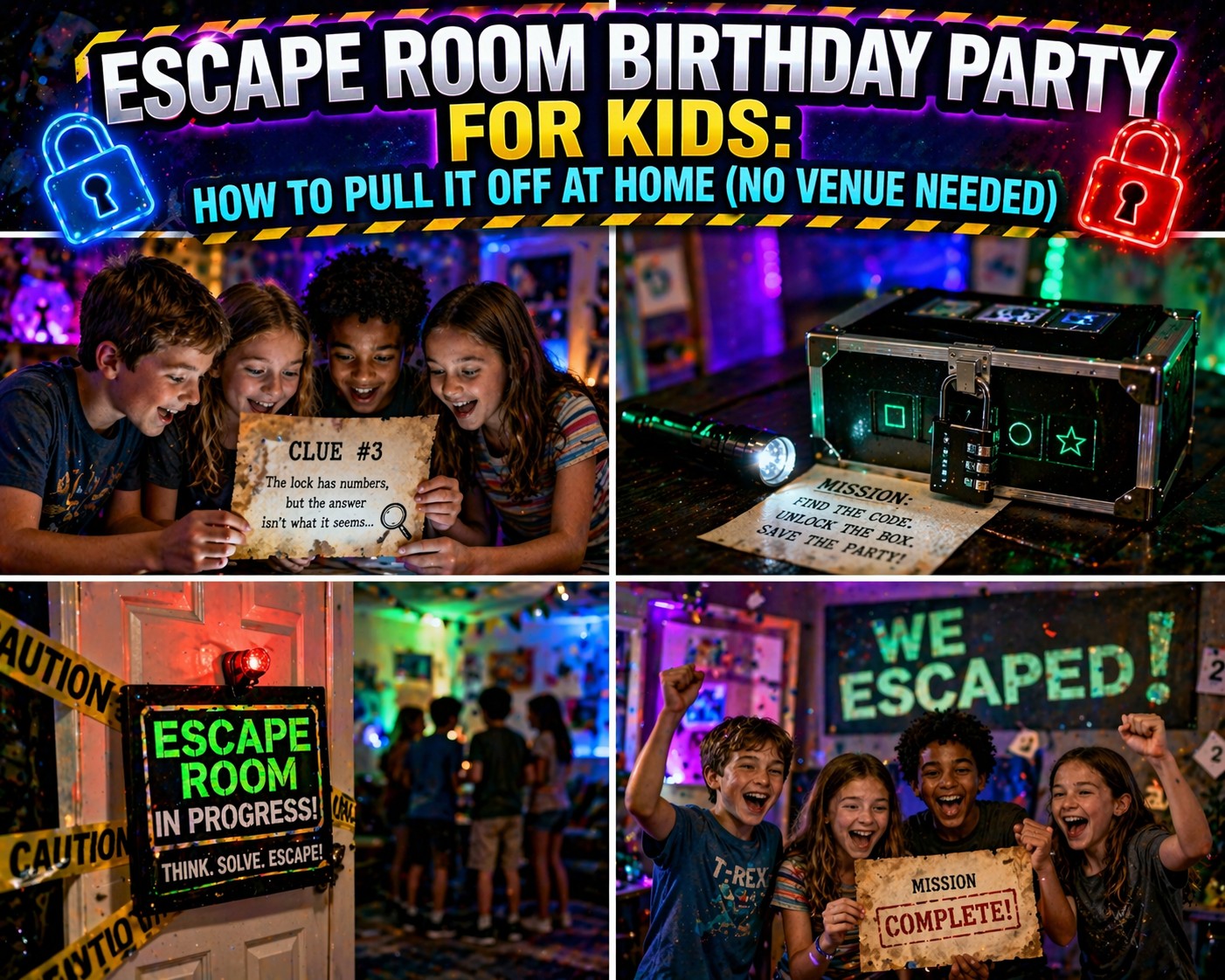
Escape Room Birthday Party for Kids: How to Pull It Off at Home (No Venue Needed)
Escape Room Birthday Party for Kids: How to Pull It Off at Home (No Venue Needed)
Arne · 15 min read · Published: June 10, 2026
You want something special for your kid’s birthday. Something they’ll talk about for months. An escape room feels perfect—but venue bookings are pricey, time slots fill up fast, and you’re stuck with someone else’s story.

Here’s the truth: You don’t need a venue. With the right structure, your living room becomes an escape room experience that’s actually more personalized, more flexible, and way more memorable than any commercial escape room.
In this guide, I’ll show you exactly how to design an escape room birthday party for kids at home—including proven puzzle templates, age-appropriate difficulty levels, and how to set the scene without spending a fortune. Whether you’re hosting six-year-olds or teenagers, you’ll have a complete roadmap.
This guide draws from 10+ years designing scavenger hunts, escape room parties, and mystery hunts. Every puzzle idea and age recommendation has been tested with real groups of kids.
Why Escape Room Parties Are the Hottest Trend in Kids’ Birthdays

Escape room parties have exploded in popularity over the last five years, and for good reason. Unlike passive entertainment—watching a movie or eating cake—an escape room party is active, collaborative, and brain-engaging.
Kids solve puzzles together. They communicate. They celebrate wins as a team. And when they “escape,” that rush of accomplishment is real—not manufactured.
Parents love it too. While kids are focused on the hunt, they’re naturally organized, entertained, and supervised in one space. No running between different activities. No screens. Just genuine, sustained engagement.
The bigger trend, though, is experiential over material. Kids are getting fewer toys and more memories. A well-designed escape room party delivers exactly that.
The Problem with Escape Room Venues (And the Solution)
Escape room venues are fun, but they come with real limitations:
- Cost: $200–$400 for a room rental, plus travel.
- Time slots: 60 minutes, rigid. If your group is fast, too bad. If they’re struggling, tough luck.
- Generic story: You get whatever theme they’ve built. No personalization for your kid or their interests.
- Risk: If your group doesn’t “escape,” some kids feel like they failed. (They didn’t—the puzzle was just hard—but try telling a seven-year-old that.)
- Logistics: Travel time, parking, waiver forms, other groups in adjacent rooms…
A home-based escape room flips all of this. You control the story, the difficulty, the timing, and the environment. And the cost? Under $50 for decorations and props.
The solution: Use a story-driven scavenger hunt structure that *feels* like an escape room but is infinitely more flexible and fun to manage.
DIY Escape Room at Home: What You Actually Need

Here’s what surprises most people: you don’t need much.
The Basics
- One printed hunt kit or template (clues, puzzles, story cards)
- Small props: Flashlight, UV pen (if using invisible ink), basic craft supplies
- Hiding spots: Your existing furniture, closets, drawers (use what you have)
- A phone timer (optional, but fun for time pressure)
- Decorations: Fairy lights, a printed “crime scene” tape, maybe a poster (all under $20)
The Secret Ingredient: Story
The real magic isn’t the props. It’s the narrative frame that ties everything together. A good story makes kids care about solving each puzzle. It transforms “here’s a clue” into “you must find the stolen ruby before midnight.”
Story examples that work:
- Detective agency: Solve a mystery, find the culprit.
- Heist team: Retrieve three stolen artifacts before the alarm sounds.
- Secret agents: Unlock codes to prevent disaster.
- Lost treasure: Decipher a map to find buried gold.
- Haunted house: Find clues to break the curse.
The story doesn’t need to be Shakespeare. It just needs to feel purposeful to the kids.
Story-Driven Scavenger Hunts: The Escape Room Experience Without the Headache
Here’s the structure that works:
Act 1: The Setup (5–10 minutes)
You gather the kids in the “headquarters” (living room, dining room—wherever you start). You explain the mission in character. “Detective Martinez needs your help. A painting went missing from the museum…” You hand out the first clue or challenge.
Act 2: The Hunt (30–50 minutes)
Kids work through a sequence of clues. Each clue leads to a location. At each location, they solve a puzzle or challenge to unlock the next clue. The sequence might be:
- Solve a cipher → Get the kitchen location
- Find a hidden safe in the kitchen → Solve a math puzzle → Get the next location
- Find a locked box in the bedroom → Answer riddles → Get the code
- Collect three “artifacts” → Bring them to the final location
- Final puzzle or challenge → Escape/Win
The key is linked progression: each completed puzzle generates the location or clue for the next puzzle. This creates momentum and prevents kids from getting lost.
Act 3: The Finale (5 minutes)
Kids reach the end, solve the final puzzle, and claim their “prize” (a small token, a certificate, or just celebration). You celebrate together. Maybe take a photo with the “escaped” team.
Total runtime: 45–65 minutes. Way more manageable than a 60-minute rigid venue slot.
How to Set the Scene in Your Living Room

Atmosphere matters. Kids need to feel like they’re somewhere other than their friend’s house.
Lighting
Dim the overhead lights. Use:
- Fairy lights or string lights around the room
- A single lamp or desk light for “interrogation” areas
- Flashlights for kids to use during the hunt (adds drama)
Decorations
- Printed posters: “Detective Agency,” “Warning: Biohazard,” “Classified Mission”—print these on cardstock, they’re free
- Tape: Red/yellow “crime scene” tape around doorways or furniture
- Clue board: A whiteboard or poster showing the story so far
- Props: A “safe” (cardboard box with a combination lock), a “spy briefcase,” a treasure chest
You can find all of this on Etsy or create it yourself in 30 minutes with a printer and some tape.
Audio (Optional but effective)
Play ambient music in the background. For detective themes, use film noir jazz. For spy themes, use action movie soundtracks. Spotify has “escape room” and “mystery” playlists ready to go. Keep it low enough that kids can hear each other talk.
Temperature & Comfort
Don’t overlook basics. Make sure the room isn’t too cold (kids won’t enjoy standing around in a freezing basement). Have water and maybe snacks nearby.
Age Guide: Escape Room Difficulty by Age
This is crucial. A puzzle that’s fun for a 12-year-old will frustrate a six-year-old. And a puzzle that’s too easy for a teenager is boring.
Ages 6–8: Simple Clues & Collaborative Solving
Puzzle types:
- Picture matching (“Find the object that matches this picture”)
- Color codes (“Follow the blue clue to the next room”)
- Simple riddles (“I have hands but cannot clap. What am I?” → Clock)
- Counting challenges (“Count the red objects in this room”)
- Physical tasks (“Arrange these items in order of size”)
Approach: Puzzles should be solvable in 2–3 minutes. Kids this age need frequent wins and momentum. Encourage group collaboration—no single kid should feel stuck alone.
Example clue sequence: “Find something that tells time” → Kids find the clock → Use a key taped to the clock to open a box → Solve a simple riddle to get the next location.
Ages 9–12: Coded Clues & Pattern Recognition
Puzzle types:
- Ciphers (substitution, Caesar shift, number codes)
- Pattern recognition (“What’s missing from this sequence?”)
- Math puzzles (“Add the numbers on the cards in this room”)
- Word puzzles (anagrams, hidden words)
- UV/invisible ink clues
- Multi-step puzzles (solve one puzzle to unlock the materials for the next)
Approach: This age group loves feeling smart and independent. Give them puzzles that require real thinking but are still solvable in 5–10 minutes without hints.
Example clue sequence: “Use the UV flashlight to reveal the invisible code” → Code reads “KITCHEN 3:05” (location + time) → Kids solve a math puzzle in the kitchen to unlock a safe → Inside is a key to the next room.
Ages 12–14: Deductive Reasoning & Mystery Depth
Puzzle types:
- Complex ciphers (multi-layer, polyalphabetic)
- Logic puzzles (“If A is taller than B, and B is taller than C…”)
- Clue analysis (“Read these three statements to figure out who stole the necklace”)
- Map navigation
- Combination locks with clues hidden throughout the story
- Murder mystery elements (if mature enough)
Approach: This age wants a real *mystery*, not just puzzles. Give them information to piece together. Include red herrings. Make them feel like detectives solving a genuine case.
Example clue sequence: “Interview three suspects to figure out who’s lying” → Cross-reference their statements with physical evidence → Deduce the culprit → Use the culprit’s birthday as a safe code.
5 Extra Puzzle Ideas to Add to Your Hunt
Here are five battle-tested puzzle types you can drop into any escape room party. I’ve included real examples for each.
1. UV/Invisible Ink Reveal
What it is: A clue written in invisible ink (milk, lemon juice) or visible only under UV light. Kids use a blacklight flashlight or UV pen to reveal the message.
How to make it:
- Write your clue on cardstock with a white paint pen or use an invisible ink pen (available on Amazon for $5).
- Place the card somewhere obvious—kids won’t see anything until they use the flashlight.
- They reveal the clue, which tells them the next location or puzzle.
Example: A plain white card taped to the refrigerator. Under UV light it reads: “Find something soft that keeps you warm at night” → They search for and find a blanket → Under the blanket is the next puzzle.
Works best for: Ages 8+
2. Caesar Cipher (Shift Cipher)
What it is: Each letter is shifted by a fixed number (often 3, like “HELLO” becomes “KHOOR”). Kids figure out the shift and decode the message.
How to make it: Write the coded message on the clue card and include a hint like “Each letter is shifted 3 spaces forward in the alphabet.”
Example:
Coded: “WKUH LV BRXU QHAW FOXH”
Decoded: “HERE IS YOUR NEXT CLUE”
(Each letter shifted 3 positions)
Teaching kids to solve it: Have them write out the alphabet twice (one normal, one shifted). Line them up and they can quickly decode each letter.
Works best for: Ages 9+
3. Hidden Safe Code (Math + Story)
What it is: A locked safe (or a box with a combination lock). Kids solve math problems or follow clues throughout the room to find three 2-digit numbers, which become the combination.
How to make it:
- Decide on a 3-digit combination for your lock (e.g., 24-17-09).
- Hide three clues around the room that lead to these numbers.
- Kids gather the numbers, enter the code, and unlock the safe.
Example:
- Clue 1: “Count the windows in the kitchen” → 2 windows (first digit: 24, so 2)
- Clue 2: “Count the picture frames in the hallway and add 8” → 9 frames + 8 = 17 (second digit)
- Clue 3: “Add your age to the year you were born, then subtract your birth year” → 9 (third digit)
- Combination: 24-17-09
Pro tip: Test the lock before the party. Some combination locks are finicky.
Works best for: Ages 7+ (adjust math complexity)
4. Riddle Challenge Board
What it is: A poster with five riddles. Kids solve them all. The *first letter of each answer*, when read top-to-bottom, spells the next location or a code.
How to make it: Print the riddles on a large poster board and display it prominently.
Example:
Solve these riddles:
- I have a head and a tail but no body. Answer: Coin (C)
- I get shorter every time I take a breath. Answer: Candle (C)
- I can travel around the world but never leave my corner. Answer: Stamp (S)
- The more you take, the more you leave behind. Answer: Footprints (F)
- I run but never walk. Answer: River (R)
First letters spell: **CCSFR** (or you can design it to spell “BASEMENT” or “KITCHEN”).
Works best for: Ages 8+
5. Story-Based Deduction Puzzle (For Teens)
What it is: Three “suspect interviews” printed on cards. Each suspect gives clues. Kids cross-reference the stories to figure out the truth, then use the answer to unlock the next section.
How to make it:
Create three suspect cards:
Suspect 1 (The Butler): “I was in the kitchen all evening. The cook can confirm. The necklace was still on the vanity at 8 PM.”
Suspect 2 (The Cook): “The butler came into the kitchen around 8:30 PM, not earlier. He seemed nervous. I was preparing dinner all night.”
Suspect 3 (The Maid): “I cleaned the upstairs at 7:30 PM. The necklace was gone by then. I saw the butler leave the upstairs hallway at 7:45 PM.”
The logic: The butler claims he was in the kitchen at 8 PM when the necklace was still there—but the cook says he didn’t arrive until 8:30 PM. The maid saw him upstairs at 7:45 PM. The butler is lying. The code might be “BUTLER” or the number 1 (suspect number).
Works best for: Ages 12+
—
If you love the idea but want a ready-made hunt with story, puzzles, and clues already designed, the Detective Scavenger Hunt comes with all puzzles, clue cards, and printable materials. Just print and hide. Saves hours of planning.

—
Common Mistakes (And How to Avoid Them)

Mistake 1: Too many puzzles, too little story
If kids are just solving puzzles back-to-back with no narrative, it gets boring. Tie each puzzle to the story. “You need the key to unlock the evidence locker” feels better than “Here’s puzzle three.”
Mistake 2: Puzzles that are too hard
A frustrated kid is not a happy kid. Test your puzzles beforehand. If it takes you 10 minutes to solve, it might take kids 20. Build in easy wins early to build confidence.
Mistake 3: No backup clues
If kids get stuck for more than 10 minutes, they lose momentum. Have one “hint” clue ready for each puzzle you can reveal if needed.
Mistake 4: Forgetting the birthday kid’s interests
If your daughter loves animals, make the mystery about a missing animal. If your son loves space, frame it as a space agency mission. Personalization makes it feel special.
Mistake 5: Underestimating setup time
Don’t try to hide clues while kids are arriving. Set everything up an hour before the party. Have a friend help if possible.
The Parent’s Step-by-Step Timeline
Two weeks before: Decide on a theme and story. Sketch out the puzzle sequence.
One week before: Create or print your hunt materials. Test at least one puzzle.
Two days before: Gather any props or decorations.
Day of (1 hour before): Hide clues, test that your puzzle sequence works, set up decorations and music.
20 minutes before: Brief any co-host (partner, friend) on the hunt progression so they can help if needed.
Party time: Introduce the story, hand out the first clue, and watch the magic happen.
FAQ

A: Start with a mystery story and a series of clues that must be solved in sequence. Each clue leads to the next, with a final “escape” reveal (finding the hidden treasure or solving the mystery). A printable detective hunt kit gives you the whole structure — just add your hiding spots.
A: Story-driven escape room-style hunts work brilliantly for ages 6–14. For 6–8 year olds, keep clues simple and collaborative. Ages 9–12 love the challenge of coded clues. Ages 12–14 want real deductive reasoning — consider upgrading to the murder mystery format.
A: Plan for 45–65 minutes total. The hunt itself should last 30–50 minutes depending on group size and age. Younger kids might need more time; older kids might race through it. Build in flexibility.
A: Have a hint ready. Something like “Look for something metal in this room” or “The answer rhymes with ‘clock.’” If they’re still stuck after a hint, give them the answer and move on. You want momentum, not frustration.
A: No. Use what you have. A cardboard box becomes a safe. A blanket becomes a “mysterious item.” A flashlight becomes a detective tool. Creativity beats budget every time.
— Sarah M., parent of twins (ages 8 & 10)
“I was skeptical about hosting an escape room at home, but this guide made it so easy. The story about the missing museum painting had them engaged the whole time. They worked together, solved real puzzles, and the ‘big reveal’ at the end was perfect. Cost me about $30 in decorations and props. Best birthday party we’ve done.”
—
Final Thought: Why Home Beats Venues
A commercial escape room is fun. But a home escape room designed *for your kid*, with *their* story, at *their* pace, with *their* friends in a comfortable space? That’s unforgettable.
Plus, you’ll see something venues never give you: the moment when your kid realizes they solved something genuinely hard. That’s the real win.
Start simple. Pick a story. Design four or five puzzles. Hide a few clues. You’ve got this.
Ready to Launch Your Party?
Don’t want to design from scratch? Our printable Detective Scavenger Hunt Kit includes story, puzzles, clue cards, and setup guides. Print, hide, and celebrate.

