

Blog
Summer Scavenger Hunt for Kids: 60+ Outdoor Boredom-Busting Ideas
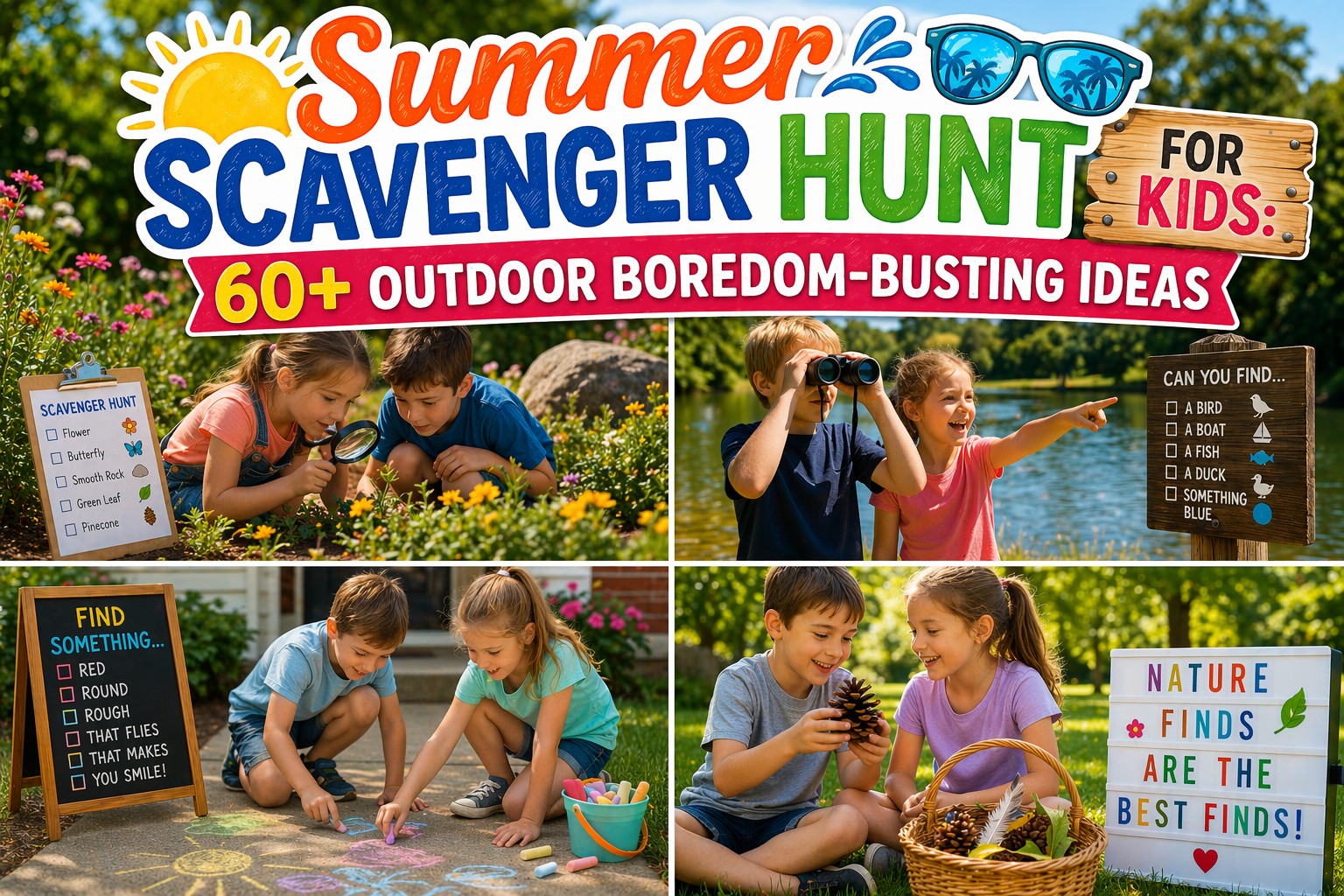
Summer Scavenger Hunt for Kids: 60+ Outdoor Boredom-Busting Ideas
Arne · 13 min read · Published: June 01, 2026
It’s June. The kids are home from school. You’ve made it through day three of “I’m bored” before noon, and summer break has just begun. Sound familiar? The solution isn’t another screen—it’s a summer scavenger hunt for kids. These outdoor adventures transform boredom into exploration, turn your backyard into a treasure island, and give you a few hours of peace while your children are engaged, moving, and thinking creatively.

After designing over 200 scavenger hunts for families, I’ve learned what actually works: hunts that have specific clues, clear objectives, and a sense of discovery. Not just “find something blue”—that’s solved in thirty seconds. Real hunts that keep kids engaged for hours.
In this guide, you’ll find 60+ practical summer scavenger hunt ideas, organized by location and difficulty. Whether you’re managing a backyard afternoon, planning a family road trip, or organizing a camp activity, these hunts are ready to launch today. We’ve also gathered tips from our outdoor scavenger hunt ideas collection and our popular scavenger hunt for kids guides.
When ‘I’m Bored’ Becomes an Adventure: Summer Hunts to the Rescue

Summer boredom isn’t just uncomfortable—it’s a missed opportunity. Research on outdoor play shows that scavenger hunts increase physical activity, sharpen observation skills, and encourage problem-solving in children. They also teach patience and systematic thinking: checking items off a list, remembering clues, and working toward a goal.
A good summer scavenger hunt does three things:
- Gets kids outside. Away from screens, moving through real environments, noticing details they’d normally miss.
- Provides structure without being rigid. Kids know what to look for, but they discover it themselves. The agency matters.
- Creates a tangible sense of completion. Checking off a list, finding the final item, earning a small prize—these moments build confidence and create memories.
The best part? You can set them up in 10 minutes. No expensive props, no elaborate setup. Just a list, a pen, and kids with a mission.
60+ Summer Scavenger Hunt Ideas (Sorted by Location)
Not all scavenger hunts are created equal. The same hunt that works in a forest will fall flat in a parking lot. Here’s how to think about location-based hunts:
- Nature hunts focus on living things and natural materials
- Beach and lake hunts use water, shells, and shoreline treasures
- Backyard hunts work with what you already have at home
- Road trip hunts keep kids engaged during long drives
- Group hunts scale up for camps, birthday parties, and community events
The challenge—and the fun—is matching the hunt to the place.
Nature Summer Scavenger Hunt

A forest, park, or wooded area gives you unlimited search material. Here are 20 specific items that work for ages 6–14:
Items to Find (Nature Scavenger Hunt)
- A leaf with more than 5 veins
- Something that is exactly 3 inches long
- A smooth rock smaller than a golf ball
- Three different types of leaves
- A flower (any color—press it in the hunt book)
- A stick shaped like the letter Y
- Bark from a fallen tree that has no moss
- A bird feather
- Evidence of an insect (web, shed skin, burrow)
- A pinecone smaller than your thumb
- Something with a pattern (stripes, spots, or grid)
- A stone that feels warm to the touch (left in sun)
- Lichen or moss on a tree
- A seed pod or acorn
- Three rocks of different colors
- A piece of wood shaped like an animal
- A plant with thorns or prickles
- Something that smells good (flower, pine)
- A snail shell or evidence of a snail trail
- A shadow that makes a shape
Tip: Tell kids they can photograph items instead of collecting everything—especially fragile things like flowers or insects. It keeps the hunt moving and respects the environment.
Nature Hunt Extensions
Once they’ve completed the main list, add tier-two challenges:
- Sketch the most interesting leaf they found
- Count how many different bird sounds they hear in 5 minutes
- Describe one animal track they discover
- Build a nature sculpture from found materials (no scissors, no damage)
- Write a three-sentence story from the perspective of an insect they saw
Beach and Lake Scavenger Hunt Ideas
Water changes the hunt entirely. You have shells, rocks, water patterns, and beach debris to work with. Here are 18 water-specific hunt items:
Beach and Shoreline Finds
- A shell with three colors
- A smooth stone that fits in your palm
- Evidence of a wave (foam pattern, seaweed line)
- A piece of driftwood
- A shell with a spiral
- Sand that feels warm
- A rock with a hole through it
- Three shells of different shapes
- Something that floats (natural item)
- A pattern in the sand made by wind or water
- Seaweed or water plants
- A rock that is flat enough to skip
- A piece of sea glass (if available in your area)
- Evidence of a footprint or animal track
- A shell smaller than your pinky nail
- Something white
- Smooth pebbles of two different colors
- A rock shaped like a creature
Lake Hunt Variations
Lakes have fewer shells but often richer plant life around the shoreline:
- Cattails or reeds
- A lily pad (intact)
- A stone with quartz
- Evidence of a turtle or frog habitat
- Three different types of water-edge plants
- A piece of lakeshore trash (collect it—bonus points for cleanup)
Pro tip: Set a “safety zone” boundary so kids don’t wander off. Mark it with a rope or towel. The hunt stays contained while still feeling adventurous.
Backyard Summer Treasure Hunt

You don’t need to leave your property. A backyard hunt uses what you already have: trees, grass, garden tools, outdoor furniture, and household items you place strategically. For more ideas on this location, check out our guide to backyard scavenger hunt ideas. Here are 17 backyard hunt ideas:
Backyard Scavenger Hunt Checklist
- A leaf from every tree in your yard
- Something soft to touch
- Three things that are the color green
- An object that makes a shadow on the ground
- Something found in the garden (flower, tomato, weed)
- A rock from the driveway
- Something you can spin
- A stick that is longer than your arm
- An outdoor toy you haven’t used in a month
- Something that moves in the wind
- A pinecone or seed
- Something orange
- A tool from the garage (retrieve and return safely)
- Your shoe size in an object (show how it measures)
- Three items that were different colors 6 months ago
- Something from the recycling bin (pre-approve items)
- A photo of everyone on your team with the backyard as background
Backyard Hunt Variations
Age matters. For younger kids (4-7):
- Hide items before the hunt and write picture clues instead of words
- Use colors instead of specific objects: “Find 5 red things”
- Give them a map with pictures of where to look
For older kids (8-14):
- Write riddles that describe items: “I’m round and can roll. I have no feet but can move. What am I?” (answer: ball)
- Create a points system: common items = 1 point, rare items = 5 points
- Set a time limit and challenge them to find everything in under 20 minutes
Ready-Made Summer Hunt Kits
Forest, Jungle, and Pirate adventures designed for outdoor play. Download, print, and head outside.
⚡ Instant Download · 🖨️ Print at Home · ⭐ 4.8/5 from 323+ Reviews
Browse Summer Hunt Kits →
Road Trip Scavenger Hunt for Long Drives

A 6-hour road trip feels endless to kids. A scavenger hunt keeps them looking out the window with purpose. Here are 15 items designed for highway driving:
Road Trip Hunt Items
- A car that is a different color than yours (count how many)
- A billboard for a restaurant you’ve never heard of
- An exit sign for a town with a funny name
- A red traffic light (note the time)
- A truck with a logo you recognize
- Three different license plates from other states
- A bridge over water
- Someone in another car waving at you
- A road sign with an animal on it
- A barn or farmland
- A motorcycle
- A vehicle towing something
- A gas station sign you’ve never seen before
- Someone eating in a car
- Three vehicles of the same color (spotted at different times)
Road Trip Hunt Rules
- Items must be spotted from your vehicle (no stopping required)
- Multiple sightings of the same item count separately (three blue cars = three checks)
- Keep a pencil and hunt sheet for each child—checking items off keeps them engaged
- Small prize at rest stops (sticker, snack, or travel game) for hitting milestones
- Rotate turns: one child is the “spotter” for 30 minutes, then switch roles
Add variety by creating different hunt sheets for different age groups. Younger kids look for colors and basic shapes; older kids look for specific brand logos or challenging-to-spot items. When the weather keeps kids indoors during rainy days, we have rainy day scavenger hunt ideas to keep them entertained as well.
Summer Scavenger Hunts for Large Groups and Camps
When you have 10+ kids, hunts get more complex. You need teams, clear boundaries, and items that work at scale. Here’s what works for summer camps, birthday parties, and organized groups:
Group Hunt Structure
- Team size: 3-4 kids per team. Any smaller and there’s not enough distributed work; any larger and some kids zone out.
- Time limit: 30-45 minutes, depending on the area size and age group.
- Boundaries: Define a clear search zone so teams don’t wander off.
- Checkpoints: Groups must visit an adult checkpoint to verify 3-4 items before moving on. This keeps teams from just running around.
- Scoring: Award points for items found, team cooperation, and creativity.
20 Items for Large Group Hunts
- A team photo where everyone is jumping
- An object starting with the letter “Q”
- A pine cone
- A rock with three different colored sides
- Evidence of team cooperation (all team members holding hands, shown in photo)
- A leaf that is bigger than your hand
- Something red (not clothing)
- A stick shaped like a “T”
- A plant growing out of concrete or asphalt
- Three items that can float
- A bug or evidence of a bug (living creature not to be harmed)
- A team cheer about scavenger hunting (2+ sentences, performed for adult checkpoint)
- An object in nature that is perfectly round
- A photo of your entire team in tree shade
- Two sticks that could make an X if placed together
- A team member’s shadow on the ground (in photo)
- Something that smells unusual (not perfume or food)
- An object you could use as a cup
- A rock collection from 5 different locations in the hunt zone
- A team story about an imaginary treasure (one person writes it, all team members sign it)
Game Variations for Large Groups
Relay Hunt: One team member runs to find an item while others wait. Once they return, the next team member goes. Faster and more active.
Checkpoint Hunt: Hide numbered envelopes around the property. Teams must find items at each checkpoint in order. Keeps groups moving and prevents chaos.
Timed Stations: Teams rotate through five different “hunt zones” (nature area, playground, parking lot, etc.). Five minutes per zone, then they rotate. Ensures equal opportunity and movement.
Photo Treasure Hunt: Instead of collecting items, teams photograph everything. Safer for nature (nothing removed), easier to verify, and kids get a visual record to take home.
Frequently Asked Questions
What are good summer scavenger hunt ideas for kids?
The best summer scavenger hunts combine specific, achievable items with engaging locations. Nature hunts (find five types of leaves, a bird feather, three different bugs), backyard treasure hunts with clues around the garden, neighborhood photo scavenger hunts, and water-themed hunts near pools or lakes are all summer favorites. The key is matching the hunt difficulty to the kids’ ages—younger kids (4-7) need picture clues and simpler items, while older kids (8-14) engage with riddles, point systems, and timed challenges.
How do you organize a scavenger hunt for a large group of kids?
Divide kids into teams of 3-4, set clear boundaries, use checkpoint verification to keep teams from just running, and give them a time limit (30-45 minutes). Award points for items found and team cooperation. For really large groups (20+ kids), use different hunt sheets for different ages or organize relay-style hunts where one child searches while others wait.
Can scavenger hunts work in small spaces?
Absolutely. A backyard hunt or even an indoor hunt (using household items) works just as well. The size of the space matters less than the creativity of the list. In small spaces, focus on observation: finding objects by color, texture, shape, or size rather than by covering distance.
What’s a good prize for finishing a scavenger hunt?
Avoid expensive prizes. Small rewards work better: stickers, a special snack, extra screen time, or a “winner’s choice” of the next activity. For group hunts, the winning team might choose the next game or get first pick of lunch. The achievement of finishing the hunt is often more rewarding than the prize itself.
How long should a scavenger hunt take?
It depends on the scope. A small backyard hunt: 15-30 minutes. A nature park hunt: 45-60 minutes. A large group hunt at a camp: 30-45 minutes with checkpoints. Always build in 5 extra minutes so kids aren’t rushed at the end.
Can younger kids do scavenger hunts?
Yes, but adjust the format. For kids 4-6, use picture clues instead of words, focus on colors and sizes rather than specific items, and keep the hunt to 10-15 minutes. Partner younger kids with older siblings or adults. Their confidence and enjoyment matter more than completing the entire list.

“My kids asked to do the Jungle Hunt three times in one week. They actually put down their tablets without being asked. That alone was worth the price.”

Make This the Summer They Remember
Outdoor adventures in 15 minutes — no prep, just download and go.
Browse All Hunt Kits →Starting at $14.99 · Instant download · Print at home · Unlimited reprints

