
Blog
Spy Riddles for Kids
Written by the Riddlelicious Team · Updated March 2026
We’ve been designing spy-themed scavenger hunts and puzzle games for over five years, testing every riddle with kids aged 9 to 15 in birthday parties, school events, and family game nights. These 20 spy riddles and code-cracking challenges are the ones that consistently get kids the most excited — the perfect mix of tricky and solvable.
Every great spy needs sharp wits and a talent for cracking codes. Whether you’re planning a spy-themed scavenger hunt, a secret agent birthday party, or just want to challenge young minds, these riddles will put their detective skills to the test. For more investigative fun, also check out our detective tasks for children.
We’ve divided this collection into three sections: Spy Equipment riddles (identify the gadget from the clues), Spy Skills riddles (guess the espionage technique), and Code-Cracking Challenges (solve actual coded messages). Each riddle includes 2-3 clues to guide young agents toward the answer.

Spy Equipment Riddles
Every secret agent carries specialised gear. Can your young spies identify these essential tools from the clues?
Riddle #1
Clue 1: I let spies talk without being in the same room — but I’m not a phone.
Clue 2: You press a button to speak and release it to listen.
Clue 3: I crackle and hiss, and you might say “over and out” when using me.
Reveal Answer
Walkie-Talkie! These handheld radios have been a spy staple since World War II. Unlike phones, walkie-talkies use radio frequencies, which means they work even when there’s no mobile signal — perfect for covert operations in remote locations.
Riddle #2
Clue 1: I help you find proof that someone touched something — even if they tried to hide it.
Clue 2: I use fine powder and a soft brush.
Clue 3: Everyone’s pattern is unique, and I reveal the swirls they left behind.
Reveal Answer
Fingerprint Kit! The oils on our fingers leave invisible prints on surfaces. A fingerprint kit uses powder (often black or white depending on the surface) to make those prints visible. No two fingerprints are exactly alike — not even identical twins share the same patterns.
Riddle #3
Clue 1: I’m tiny enough to hide inside a lamp or under a table.
Clue 2: I pick up every word spoken in a room and send it to someone far away.
Clue 3: Spies call me a “bug,” but I have nothing to do with insects.
Reveal Answer
Listening Device (Bug)! These miniature microphones can be hidden almost anywhere. In spy movies, agents often “sweep” a room to check for bugs before having a secret conversation. Modern bugs can be as small as a grain of rice.
Riddle #4
Clue 1: I protect valuable things by creating an invisible web across a room.
Clue 2: If you touch one of my beams, alarms go off immediately.
Clue 3: In movies, spies must twist and tumble to get through me without breaking a single red line.
Reveal Answer
Laser Grid! These security systems use criss-crossing laser beams to protect museums, vaults, and secret bases. Breaking any beam triggers an alarm. In real life, most security systems use infrared beams that are invisible to the naked eye — the red beams in movies are just for dramatic effect!
Riddle #5
Clue 1: I turn complete darkness into a world of green light.
Clue 2: I strap onto your head and cover your eyes — but I help you see better, not worse.
Clue 3: Owls don’t need me, but human spies on night missions certainly do.
Reveal Answer
Night-Vision Goggles! These amazing devices amplify tiny amounts of light (even starlight) to let the wearer see in near-total darkness. Everything appears green because the human eye can distinguish more shades of green than any other colour, making it easier to spot details.
Spy Skills Riddles
Gadgets are great, but a true spy’s greatest tools are their skills and techniques. Can your agents identify these classic espionage methods?
Riddle #6
Clue 1: I help a spy become someone else entirely — a different person with a different face.
Clue 2: Wigs, glasses, fake moustaches, and new clothes are all part of my toolkit.
Clue 3: The best spies can use me to walk right past their enemies without being recognised.
Reveal Answer
Disguise! The art of disguise is one of the oldest spy skills in history. Real intelligence agencies have entire departments dedicated to creating convincing disguises. The CIA’s former Chief of Disguise, Jonna Mendez, once wore a disguise into the Oval Office that even fooled the President!
Riddle #7
Clue 1: I’m a way to pass secret messages without two spies ever meeting face to face.
Clue 2: One spy leaves something hidden in an agreed spot; the other picks it up later.
Clue 3: A hollow rock, a gap in a wall, or a loose brick could all be used as me.
Reveal Answer
Dead Drop! Dead drops are pre-arranged hiding spots where spies exchange information without direct contact. This technique is incredibly important because if two spies are never seen together, it’s much harder for the enemy to connect them. One of the most famous dead drops was a hollow bolt used during the Cold War.
Riddle #8
Clue 1: I look like an ordinary building from the outside, but I’m anything but ordinary inside.
Clue 2: Spies come to me when they’re in danger and need a place to hide.
Clue 3: My address is a closely guarded secret, and I have my own special name that sounds like security and shelter.
Reveal Answer
Safe House! A safe house is a secret location where spies can hide, meet, or rest without fear of being discovered. They’re designed to blend in with their surroundings — a safe house might look like a completely normal flat or house from the outside. Intelligence agencies maintain safe houses in cities around the world.
Riddle #9
Clue 1: I pretend to work for one side, but I’m secretly loyal to the other.
Clue 2: Trust is my weapon — people tell me their secrets because they think I’m on their team.
Clue 3: My name suggests I’m two of something, and my true loyalty is always a mystery.
Reveal Answer
Double Agent! A double agent works for one intelligence agency while secretly serving another. They are some of the most dangerous and valuable assets in the spy world. History is full of famous double agents — like the Cambridge Five, a group of British spies who secretly worked for the Soviet Union during the Cold War.
Riddle #10
Clue 1: I involve watching someone carefully without them knowing they’re being watched.
Clue 2: Cameras, binoculars, and following from a distance are all part of my technique.
Clue 3: Spies who do this might sit in a parked car for hours or blend into a crowd, always keeping their target in sight.
Reveal Answer
Surveillance! Surveillance means carefully monitoring a person, place, or activity. Spies use both physical surveillance (following someone in person) and electronic surveillance (cameras, phone tapping). Counter-surveillance is the art of detecting and evading surveillance — a skill every top spy must master.



Code-Cracking Challenges
Now it’s time to put your agents’ skills to the ultimate test! These five code-cracking challenges use real encryption methods that spies have used throughout history. Each challenge includes a coded message for kids to solve.
Challenge #11 — Caesar Cipher
How it works: Each letter in the message is shifted forward by a set number of places in the alphabet. For example, with a shift of 3, A becomes D, B becomes E, and so on.
Crack this message (Shift = 3):
WKH VHFUHW PHHWLQJ LV DW PLGQLJKW
Reveal Solution
THE SECRET MEETING IS AT MIDNIGHT
How to solve it: Shift every letter back by 3 positions. W→T, K→H, H→E, and so on. The Caesar Cipher is named after Julius Caesar, who used it to send military messages over 2,000 years ago!
Challenge #12 — Number Code
How it works: Each number represents a letter’s position in the alphabet. A=1, B=2, C=3 … Z=26. Dashes separate the letters, and slashes separate the words.
Crack this message:
1-7-5-14-20 / 8-9-4-4-5-14 / 9-14 / 20-8-5 / 16-1-18-11
Reveal Solution
AGENT HIDDEN IN THE PARK
How to solve it: Convert each number to its corresponding letter. 1=A, 7=G, 5=E, 14=N, 20=T spells AGENT. This is one of the simplest codes, but it’s surprisingly effective when you need to send a quick secret message!
Challenge #13 — Morse Code
How it works: Letters are represented by combinations of dots (.) and dashes (-). Here’s a quick reference:
A=.- | B=-… | C=-.-. | D=-.. | E=. | F=..-. | G=–. | H=…. | I=.. | L=.-.. | M=– | N=-. | O=— | P=.–. | R=.-. | S=… | T=- | U=..- | W=.–
Crack this message:
— .. … … .. — -. / .- -.-. -.-. . .–. – . -..
Reveal Solution
MISSION ACCEPTED
How to solve it: Match each group of dots and dashes to the reference chart above. M=–, I=.., S=…, S=…, I=.., O=—, N=-. spells MISSION. Morse Code was invented by Samuel Morse in 1838 and has been used by spies, soldiers, and sailors ever since. The famous SOS distress signal (…—…) is Morse Code!
Challenge #14 — Reverse Writing
How it works: The message is written completely backwards — each word is reversed AND the word order is reversed. You need to flip everything to read it!
Crack this message:
ESUOHERAW EHT NI SI ESACTIUS EHT
Reveal Solution
THE SUITCASE IS IN THE WAREHOUSE
How to solve it: Read the entire message backwards, letter by letter: E-H-T → THE, E-S-A-C-T-I-U-S → SUITCASE, and so on. Leonardo da Vinci famously wrote all of his notebooks in mirror writing (reversed text that can only be read in a mirror), possibly to keep his ideas secret!
Challenge #15 — Semaphore Flag Positions
How it works: In semaphore, each letter is shown by holding two flags in different positions, using clock directions. We’ll describe the flag positions — can you decode the word?
Decode these five flag positions:
Letter 1: Left flag at 7 o’clock, Right flag at 8 o’clock (both down) → ?
Letter 2: Left flag at 10 o’clock, Right flag at 12 o’clock → ?
Letter 3: Left flag at 7 o’clock, Right flag at 3 o’clock → ?
Letter 4: Left flag at 10 o’clock, Right flag at 3 o’clock → ?
Letter 5: Left flag at 9 o’clock, Right flag at 12 o’clock → ?
Reveal Solution
ALERT
How to solve it: Each pair of flag positions corresponds to a specific letter in the semaphore alphabet. Semaphore signalling was used by the navy to send messages between ships before radio was invented. Sailors would stand on deck holding large flags and spell out words one letter at a time. Today, it’s still taught in scouts and military training!


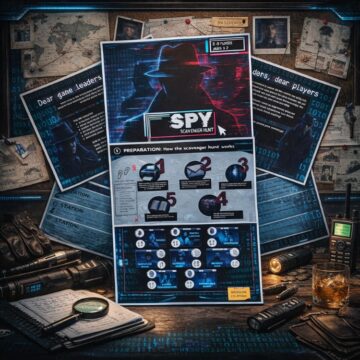
Spy Scavenger Hunt
Printable spy scavenger hunt – stealth missions and secret codes. Ages 5-15.
Download & Print → $21.99
Tips for Using These Spy Riddles
- Build a mission briefing: Print the riddles in a sealed envelope marked “TOP SECRET” and hand it to each team. Kids love the theatre of a real spy mission!
- Scale the difficulty: For younger kids (9-10), give all three clues at once. For older kids (13-15), reveal one clue at a time and award more points for solving with fewer clues.
- Create a code book: Print out the Morse Code and Number Code reference charts so kids can both decode AND create their own secret messages.
- Team vs. solo: The riddles work great for individual thinkers, but the code-cracking challenges are especially fun in small teams where kids can collaborate.
- Combine with a scavenger hunt: Hide each riddle at a different location. The answer to each riddle gives a clue to where the next one is hidden. Our Spy Scavenger Hunt is designed exactly for this!
- Add props: A magnifying glass, a UV pen for invisible ink, or a toy walkie-talkie can make the whole experience feel authentically spy-like.
Frequently Asked Questions
What age group are these spy riddles best for?
These riddles are designed for ages 9 to 15. The spy equipment and skills riddles (1-10) work well from age 9 upward, while the code-cracking challenges (11-15) are most engaging for ages 11-15. Younger children can enjoy them too with a bit of adult guidance, especially for the Morse Code and Semaphore challenges.
Can I use these riddles for a spy-themed birthday party?
Absolutely! These riddles are perfect for spy birthday parties. You can use them as a standalone activity, combine them with our Spy Scavenger Hunt, or weave them into a larger “secret mission” narrative. We recommend printing them on aged-looking paper (tea-stain regular paper for an authentic effect) and sealing them in envelopes marked “CLASSIFIED.”
How can I make the code-cracking challenges easier or harder?
To make them easier: provide the full alphabet key for each code type, use shorter messages, and let kids work in teams. To make them harder: don’t reveal which type of code is being used (let them figure it out), use longer messages, or combine two code types in one message — for example, a Caesar Cipher where the shift number is hidden in a Number Code!
Discover More Riddle Posts!