

Blog
Perception games in kindergarten – playfully promoting…
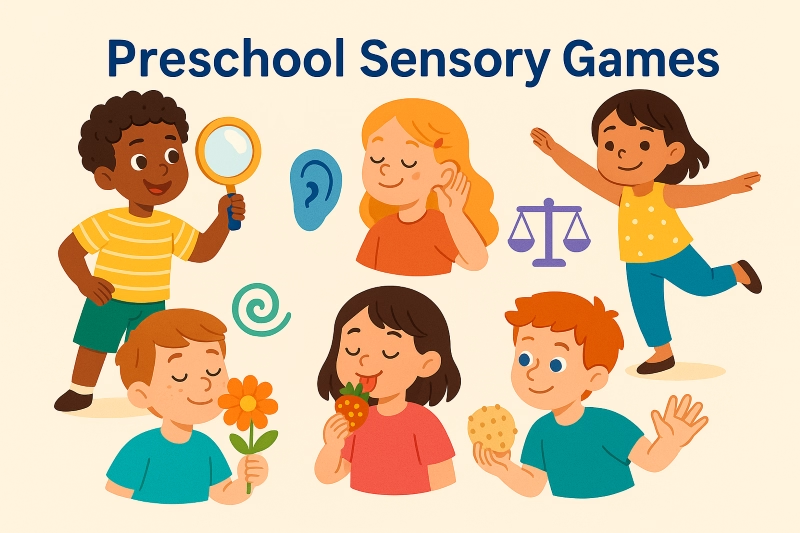
Children are natural explorers. They smell flowers, listen to birds chirping, feel warm sand between their fingers, and observe the world around them with endless curiosity. In preschool, this curiosity is pure gold — because sensory games are the perfect way to strengthen and develop all five senses.
Whether it’s sight, hearing, smell, taste, or touch — every sensory experience supports healthy development and prepares children for new learning adventures. And the best part? Many of these activities can be done indoors, outdoors, or even turned into a fun little scavenger hunt (here are creative outdoor scavenger hunt ideas).
Why Sensory Games Matter in Preschool
Last updated: April 2026 | Reading time: 7 min
These game ideas are based on hands-on testing with groups of children at parties, schools, and family events. Every game listed here is a proven crowd-pleaser.
Kids don’t just learn with their eyes — they learn with their entire body. Sounds, scents, tastes, movements, and colors form new impressions every day. The more senses they use at once, the deeper the learning experience sticks.
Sensory games help kids notice and process these impressions. They strengthen concentration, fine motor skills, language development, creativity, and social interaction. They also prevent certain senses from being under-stimulated — especially in our digital world, where screens mainly use the eyes and ears.
A well-balanced preschool routine should always combine free play, structured sensory activities, and movement — and sensory games are the perfect addition to make that happen.
Engaging All the Senses Through Play
Sensory games thrive on variety and multisensory experiences. Some activities focus on one specific sense — like listening — while others activate several senses at once, just like a well-designed kids’ scavenger hunt does (here are matching riddle ideas for kids).
Experiencing different sensory inputs helps sharpen awareness and boosts children’s concentration. Teachers and parents should always adapt these games to each child’s age and comfort level. Some kids are sensitive to loud sounds or strong flavors, while others constantly seek new sensory experiences. A good mix ensures every child benefits.
Seeing – Exploring the World With Their Eyes
Sight is one of the most important senses for young children. They love comparing colors, spotting shapes, and discovering tiny details. Games that strengthen visual awareness are perfect for helping them focus and observe more closely.
One exciting variation is temporarily “taking away” their vision — for example, using a blindfold. This helps kids realize how much they rely on their eyes and how their other senses take over when sight is limited.
Games like “Spot the Difference”, memory, or detailed puzzles help sharpen attention while building patience and persistence. Search-and-find activities — indoors or outdoors — are also ideal: Who can find the red ball in the bushes or the colorful marble on the playground first? These challenges fit perfectly into a preschool scavenger hunt where children follow picture clues or symbol-based hints (here are our printable templates).
Intensifying Visual Awareness: Blindfold Games & Light–Dark Experiments
Because we rely so heavily on sight, it’s thrilling for kids to “switch it off” for a moment. Blindfold games help children explore their environment in a completely different way — and encourage them to trust their other senses. Many activities also strengthen teamwork, especially when one child leads another through a task.
A classic example is blindman’s bluff, but scavenger hunt challenges with blindfolds can be just as exciting. The key: participation should always be voluntary, since some children may feel uneasy in the dark. Watching first often helps them feel safe enough to join later on.
Things get even more fascinating when kids experiment with light and darkness. Darkening the room and then slowly turning the lights back on helps them realize how colors and mood change — a surprising and memorable experience.
This is also perfect for an indoor scavenger hunt where clues only appear in the dark, such as glowing symbols revealed by a flashlight (here are matching indoor game ideas).
Smelling – Exploring the World With Their Nose
Scents trigger memories, emotions, and recognition. Kids quickly learn that flowers smell wonderful while the trash can… doesn’t. It becomes even more exciting when they start noticing subtle scents — like vanilla, fresh-cut grass, or rain hitting warm pavement.
Smell-based sensory games strengthen focus and attention. A favorite is scent memory: small containers with matching scent pairs — cinnamon sticks, lemon peel, mint leaves — are used to match smells while blindfolded.
These activities work beautifully outdoors as well — during a walk in the woods, children can explore the smell of moist soil, pine needles, or mushrooms.
Tip: During a nature scavenger hunt, scents can even be used as clues — like following the lavender smell to the next station.



Tasting – Engaging the Sense of Flavor
Kids love trying new things — and taste is deeply connected to memory. A sweet strawberry cake may remind them of Grandma’s backyard, while a salty pretzel evokes a fun day at the playground.
A great way to explore tastes is a tasting rally with small bite-sized samples — lemon slices (sour), pretzels (salty), dark chocolate (bitter), or strawberries (sweet). Children guess the flavor, expand their vocabulary, and learn to describe what they taste.
Special occasions like holiday baking or a picnic are also perfect for these conversations. Tip: In a station-based scavenger hunt, you can include a blind taste test where kids guess fruits or spices — like banana, cucumber, or cinnamon.
Touch – Discovering the World With Their Skin
The skin is our largest sensory organ — and kids can feel countless textures and temperatures: warmth, cold, roughness, softness. Touch is essential for motor development and body awareness.
An all-time favorite is the blindfold touch box: children feel different items — stones, sponges, feathers, shells, pinecones — and describe what they notice. Words like “soft,” “scratchy,” “cool,” or “smooth” become easier to understand when linked to real experiences.
A summer highlight is the barefoot path: walking over sand, moss, pebbles, or bark chips. Even more fun: integrating it into an outdoor scavenger hunt as a mini-challenge before the next clue (here are more outdoor movement games).
Hearing – Exploring the World With Their Ears
Sounds fascinate kids — chirping birds, the wind, a flowing stream, or the rustling of paper. Hearing helps them learn language, rhythm, and music.
A great auditory game is sound memory: children listen to different sounds — tapping wood, shaking a can, rustling leaves — and match pairs. These sounds can even become scavenger hunt stations: only if the sound is identified correctly do they get the next clue.
Sound stories are also popular: the adult tells a story, and kids create matching noises — thunder on a drum, wind with paper. It strengthens both listening skills and imagination.
Balance – Finding Stability Through Play
The sense of balance is essential for coordination, motor skills, and confidence. Preschoolers love activities that challenge their balance.
A classic is a balancing course — walking along a line, beam, or rope while stepping over or ducking under obstacles. This can easily be turned into an adventure scavenger hunt by naming it a “wobbly bridge” leading to the next clue (here are more outdoor scavenger hunt ideas).
Circle games with spinning and jumping also strengthen balance — older kids especially enjoy friendly competitions like who can walk straight after five spins.
Conclusion: Sensory Play in Preschool – Fun, Engaging & Full of Learning
Sensory games are far more than fun activities — they are essential for children’s comprehensive development. Sight, hearing, smell, taste, touch, and balance all work together to help kids understand the world, make connections, and grow with confidence.
Preschool offers endless opportunities to support these senses — indoors, outdoors, individually, or in groups. The best part? Kids don’t even realize they’re learning, because they’re having such a great time.
You can also integrate these sensory challenges into a scavenger hunt to boost motivation even more. The result? Unforgettable adventures — and stronger skills kids will carry with them for years to come.
Paper Clue Scavenger Hunt
$4.99 — View & Download