

Blog
Culinary Scavenger Hunt: 8 Junior Iron Chef Challenges for a Food Science Birthday Party
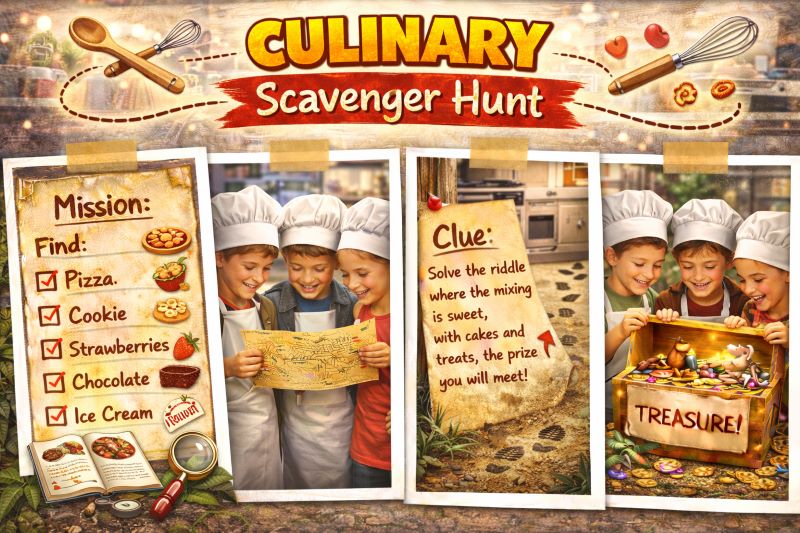
Last updated: April 2026 | Written by Arne, founder of Riddlelicious
About this guide: The best culinary party format isn’t a cooking class — it’s a competition with real judging criteria. Professional chefs are evaluated on technique, flavor balance, presentation, and knowledge. This guide applies those same four categories to 8 stations that teach the actual science behind cooking: emulsification, Maillard reactions, flavor pairing, knife skills, and plating principles. Kids learn to cook and understand why each technique works.
Professional chefs train for years. But the fundamental science of cooking — why bread rises, why onions caramelize, why vinegar cuts through fat — can be explained and experienced in 10-minute stations. When kids understand the mechanism behind a technique, they remember it permanently and can apply it to any recipe.
The Junior Iron Chef Challenge structures the party as a professional culinary competition. Each station is a judged challenge with specific scoring criteria. Teams earn points for technique, flavor, and presentation at each station. The team with the highest cumulative score at the end wins the Junior Iron Chef title.
Quick Facts
- Ages: 7–12 (adult supervision at heat stations)
- Players: 4–16 (chef teams of 2–4)
- Duration: 90–110 minutes (cooking takes longer than non-food stations)
- Location: Kitchen — needs counter space and adult supervision
- Equipment: Cutting boards, mixing bowls, hand mixer, measuring tools, timer
- Food science: Emulsification, Maillard reaction, acid-base leavening, flavor pairing, knife skills

The Junior Iron Chef Setup
Give each team a Chef’s Dossier: their team name (they choose a culinary style — Team French Technique, Team Street Food, Team Farm-to-Table), a scoring card with columns for Technique, Flavor, and Presentation, and a set of Mise en Place Cards listing the tools and ingredients at their station.
A head judge (host adult or an older helper) scores each team at each station immediately after completion — 1–5 points per criterion. Scores are posted on a visible “Score Board” between rotations. The transparent scoring creates competitive energy without requiring explicit ranking until the finale.
Want Printable Culinary Station Cards?
Our Paper Clue Scavenger Hunt is fully customizable — use it to build your own food-themed clue trail with custom recipe cards and scoring sheets for any culinary theme.
The 8 Culinary Challenges
Knife Skills — Brunoise and Julienne
Food science: Uniform cut size ensures even cooking — large pieces take longer than small ones, so inconsistent cuts produce some over-cooked and some under-cooked pieces in the same dish. Professional knife skills are fundamentally about consistency, not speed.
Task: Each team member cuts a cucumber or carrot into: (1) a julienne (thin matchstick strips, ~3mm × 3mm × 5cm), (2) a brunoise (tiny cubes by cross-cutting the julienne, ~3mm × 3mm × 3mm). The judge scores the most consistent 10 pieces from each kid: how many are within 1mm of each other?
Judging: Technique (claw grip used, controlled cuts) + Consistency (uniform size)
Emulsification — Making Vinaigrette
Food science: Oil and water don’t mix because oil molecules are nonpolar and water molecules are polar — they repel each other. An emulsifier (mustard, egg yolk, honey) contains molecules with both polar and nonpolar ends, bridging the two phases into a stable mixture. Vinaigrette without emulsifier separates in minutes; vinaigrette with Dijon mustard stays combined for hours.
Task: Make two vinaigrettes: (1) oil + vinegar only (shake vigorously), (2) oil + vinegar + 1 tsp Dijon mustard (whisk). Observe which separates faster. Taste both. The emulsified version has a creamier texture and more integrated flavor. The team’s final dressing is judged on: proper emulsification (does it hold for 5 minutes?) and flavor balance (is the acidity-to-oil ratio appropriate?).
Scoring: Technique (proper whisking) + Flavor (balance) + Science explanation (can they explain why it worked?)
Maillard Reaction — Caramelized Onions
Food science: The Maillard reaction occurs when amino acids and reducing sugars are heated above approximately 280°F (140°C), producing hundreds of flavor compounds and the characteristic brown color of seared meat, toasted bread, and caramelized onions. It is the single most important flavor-development reaction in cooking. Caramelization (separate process) occurs at 320°F in sucrose and produces bitter/sweet compounds.
Task (adult supervised): Slice onions and cook them in a pan over medium heat — one batch with stirring every 30 seconds (prevents browning), one batch left to cook undisturbed (full Maillard). Compare color, texture, and taste after 8 minutes. The undisturbed batch should show more color development. Teams describe the flavor difference in 3 words each.

Leavening Science — Baking Soda vs. Baking Powder
Food science: Leavening in baking means introducing CO2 gas that expands in the oven and makes baked goods rise. Baking soda (pure sodium bicarbonate) requires an acid to react. Baking powder contains both sodium bicarbonate and a dry acid — it activates in two stages: once when wet, once when heated (double-acting). Using the wrong type or amount dramatically changes the result.
Task: Mix two small batches of pancake batter: (1) with baking soda + vinegar (acid source), (2) with baking powder. Pour equal amounts into a dry pan (or just observe the batter reaction without cooking). Which produces more visible bubbles? Which batter rises more on the griddle? Teams also explain: why do recipes sometimes call for both baking soda and baking powder?
Scoring: Technique + Correct scientific explanation of leavening mechanism
Flavor Pairing — Build a Balanced Dish
Food science: Flavor is a combination of taste (sweet, sour, salty, bitter, umami) and aroma (thousands of volatile compounds detected by olfactory receptors). Professional chefs balance flavors using the “flavor wheel” and empirical pairing principles. Contrasting flavors (sweet + sour) amplify both. Complementary flavors (butter + cream) reinforce richness. Cutting flavors (acid, salt) reduce heaviness.
Task: Provide 12 ingredients: salt, sugar, lemon juice, olive oil, fresh herbs, black pepper, honey, soy sauce, hot sauce, cheese, vinegar, cream. Each team creates a 4-ingredient dip or spread using the flavor balance principle: one fat, one acid, one seasoning, one aromatic. The judge tastes each and scores on the five flavor dimensions.
Scoring: Flavor (balance, no single element dominates) + Technique (correct measurement) + Presentation (plated neatly)
Plating — The Art of Presentation
Food science: Food presentation affects perceived taste — studies show that diners consistently rate the same dish higher when it’s plated artistically vs. randomly. The brain processes visual information before taste information, setting expectations that flavor either confirms or contradicts. Professional plating uses: odd numbers (3 elements look better than 4), negative space (empty plate areas draw focus), height (builds dimension), color contrast, and a sauce application technique.
Task: Provide each team the same 5 ingredients: a protein (cheese cube), a vegetable, a sauce (store-bought), a garnish (herb), and a starch (cracker or bread). They have 8 minutes to plate one serving as attractively as possible. Judge scores: color contrast, height/dimension, sauce placement, overall visual appeal.
Sensory Evaluation — Blind Taste Test
Food science: Professional chefs, sommeliers, and food scientists use structured sensory evaluation: appearance, aroma, texture, and taste assessed separately and scored. Blind evaluation removes visual bias — we perceive wines, olive oils, and even chocolate differently when we can’t see the label or color.
Task: Prepare 5 small samples of the same food in different versions: 5 olive oils (different quality/origin), 5 apple varieties, 5 types of cheese, or 5 hot sauces (ranked mild to hot). Teams taste each blind (no labels) and rank from their least to most preferred, then describe what makes each different using professional sensory vocabulary provided on a reference card: finish length, bitterness, astringency, umami, acidity, mouthfeel.
Iron Chef Final — Mise en Place Challenge
“Mise en place” (French: “everything in its place”) is the foundational organizing principle of professional kitchens. Before cooking begins, every ingredient is measured, chopped, and arranged in the order it will be used. Chefs who work without mise en place waste time searching, forget ingredients, and cook unevenly.
Task: Each team receives a recipe card for a simple no-cook dish (a layered parfait, bruschetta topping, or yogurt-based dip). They have 5 minutes to complete mise en place — all ingredients measured and laid out in order — then 5 minutes to assemble and plate. The judge scores: was the mise en place organized before assembly began? Was the final dish completed within time? Does it match the recipe?
Final scoring: Total all station points. Team with highest score wins Iron Chef title. Award individual titles too: Best Knife Skills | Best Flavor Balance | Most Creative Plating | Best Blind Taster.
Decoration Ideas
- Restaurant menu: Print a “party menu” for the day listing all 8 stations in restaurant language — “Course 3: Maillard Reaction Study — pan-caramelized alliums with Maillard commentary”
- Score board: A whiteboard with team names and station columns — visible, updated between each rotation
- Chef uniforms: Paper chef hats (easy to fold) and aprons for each kid — even a simple apron changes body language dramatically
Age Calibration
Ages 7–8
Skip Maillard and leavening heat stations. Focus on plating, flavor pairing, blind taste test, and vinaigrette (no heat required). Knife skills: use child-safe tools only, supervise closely. Final challenge: build a fruit kebab in mise en place order.
Ages 9–10
Full program with adult supervision at heat stations. Flavor pairing is the most engaging creative station at this age. Blind taste test generates surprising discussions about what makes food different.
Ages 11–12
Add: calculate the percentage change in mass from raw to caramelized onions (water evaporation), research one professional chef’s signature flavor pairing technique, and attempt a sauce reduction demonstrating concentration of flavor.
Build Your Own Culinary Hunt
The Paper Clue Scavenger Hunt is our fully customizable template — build your own food science station trail with recipe clue cards, scoring sheets, and any culinary theme you choose.
Frequently Asked Questions
How do I manage safety with kids around heat?
Stations 3 (Maillard) and 4 (leavening griddle) are the only heat stations. At each, assign one adult per station who controls the heat source — kids stir, observe, and taste, but the adult manages the pan. If you prefer to avoid heat entirely, the toast substitution (toaster for Maillard) and the batter bubble observation (no cooking required, just observe the batter reaction) produce the same educational result without any open heat source.
What do I do with all the food the kids make?
The plating station products become the party snack table — present them as the “competition dishes” for everyone to sample after judging. The vinaigrette becomes the salad dressing for the snack spread. The leavening test pancakes can be party snacks. Most station products are designed to be edible — this is part of the appeal.
Sources & Further Reading
- Maillard, L.C. “Action des acides aminés sur les sucres.” Comptes Rendus, 1912 (original Maillard reaction paper)
- McGee, Harold. On Food and Cooking: The Science and Lore of the Kitchen. Scribner, 2004
- Spence, Charles. “On the relationship between visual and tactile perception.” Flavour, 2013 (plating and perception)
- Culinary Institute of America — Knife Skills Curriculum (ciachef.edu)