

Blog
Art Scavenger Hunt for Kids: 8 Studio Investigation Challenges for a Lost Masterpiece Birthday Party
Last updated: April 2026 | Written by Arne, founder of Riddlelicious
About this guide: I’ve run art-themed scavenger hunts for kids aged 6–12 using the art investigation framework — combining actual studio technique stations with art history mystery solving. The key discovery: kids engage much more deeply with art history when they’re investigating a mystery than when they’re being taught. Framing every art fact as a clue in an authentication case changes the dynamic completely.
The most famous art theft in history was the 1911 Mona Lisa theft from the Louvre — it was missing for two years before being recovered. Art authentication, forgery detection, and provenance research are real professional fields employing hundreds of specialists worldwide. The FBI’s Art Crime Team investigates art theft as seriously as any other major crime.
The Lost Masterpiece Recovery format makes every kid an art investigator on a case. A famous (fictional) painting has been stolen and replaced with a forgery. Kids work through 8 investigation stations — combining real studio art techniques with art history analysis — to authenticate the real painting and identify the forger.
Quick Facts
- Ages: 6–12
- Players: 4–20 (investigation teams of 3–4)
- Duration: 80–95 minutes
- Location: Indoor — art stations need flat surfaces
- Materials: Watercolors, black paper, white crayons, color wheel, magnifying glasses
- Art skills: Color theory, perspective, texture, style period ID, art medium ID, forgery detection
The Lost Masterpiece Case Setup
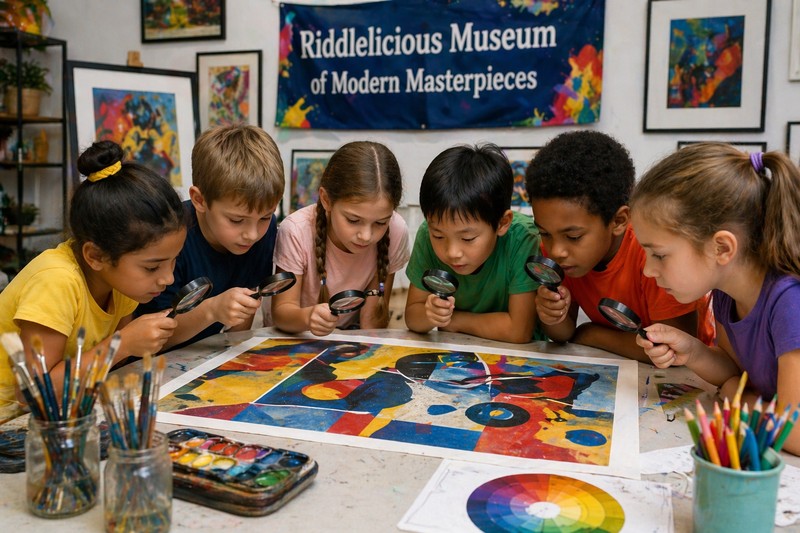
Before the party, create a fictional “Case File” for the investigation: a painting called “Portrait of a Young Falcon” attributed to a Renaissance master was stolen from a museum 48 hours ago. A forgery was left in its place. The forgery contains 8 errors — one per station. Teams must find each error and document it in their Investigation Dossier.
Print two versions of a simple portrait painting (you can use any Renaissance portrait from public domain art databases — Raphael, Holbein). Mark the “forgery” with subtle errors in each category that matches the stations: wrong color mixing, incorrect perspective, wrong historical period detail, etc. Kids don’t know which errors correspond to which stations until they work through each one.
Want Printable Art Investigation Cards?
Our Paper Clue Scavenger Hunt includes blank, fully customizable station cards — perfect for creating your own art investigation clue trail with custom dossiers and evidence cards.
The 8 Investigation Stations
Color Theory Lab — Primary Mixing
Art skill: Subtractive color mixing, the color wheel, complementary colors
Renaissance painters mixed their own pigments. The color wheel developed by Johann Wolfgang von Goethe (1810) and later standardized by Josef Albers describes how pigment colors mix: red + yellow = orange, blue + yellow = green, red + blue = violet. Complementary colors (opposite on the wheel) produce the most visual contrast.
Task: Mix primary colors (red, yellow, blue watercolor) to produce 6 secondary and tertiary colors. Record each mix recipe. Then examine the “forgery painting” — which colors appear in it that are impossible to achieve with pure primary color mixing? (A specific unnatural bright orange that clearly contains synthetic pigment not available in the Renaissance period.)
Forgery error found: The orange in the painting couldn’t exist before cadmium pigments were developed in 1817.
Texture Analysis — Medium Identification
Art skill: Impasto, glazing, watercolor wash — identifying technique from surface texture
Different painting media leave distinct surface textures. Oil paint can be applied thickly (impasto — visible brush strokes raised off the canvas) or thinly (glazing — transparent layers). Watercolor produces soft edges and is applied on absorbent paper. Tempera (the primary medium before oil painting in the 15th century) dries matte and flat. A trained conservator can identify medium from surface texture under magnification.
Task: Examine 5 printed texture close-ups from different paintings. Using magnifying glasses and a texture reference guide, identify each as oil/impasto, oil/glaze, watercolor, tempera, or acrylic. The forgery shows acrylic texture in a “Renaissance” painting — acrylic wasn’t invented until 1940.
Forgery error found: The surface texture is consistent with acrylic, not 16th-century tempera or oil.
Perspective Workshop — One-Point Drawing
Art skill: Linear perspective — vanishing point, horizon line, convergence lines
Linear perspective was developed by Filippo Brunelleschi around 1420 and codified by Leon Battista Alberti in 1435. Before this, European painting had no consistent perspective system — objects in the background were simply painted smaller without geometric logic. One-point perspective (all parallel lines converge at a single vanishing point) became the standard for architectural and interior spaces in Renaissance paintings.
Task: Draw a simple hallway in one-point perspective using a provided template (horizon line and vanishing point already marked). Then examine the forgery — the architectural elements in the background show two-point perspective errors that no trained Renaissance artist would make. Mark the incorrect lines.
Forgery error found: The floor tiles converge to a different vanishing point than the walls.
Art Period Timeline — Anachronism Detection
Art skill: Art history — period identification by style and content
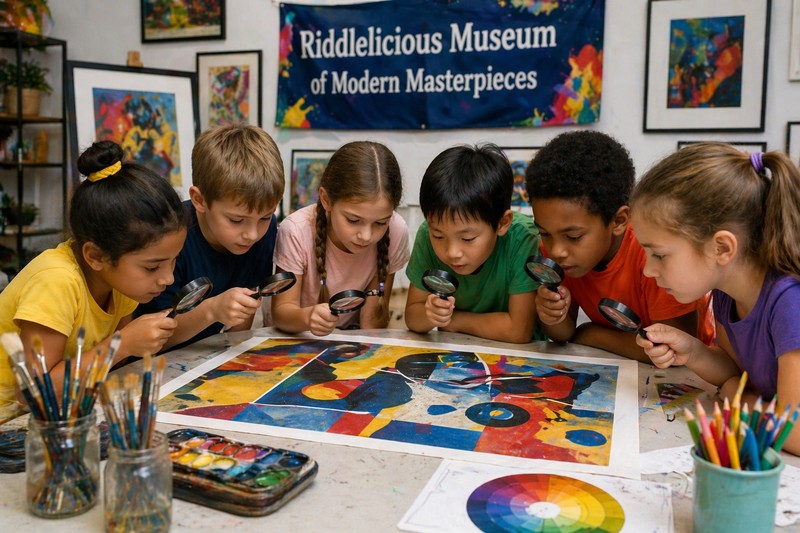
Every art period has distinct visual characteristics: Byzantine art features flat gold backgrounds and symbolic figures; Renaissance shows naturalistic figures with chiaroscuro shading; Baroque uses dramatic lighting and movement; Impressionism uses visible brushwork and outdoor light; Abstract art abandons representational forms entirely. A forger who doesn’t know these differences makes anachronistic errors.
Task: Match 10 painting reproductions (printed, public domain) to their correct period from a reference chart. Then examine the forgery — what period does it claim to be from? Find the anachronistic element that belongs to a later period (e.g., a Baroque lighting technique in a supposedly early Renaissance painting).
Forgery error found: The dramatic tenebrism lighting technique wasn’t used until Caravaggio in the 1590s — 40 years after the painting’s supposed creation date.
Wax Resist Art — Hidden Message Reveal
Art skill: Wax resist technique + hidden content analysis
Wax resist (batik) uses the fact that wax repels water-based paint — draw with a white crayon on white paper, then paint over with watercolor to reveal the “invisible” drawing. Art conservators use a similar principle with infrared photography to reveal underdrawings hidden beneath layers of paint — this is how we know Raphael frequently changed his compositions mid-painting.
Task: Draw a secret message or pattern with a white crayon on white paper, then reveal it by painting over with dark watercolor. Each team reveals a hidden clue this way — the clue points them toward identifying the forger (a fictional character name drawn in hidden text). The technique is also the station “creation” task — each kid makes their own wax resist artwork as a party favor.
Composition Analysis — Golden Ratio Investigation
Art skill: The golden ratio (phi ≈ 1.618), rule of thirds, visual balance
Renaissance artists used mathematical proportions to create visually balanced compositions. The golden ratio (approximately 1.618) appears in the Parthenon, Da Vinci’s Vitruvian Man, and numerous Renaissance paintings. The rule of thirds (dividing the frame into a 3×3 grid and placing subjects at intersection points) is a simplified version still used in photography today.
Task: Place a transparent rule-of-thirds grid overlay on 4 different painting prints. Which subjects align with the grid intersections? Then examine the forgery — the subject’s eyes are positioned at dead center (a composition error that trained Renaissance painters systematically avoided). Mark the positioning error.
Forgery error found: Portrait subject is centered, violating the compositional conventions of the period.
Chiaroscuro Practice — Light and Shadow
Art skill: Chiaroscuro — the use of contrasting light and shadow to model three-dimensional form
Chiaroscuro (Italian: chiaro = light, scuro = dark) was developed systematically by Leonardo da Vinci and perfected by Caravaggio. The technique creates the illusion of three-dimensional form on a flat surface. All shadows fall away from the single light source; highlights appear only on surfaces directly facing it. A forger who doesn’t understand the physics of light makes shadow errors.
Task: Using black and white paint or pencil on gray paper, render a simple sphere with correct chiaroscuro shading — light from upper left, darkest shadow on lower right, reflected light along the bottom edge. Then find the shadow errors in the forgery painting: where do the shadows fall from multiple inconsistent light sources?
Final Authentication — The Forger’s Verdict
Task: Teams compile their Investigation Dossier. Each of the 7 previous stations revealed one forgery error. Teams present their complete list of errors (maximum 7 possible) and a final verdict statement: “This painting is a forgery because [list evidence]. The forger made errors in [categories] consistent with knowledge from after [date]. We estimate the forgery was produced in [era].”
The “real painting” is then revealed (a different print with correct period details) — teams compare their findings to confirm their verdict.
Award categories: Most Errors Found | Best Color Mixing Technique | Best Chiaroscuro Sphere | Best Wax Resist Artwork | Best Documented Dossier
Decoration Ideas
- Gallery walls: Print 10–12 famous paintings (public domain) and hang them with labels — the party space becomes a miniature museum before guests arrive
- Crime scene tape: Yellow “CAUTION: AUTHENTICATION IN PROGRESS” tape across one doorway
- Artist palettes: Paper plate palettes with dried paint (or just colored paint blobs) as table decorations
- Museum labels: Every decoration gets a formal label: “Table No. 3: Mahogany, attributed to IKEA, contemporary period, mixed media”
Snacks
- Artist’s palette cookies: Oval cookies with icing in primary color dots
- Paintbrush pretzels: Pretzel rods dipped in yellow candy melt (the handle) and one end in red (the brush tip)
- Color theory cupcakes: Six cupcakes in red, yellow, blue, orange, green, violet — arranged on a plate in color wheel order
Age Calibration
Ages 6–7
Focus on color mixing, wax resist (they love it), and texture (using magnifying glasses). Skip the period timeline and composition analysis — replace with “find the silly mistake” simpler versions. The sphere shading becomes simple coloring with one dark side.
Ages 8–10
Full program as described. The anachronism detection (finding the wrong historical item) is genuinely engaging at this age. Wax resist artworks become prized party favors. Color theory mixing produces visible “ah-ha” moments.
Ages 11–12
Add: research one additional anachronistic element independently, write a formal authentication report in gallery-standard language, and attempt a small oil pastel study of the chiaroscuro sphere with full mid-tone gradation.
Build Your Own Art Investigation Hunt
The Paper Clue Scavenger Hunt is our fully customizable hunt template — design your own investigation trail with custom evidence cards and dossiers for any theme.
Frequently Asked Questions
Do I need any art experience to run this party?
No — the station guides tell you exactly what to explain. The color theory wheel and chiaroscuro principles each take about 30 seconds to introduce. The investigation framing does most of the engagement work — kids are solving a mystery, not attending an art class.
Where do I get printable public domain paintings?
The Smithsonian Open Access collection (si.edu/openaccess), the Metropolitan Museum of Art’s open access collection (metmuseum.org/art/collection), and the National Gallery of Art (nga.gov) all provide free high-resolution downloads of thousands of paintings. Filter for Renaissance period portraits for the most relevant material for this theme.
Sources & Further Reading
- FBI Art Crime Team — art forgery investigation methods (fbi.gov/investigate/violent-crime/art-theft)
- Alberti, Leon Battista. On Painting (Della Pittura), 1435 — linear perspective codification
- Albers, Josef. Interaction of Color, Yale University Press, 1963
- Metropolitan Museum of Art — How We Authenticate (metmuseum.org)
- Smithsonian Open Access Collection — free public domain paintings (si.edu/openaccess)