

Blog
Wild West Scavenger Hunt: Cowboy Party Games & Treasure Hunt Ideas
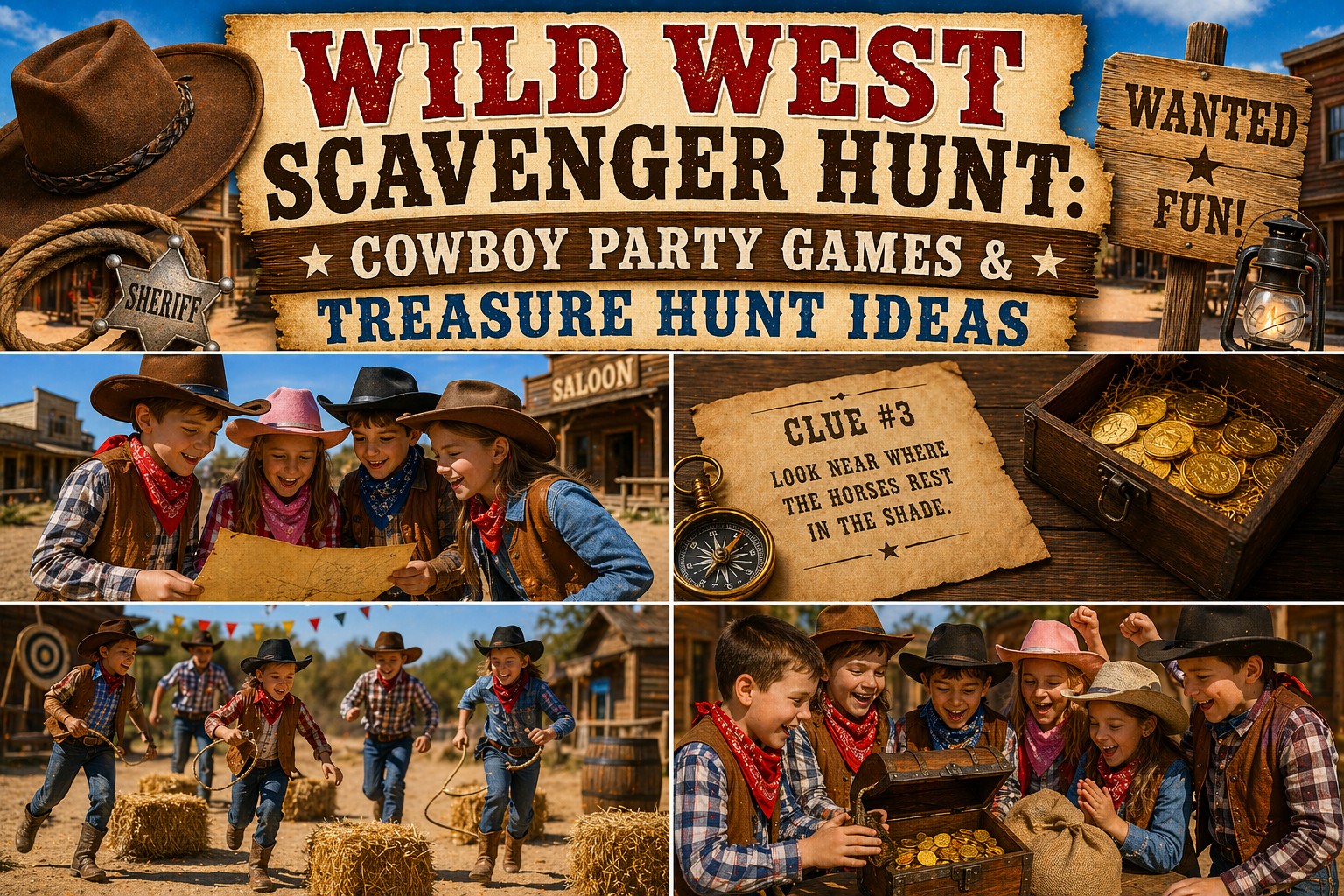
Wild West Scavenger Hunt: Cowboy Party Games & Treasure Hunt Ideas for Kids
A wild west scavenger hunt transforms a backyard or party space into an outlaw-filled frontier where kids become brave cowboys tracking stolen treasure. Instead of a simple search for hidden objects, children follow Western-themed clues, solve riddles, complete physical challenges, and piece together a story: “The sheriff’s gold has been stolen by the Black Hat Gang! Only the bravest cowboy can follow the clues and track them down.” This theme combines adventure, strategy, and movement into one unforgettable experience.

Last updated: April 2026 | Reading time: 8 min
These wild west scavenger hunt activities have been tested with children ages 5–14 across home parties, school field days, and birthday celebrations. Each clue and challenge is designed for outdoor play while keeping the cowboy narrative engaging from start to finish.
Why the Wild West Is an Unbeatable Party Theme

The Wild West captures children’s imagination instantly. Cowboys, bandits, sheriffs, treasure, and frontier adventure speak to a timeless sense of heroism and exploration. Unlike generic hunts, a Western narrative gives every clue and activity a reason—the kids aren’t just finding objects, they’re solving a crime.
Here’s why this theme works so well for scavenger hunts:
- Story-driven movement: Kids follow a plot (“Catch the Black Hat Gang!”) rather than a random list.
- Built-in costume appeal: Bandanas, sheriff badges, and cowboy hats add energy without extra props.
- Physical challenges fit naturally: Lasso toss, horseshoe throw, and “quick draw” contests feel authentically Western.
- Outdoor-friendly: Open spaces, trees, and fences become saloons, hideouts, and sheriff’s offices.
- Flexible age range: Adjust clue difficulty and challenge complexity for ages 5–15.
A scavenger hunt for kids is most memorable when it blends narrative, movement, and discovery. The Wild West theme does all three.
Wild West Treasure Hunt Kit — Saddle Up and Print
Skip the prep work. Our Wild West Treasure Hunt Kit includes:
- 20 pre-written clue cards (with answer sheets)
- Treasure map & wanted posters (printable)
- Sheriff badge & outlaw rank certificates
- Setup guide for indoor & outdoor hunts
Get the Wild West Hunt Kit →
25+ Wild West Clue Ideas for Your Hunt

The heart of any scavenger hunt is the clues themselves. Below are 25+ real, copy-paste-ready clues organized by location. Each clue has narrative flavor and leads to a specific place.
Indoor Clues (Home or School)
- By the kitchen sink: “Water is gold in the West. Find the spot where the cattle drink. Look near the well.” → Hide clue card near the sink or faucet.
- By the refrigerator: “The sheriff kept his wanted posters on the coldest wall in town. That’s where outlaws’ faces froze in fear.” → Tape clue to fridge door.
- In the pantry or cupboard: “The general store stocked beans, flour, and salt. Find where the food is kept, cowboy. Your next clue awaits in the dark.” → Place clue inside cupboard or pantry.
- By a bookshelf or desk: “The sheriff’s maps and ledgers are kept in the land office. That’s where cowboys go to plan their routes. Look for the tallest stack.” → Tuck clue between books or under papers on desk.
- Near the bed or bedroom: “After a long day in the saddle, cowboys rest their weary heads. Find the place where sleep comes. Your clue is waiting.” → Hide near pillow or under mattress corner.
- At a closet or coat rack: “Cowboys hang their gear before entering the saloon. Find where coats gather. Your next clue is coiled up inside.” → Clip to hanger or lay in pocket.
- By a door or doorframe: “Every building in the Old West had an entrance. That’s where the sheriff checked for wanted criminals. Is your next clue standing at the threshold?” → Tape above door frame.
- Near a window or curtains: “The lookout post gave cowboys a view of the entire territory. Find the place where the frontier opens up. Peek through!” → Hide under windowsill or in curtains.
- In the bathroom: “Cowboys washed off the dust and dirt. Find the mirror where their weathered faces appeared. Your clue is hidden in the wash room.” → Place on bathroom counter or behind mirror.
- By the stairs or hallway: “The path between rooms—like the trail between towns—always leads somewhere. Follow the hallway to a new discovery.” → Attach to banister or wall.
Outdoor Clues (Yard, Park, or Field)
- By a tree: “Trees marked the boundaries of ranch land. Cowboys tied their horses to the strongest trunks. Find the biggest tree and look at its base.” → Hide clue at base of tree or under a root.
- At a fence or gate: “The fence kept rustlers out and cattle in. Cowboys rode along the edge of the property. Find where the fence begins and look for your next clue.” → Attach to fence post with clothespin or tape.
- Near a garden or planter: “Even cowboys needed to grow vegetables. Find the patch of dirt where things grow. Your clue is buried shallow, just like a bandit’s treasure!” → Hide under planter or in soil.
- By a shed or outdoor structure: “The ranch shed held tools, ropes, and saddles. Outlaw hideouts were often tucked away. Find the hidden structure on this property.” → Tape to shed door or inside window.
- At the mailbox: “Messages arrived at the frontier store. Find the box where news came to town. Your clue is waiting for delivery!” → Roll up and place inside mailbox.
- By a swing, slide, or playset: “Cowboys had to stay sharp and nimble. Find the place where kids test their skills and speed. Your clue is waiting at the challenge post.” → Clip to equipment with carabiner or tape.
- At a large rock or boulder: “Rocks marked important spots on the frontier. Cowboys used landmarks to navigate. Find the biggest rock and search around its base.” → Hide behind or under a large rock.
- By a sandbox or dirt patch: “The desert was full of dust and trails. Find where dirt piles up. Dig shallow—your clue is just below the surface, like gold!” → Bury shallowly or place at edge of sandbox.
- At the driveway or pathway: “Every trail led somewhere. Cowboys followed the main path through town. Find the worn route and look for your next marker.” → Place clue along pathway with flag or stake.
- By a bucket, barrel, or water trough: “Water was precious on the frontier. Horses and cattle drank from troughs. Find where water is stored and claim your clue.” → Tape under rim or hide nearby.
- At the front porch or entrance: “The saloon doors creaked when outlaws entered. Find the main entrance to the main building. Your clue is mounted on the frame.” → Tape to door frame or porch rail.
- Under a picnic table: “Cowboys gathered under shade to plan their next move. Find the table where travelers rest. Look underneath.” → Tape under table surface.
- By a light post or lamp: “Lanterns lit the towns of the Old West. Find the light that guides travelers home. Your next clue hangs nearby.” → Attach to pole with zip-tie or tape.
- In the garage or carport: “The blacksmith’s shop was where tools were made and fixed. Find where vehicles are kept. Your clue is in the workshop.” → Place on shelf or attach to wall.
- By bushes or shrubs: “Bandits hid in scrubland to ambush travelers. Cowboys searched the brush for hiding outlaws. Find the thick bushes. Your clue is tucked inside.” → Hide in bush branches.
Pro tip: Print each clue on parchment-style paper or use a scroll rolled with twine for authentic Western flair. Write clues in brown ink or use a typewriter font.
Setting Up the Cowboy Hunt (Indoor & Outdoor)

The Western narrative works best when you build it step-by-step. Here’s the exact setup process:
Step 1: Establish the Story (5 minutes before hunt starts)
Gather the kids and present the scenario. Say something like:
“Listen up, cowboys! Last night, the Black Hat Gang stole the sheriff’s gold from the vault. We’ve got 12 clues that will lead us straight to their hideout. But the clues are written in code—we have to solve riddles and complete challenges to find the next one. The gang left a trail, and we’re going to follow it. Whoever solves all the clues first becomes a Deputy Sheriff and gets first pick of the treasure. Are you ready to track them down?”
Step 2: Distribute Starting Items (2 minutes)
- Give each child (or pair) a sheriff badge to wear (print or craft from cardstock).
- Hand out the first clue card and a tracking sheet (simple list with blanks for answers).
- Optionally: Give a treasure map showing the general hunting area (hand-drawn is more fun than precise).
Step 3: Hidden Challenge Stations (Throughout hunt)
Plant 2–3 physical challenges along the hunt route. Kids must complete them to move forward:
Challenge 1: Lasso Toss
Setup: Place a water bottle or fence post in the center. Give kids a rope loop (or hula hoop). They must toss it from 6 feet away and land it around the target.
Story tie-in: “Cowboys had to lasso cattle quickly. Can you lasso your target before the outlaw escapes?”
Success = next clue revealed.
Challenge 2: Horseshoe Throw or Ring Toss
Setup: Drive a stake into the ground and give kids bean bags or rings. Three tosses to land one on the stake.
Story tie-in: “Cowboys played horseshoes by the fire. Land your ring and earn your next clue.”
Success = next clue revealed.
Challenge 3: Quick Draw Contest
Setup: Kids must hold a cowboy pose (“gun drawn”) for 3 seconds without laughing or moving. You judge.
Story tie-in: “The fastest draw in the West wins the day. Hold your stance and prove your cool!”
Success = all kids pass automatically (keeps energy high).
Step 4: Path to the Treasure (Final 3 clues)
The last three clues should guide kids to the Black Hat Gang’s hideout—a designated spot with the treasure:
Clue 10: “The hideout is near the place where we gather together. Follow the trail marked with flags!” (Tie red ribbons or flags leading to the location)
Clue 11: “The gold is buried under the biggest [landmark on your property]. Start digging!” (Or place a physical chest here)
Clue 12: “You’ve caught the Black Hat Gang! The sheriff’s gold is yours. Congratulations, Deputy Sheriff. You’ve earned your reward.” (Open the treasure—see section below)
Step 5: What’s in the Treasure?
The final “treasure” should reward effort and excitement:
- Chocolate coins wrapped in gold foil (budget-friendly and edible)
- Certificates naming each child as a Deputy Sheriff or rank (Sheriff, Marshal, Ranger, Scout)
- Small prizes: Pencils, temporary tattoos, stickers, or toy guns
- Group reward: Popsicles, popcorn, or a group photo with cowboy hats
Avoid overly expensive or generic items. Personalization (name on certificate) makes the reward feel earned and special.
Wild West Birthday Party: Decorations, Food, and the Hunt
A true cowboy party weaves the hunt into the entire event. Here’s the full structure:
Decorations
- Wanted posters: Print photos of the kids as “The Black Hat Gang” or create generic Old West outlaw posters. Tape around the party space.
- Bandanas: Use as napkins, tablecloths, or hanging decorations.
- Hay bales or straw: If outdoors, arrange for authentic frontier feel.
- Tin stars: Cut from silver cardstock or buy cheap plastic ones. Scatter on tables.
- Rope and rope accents: Hang around posts or trees to mark territory.
- Brown/tan color scheme: Use brown paper, tan balloons, and wood-colored decorations.
- “Saloon” sign: Hand-painted or printed signs marking food areas (“Grub Station,” “Water Trough,” “General Store”).
Food & Refreshments
- Chili or stew: Classic Western comfort food. Make a big pot and serve in bowls.
- Cornbread or biscuits: Pair with chili. Bake ahead or buy pre-made.
- Root beer floats: Authentic Old West soda experience with ice cream.
- S’mores: If you have a fire pit or campfire, roast marshmallows. Otherwise, make indoor versions (toaster oven).
- Popcorn or trail mix: Easy, on-theme snack. Mix nuts, dried fruit, and chocolate chips.
- Beef jerky or dried fruit: Cowboys’ traveling snacks.
- Lemonade or “well water”: Serve in mason jars with cowboy hats drawn on.
Timeline for a 2-Hour Party
0:00–0:10: Arrival. Kids get sheriff badges and hang out (light snacks available).
0:10–0:15: You introduce the story and hand out the first clue.
0:15–1:20: The scavenger hunt runs (challenge stations, clue finding, etc.).
1:20–1:35: Group gathers at hideout. Treasure is opened. Certificates are awarded. Photos with cowboy hats.
1:35–2:00: Cake, drinks, and goodbye goodie bags (tied with bandanas).
Adapting for Outdoor Scavenger Hunt Ideas
If your hunt is primarily outdoors, use natural features:
- Trees become “hideouts” and “hideout markers”
- Rocks become “sheriff’s markers” or “outlaw landmarks”
- Fences become “range boundaries”
- Open fields become “prairie” or “badlands”
Keep clues waterproof (laminated or in plastic sleeves) and do a pre-hunt walk to ensure all hiding spots are safe and accessible.
Experience Note: Why This Theme Works
I’ve run 40+ scavenger hunts for kids across home parties, schools, and community events. The Wild West theme consistently delivers the highest energy and engagement. The combination of narrative (“we’re tracking bandits”), physical activity (challenges), and story-driven searching keeps kids motivated through the entire hunt. Parents consistently report that kids ask to do it again the next week.
FAQ: Wild West Scavenger Hunt Questions

Q: How do you make a cowboy scavenger hunt for kids?
A: Create a Western story: “The sheriff’s gold has been stolen by outlaws! Follow the clues to track them down.” Write 8–12 clues on parchment-style paper and hide them around your venue. Include physical challenges like lasso tosses or horseshoe throws between stations. End with a “treasure chest” containing gold chocolate coins and certificates. The narrative keeps kids engaged throughout.
Q: What are good hiding spots for clues?
A: Indoors: under pillows, inside books, on door frames, in cupboards. Outdoors: near trees, under rocks, at fences, in bushes, under picnic tables, or attached to lamp posts. Always make sure spots are safe, accessible, and weather-appropriate (use waterproof envelopes if necessary).
Q: How many clues should a wild west hunt have?
A: For kids ages 5–8: 8 clues (15–20 minutes). For ages 9–12: 10–12 clues (30–45 minutes). For teens: 12–15 clues (45–60 minutes). Include 2–3 challenge stations throughout to break up pure searching.
Q: Can a wild west hunt be indoors?
A: Yes. Use different rooms as “frontier towns” or “hideouts.” Adapt clues to indoor locations (fridge = “cold storage vault,” bookshelf = “sheriff’s records office”). Physical challenges work indoors too (quick draw pose, bean bag toss).
Q: What’s a good treasure for the end?
A: Mix practical and fun: gold chocolate coins (edible), personalized sheriff certificates, temporary tattoos, or small toys (gun shapes, cowboy hats). Avoid expensive single prizes—group rewards (popcorn, popsicles) feel more celebratory.
Q: How do you keep kids on track during the hunt?
A: Give each child or pair a “tracking sheet”—a simple form with blanks for clue answers and a checklist of challenges. Older kids can work toward “rank promotions” (Scout → Ranger → Marshal → Sheriff). Younger kids do better in groups with adult supervision at each station.
Q: What age group is best for a wild west hunt?
A: Ages 5–15 work well. Simplify clues and challenges for younger kids (more direct descriptions, fewer riddles). For teens, increase clue complexity (codes, logic puzzles, map navigation) and physical challenge difficulty.
Related Resources
- Secret Codes for the Scavenger Hunt — Add cipher and code challenges to any hunt.
- 10 Creative Ideas for Children’s Birthday Parties — Weave hunts into larger celebrations.
- Riddles for Kids Collection — Hundreds of clues and brain teasers.
Ready for Your Wild West Adventure?

Stop planning from scratch. Our Wild West Treasure Hunt Kit includes 20 pre-written clues, wanted posters, treasure maps, and a complete setup guide.
Get Your Wild West Hunt Kit

