

Blog
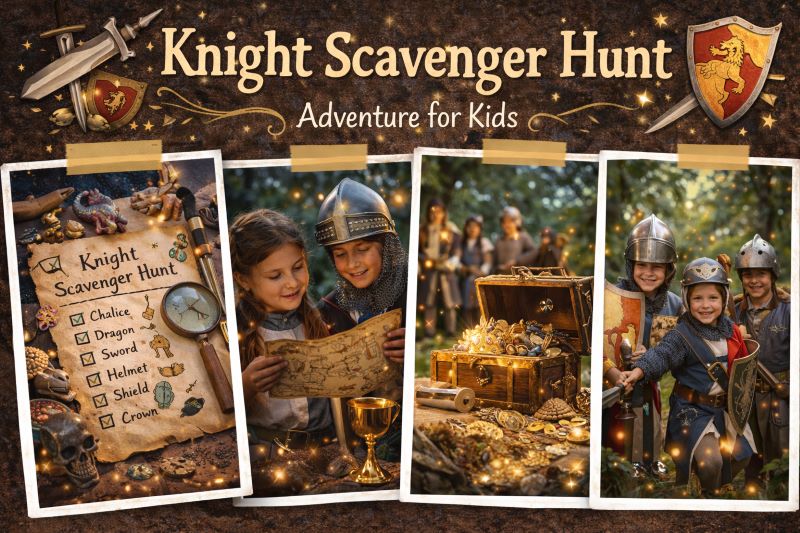
Knight Scavenger Hunt: 8 Quest Challenges for a Medieval Birthday Party
Last updated: April 2026 | Written by Arne, founder of Riddlelicious
About this guide: Medieval knight training was a 15-year process beginning at age 7. Pages became squires, squires became knights — each stage involving specific physical, academic, and chivalric tests. The 8 stations here are based on the actual stages of medieval martial training (combat, horsemanship, fortification, navigation) combined with the Code of Chivalry documented in historical texts like Ramon Llull’s “Book of the Order of Chivalry” (1275). Kids earn Knighthood through genuine trial completion, not participation trophies.
Medieval knights weren’t just warriors in armor. They were the officers, engineers, diplomats, and administrators of their age. A fully trained knight knew siege warfare engineering, celestial navigation, multiple languages, music, combat law, and estate management. Becoming a knight was the most demanding professional training program of the medieval world.
The Order of the Iron Shield party format puts every kid through the traditional squire trials — the same 8 categories of medieval training that determined whether a squire would receive knighthood. Complete all 8 trials and earn a personalized Knight’s Charter (a printed scroll with their chosen knight name).
Quick Facts
- Ages: 5–12
- Players: 6–24 (squire companies of 3–4)
- Duration: 75–90 minutes
- Location: Backyard or indoor — most trials need open space
- Equipment: Pool noodles (swords/lances), tin foil (armor), compass, rope, paper/pens
- Historical themes: Combat, fortification, navigation, chivalric code, siege engineering, heraldry
The Order of the Iron Shield Setup
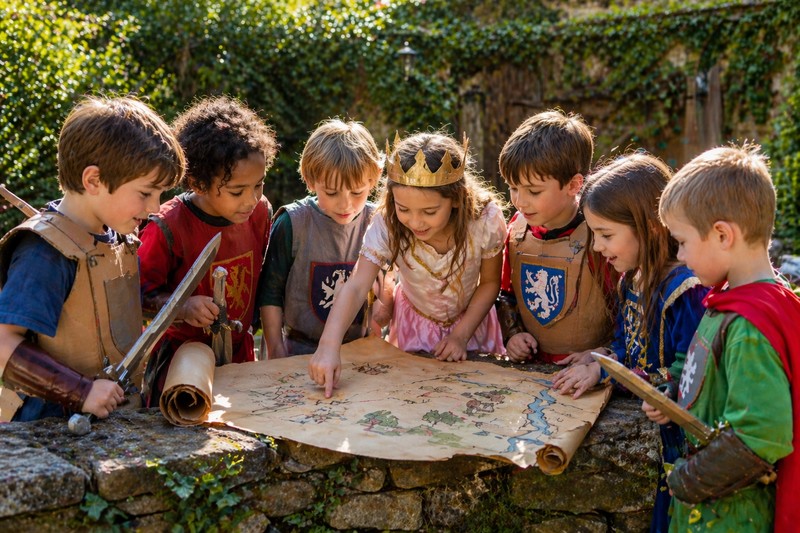
At arrival, each squire chooses a Knight Name (Sir [name], Dame [name]) and joins a company (Company of the Red Lion, Company of the Silver Falcon, Company of the Golden Tower). Each company receives a Squire’s Record — a scroll-style booklet tracking their trial completion. Eight trials, eight seals, one Knighthood.
The host plays the role of the Lord Commander — the presiding knight who oversees all trials. Brief “proclamations” (3–4 sentences, read dramatically) introduce each trial. Tone is everything: solemn but playful.

Want Printable Quest Cards for Your Knights?
Our Princess & Knight Treasure Hunt includes 8 quest station cards, squire trial scrolls, knight charter template, and a castle map — instant download, print and quest.
The 8 Squire Trials
Combat Training — The Sword Trial
Historical basis: Medieval swordsmanship was a formal discipline documented in fighting manuals (Fechtbücher). The earliest surviving manual is MS I.33, dated ~1300 CE. Techniques included the high guard, half-sword grip, and bind-and-thrust sequence. Combat was never random swinging — it was a codified system closer to chess than brawling.
Trial: Using pool noodles as swords, each squire must demonstrate 3 guard positions (taught by the Lord Commander at the start of the trial) and then defend a designated “hit zone” target for 30 seconds against a single attacker who can only strike to that zone. The exercise teaches parry, footwork, and controlled aggression.
Fortification Engineering — Castle Defense
Historical basis: Medieval castle design evolved continuously to counter siege technology. Concentric walls (outer and inner), murder holes, arrow slits, portcullises, moats, and baileys all served specific defensive functions. Military engineers (sappers) were among the most valued members of any medieval army.
Trial: Each company receives 20 wooden blocks or LEGO pieces and must build a defensive fortification that can withstand 5 direct “trebuchet shots” (small foam balls thrown from 2 meters). Their design must include at least: an outer wall, an inner structure (keep), and one additional defensive feature they explain in historical terms. Score: structural integrity (how many shots survived) + historical accuracy of explanation.
Navigation — Star and Sun Reading
Historical basis: Medieval knights on crusade navigated across deserts and unfamiliar territory using sun position, star patterns, and local landmarks. The quadrant (measuring the sun’s angle above the horizon) and the astrolabe allowed reasonably accurate latitude determination. A knight who got lost was a liability to the entire campaign.
Trial: Provide a simple compass and a sun direction guide (sun rises east, sets west, is due south at noon in Northern Hemisphere). Teams must determine the cardinal direction of 4 objects in the yard using only compass or sun position. Bonus: identify the North Star (Polaris) from a star chart at night or, during the day, identify which way is north based on tree moss growth (north side of trees typically shows more moss in shade).
The Chivalric Code — Oath and Honor Test
Historical basis: The Code of Chivalry, codified in texts like Ramon Llull’s “Book of the Order of Chivalry” (1275) and the Song of Roland (~1040 CE), required knights to: protect the weak, serve their lord faithfully, never retreat dishonorably, defend the Church, and treat enemies with honor in defeat. Violations could result in formal degradation — the stripping of knighthood.
Trial: Present 5 chivalric dilemmas — scenarios where multiple “honorable” choices conflict. Example: “Your company is retreating. A fallen enemy soldier calls for help. Your lord has ordered no delay. What does the Code require?” Teams discuss and reach a verdict. The Lord Commander reveals the historical answer from the Llull text. No single answer is always “correct” — the discussion is the test.
Siege Engineering — Trebuchet Physics
Historical basis: The trebuchet (counterweight siege engine) was the most powerful artillery of the medieval period. A large trebuchet could hurl 300-pound stones over 300 meters. The physics: a falling counterweight transfers energy through a lever arm to a sling, launching the projectile. Accuracy was achieved through consistent counterweight, consistent sling length, and consistent release angle.
Trial: Build a small trebuchet from a ruler, a fulcrum (eraser), and a small cup taped to one end. Use a small ball of clay as the projectile. Companies test: (1) where on the ruler should the fulcrum be placed for maximum distance? (2) does adding more weight to the counterweight side increase distance? (3) what angle produces the flattest trajectory? Record results — the physics answers are derivable from the experiment.
Armor and Heraldry — Design Your Shield
Historical basis: A knight’s coat of arms was their legal identity — more binding than a signature in many medieval legal contexts. Heralds (specialists in heraldic law) maintained registers of every coat of arms to prevent duplication. The design rules (tincture law: never put color on color, always metal on color or color on metal) ensured coats of arms remained visually distinguishable at combat distance.
Trial: Each squire designs their personal coat of arms on a paper shield, following three rules: (1) a metal (gold/silver) background requires a colored charge; (2) a colored background requires a metal charge; (3) choose a symbol that represents a personal quality — and explain it. The Lord Commander reviews each shield for tincture law compliance before granting this trial’s seal.
Jousting — The Lance Trial
Historical basis: Tournament jousting evolved from actual mounted combat training into a formalized sport with strict rules by the 13th century. Points were scored for: breaking a lance on the opponent’s shield (1 point), striking the helmet (2 points), unhorsing the opponent (3 points). Aim mattered more than force — the lance had to contact a specific target zone.
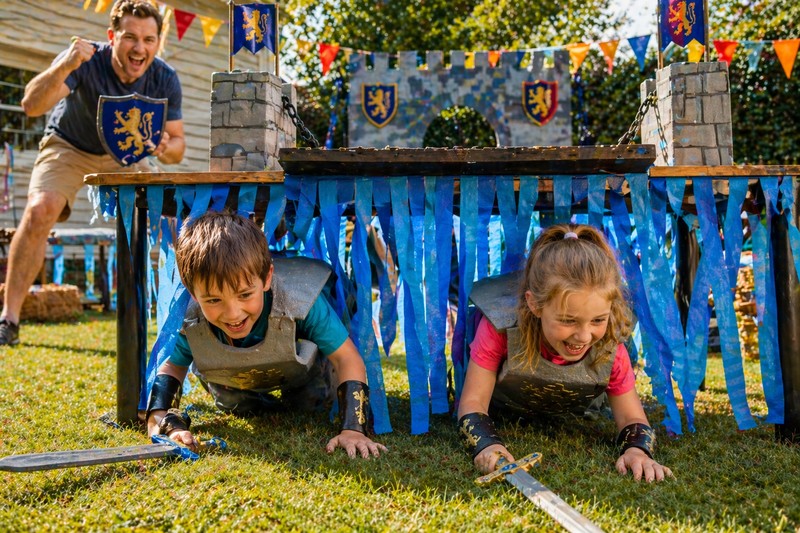
Trial: Simplified ground version with pool noodle lances. Two squires face each other 10 meters apart and walk (not run) toward each other. The lance must contact the target zone (a paper shield held in front of the chest) and not the face or sides. Speed is not scored — accuracy and control are. Each company runs 3 passes per member; scores recorded as per the historical point system.
The Knighting Ceremony
Historical basis: The dubbing ceremony (from Old French “adouber” — to equip) involved the squire kneeling, receiving a sword blow to the shoulder (the accolade), and swearing the knightly oath. The ceremony’s purpose was public — witnessed by peers, it carried legal and social weight that private ceremony did not.
The ceremony: The Lord Commander calls each squire’s company forward. The squire’s full name and knight title is read aloud. The Lord Commander taps each shoulder with a foam sword (or a ruler) and reads the abbreviated Knightly Oath: “Do you swear to act with courage, defend the weak, honor your word, and uphold justice?” The squire answers: “I do so swear.” The Knight’s Charter (printed, with their name and knight title) is presented.
Award categories: Most Honorable Combat | Best Fortification Design | Most Accurate Trebuchet | Best Coat of Arms | Most Thoughtful Chivalric Argument
Decoration Ideas
- Castle gate entrance: Two large cardboard box towers flanking the party entrance — a rope “drawbridge” between them completes the effect
- Tournament banners: One banner per company, hung at their team area with the company’s heraldic animal
- Weapons rack: A decorated rack (ladder leaned against a wall) holding all the pool noodle swords and lances before the party starts
- Medieval feast table: Wooden board placemats, simple pewter-style plates, and candles (or battery candles) — the aesthetic is 80% of the atmosphere
Snacks
- Feast spread: Whole roasted chicken pieces, bread, grapes, cheese — items that work with a medieval feast aesthetic and require no utensils
- Knight’s ration pouches: Drawstring bags with nuts, dried fruit, and crackers — authentic to what knights carried on campaign
- Castle cake: A rectangular cake with four round ice cream cone turrets covered in gray frosting
Age Calibration
Ages 5–6
Focus on combat (simple tag with pool noodles), shield design (coloring), and the knighting ceremony (which is the highlight at this age). Skip trebuchet physics, compass navigation, and chivalric dilemmas.
Ages 7–9
Full program as described. Trebuchet experiment works well and produces visible results. Shield design with heraldry rules is achievable with the reference card. Chivalric dilemmas generate surprisingly good discussions.
Ages 10–12
Add: calculate trebuchet launch angle for maximum range (45° theory), research one historical knight’s documented coat of arms and compare to their own design, and write the full chivalric oath text in period-appropriate language.
Download the Princess & Knight Treasure Hunt
Quest station cards, squire trial scroll, knight charter template, and castle map — for ages 5–12, instant download, print and quest.
Frequently Asked Questions
Can girls participate equally in the knight theme?
Absolutely — historically, female knights existed (most notably Dame Nicola de la Haie, who held Lincoln Castle through a siege in 1217, and the female Order of the Hatchet in 14th-century Catalonia). Use “Dame [name]” titles for female squires. The shield, combat, and chivalric trials apply identically regardless of gender. The Princess & Knight Treasure Hunt product supports both roles.
Is the combat trial safe?
Yes — pool noodles are soft enough to prevent injury on accidental face contact. The controlled walking version of jousting (Trial 7) eliminates collision risk. Establish one rule at the start: no strikes above shoulder height in the sword trial. This single rule prevents all the problematic contact while keeping the activity engaging.
Sources & Further Reading
- Llull, Ramon. Book of the Order of Chivalry (~1275 CE) — chivalric code text
- MS I.33 (c. 1300 CE) — Royal Armouries, oldest known European fighting manual
- Gravett, Christopher. Knight: Noble Warrior of England 1200–1600. Osprey Publishing, 2008
- Trebuchet physics — University of Nottingham medieval engineering research
- College of Arms (London) — Heraldry and tincture law (college-of-arms.gov.uk)