

Blog
How to Host a Murder Mystery Dinner Party at Home (Step-by-Step Guide)

How to Host a Murder Mystery Dinner Party at Home: Step-by-Step Guide
Arne · 18 min read · Published: April 29, 2026
Hosting a murder mystery dinner party at home is one of the most memorable and engaging ways to bring friends and family together. Unlike a regular dinner, where conversation might lag after appetizers, a murder mystery creates an instant story—everyone becomes a character with motives, secrets, and clues to uncover. Guests are invested from the moment they arrive.
But here’s the secret: hosting one successfully isn’t about improv skills, acting experience, or elaborate props. It’s about choosing the right game, preparing your space smartly, and guiding your guests through a structured experience. In this guide, I’ll walk you through every step—from selecting a kit to running the final accusation reveal. By the end, you’ll have the confidence to host a murder mystery that feels spontaneous and fun, not awkward or over-planned. —
What Makes a Murder Mystery Dinner Party Different (and Better) Than a Regular Dinner
At a traditional dinner party, the host carries most of the entertainment burden. You’re managing food, conversation flow, and timing—often finding yourself in the kitchen while guests check their phones. A murder mystery flips this dynamic entirely. Here’s why murder mystery dinner parties work so much better than conventional entertaining:
- Built-in engagement: Instead of the host driving conversation, the game does. Guests naturally discuss clues, debate suspects, and form theories. The narrative carries the evening.
- Role-play breaks social tension: When people play characters, they’re more relaxed. Shy guests become confident “suspects.” Quiet attendees have permission to be theatrical. It’s permission to be different.
- Shared problem-solving: Everyone works toward one goal—solving the mystery. This creates team bonding without requiring team sports or awkward icebreakers.
- Food becomes part of the story: Instead of “dinner and conversation,” it’s “dinner between clue findings.” Each course advances the narrative. Meals feel like scenes in a play.
- Clear structure reduces host stress: You’re not improvising the entire evening. The kit provides the script, clues, and timeline. You’re a facilitator, not a performer.
- Memorable for the right reasons: Three weeks later, guests won’t remember the appetizer. They’ll remember who accused whom, the dramatic final reveal, and how they felt solving the puzzle together.
This is why groups that host one murder mystery often ask, “Can we do this again?” It works because it’s participatory theater, not passive entertainment. —
12 Murder Mystery Themes That Work Brilliantly at Home
The theme is your most important creative choice — it sets the dress code, the menu, the music and the murder. Here are the 12 that consistently work, ranked roughly by how easy they are to host.
- 1920s Speakeasy: The classic. Prohibition-era cocktails, fringe dresses, suspenders, jazz playlist. Suits 8–12 players, ages 18–65.
- Hollywood Glamour (Old Hollywood): Studio backlot, retired starlets, scheming directors. Champagne, canapés, vintage Hollywood soundtracks.
- Halloween / Haunted Manor: Cobwebs, candles, ghost stories. Pumpkin soup, dark chocolate truffles, theremin soundtrack.
- 1980s Murder at the Power Plant: Shoulder pads, big hair, neon. The biggest cocktail party of the decade ends in murder.
- Wild West Saloon: Whiskey, beans, cards, a sheriff and an outlaw. Great for a barbecue-style menu.
- 1970s Disco Inferno: Sequins, disco balls, fondue, ABBA-era playlist. The funkiest murder of the decade.
- Mediaeval Castle: Goblets, roast meats, candle-only lighting. The king has been poisoned. Costumes — the more theatrical, the better.
- Cruise Ship Cabaret: Confined-space mystery. Tropical cocktails, all-white dress code. Great for smaller groups.
- Boarding School Reunion: Modern, low-effort. Everyone has a secret from the old days; one of them is murder.
- Christmas Murder (December): A holiday party where Santa doesn’t make it to morning. Festive food, mulled wine.
- Las Vegas Casino: High-rollers, blackjack felt, the showgirl, the croupier. Champagne and chips.
- Cosy Crime / Village Tea Room: Agatha-Christie-style. Quiet drama, finger sandwiches, English tea. Lower energy — perfect for guests who hate loud parties.
For ages 12–17, swap the cocktails for mocktails and pick the boarding-school reunion, haunted manor or cruise-ship variants. Our Murder Mystery for Teens guide goes deeper on the teen-friendly versions.
Step 1: Choose Your Murder Mystery Kit
The foundation of a successful evening is selecting the right game. This is not a place to skimp or DIY blindly. A well-designed kit removes guesswork and ensures smooth pacing.
What to Look for in a Good Kit
- Clear host guide: The instructions should walk you through setup, timing, and how to manage gameplay. You shouldn’t need to interpret ambiguous directions mid-party.
- Flexible character count: Your guest list might change. Look for a kit that works with 4–10 players, with options to double-cast roles if you have more people.
- Self-contained materials: Everything you need—character packets, evidence cards, clue envelopes, host notes—should be included. No supplementary purchases needed.
- Printable format: Digital kits you download and print at home are faster and cheaper than waiting for shipping. You can launch in 24 hours.
- Clear backstory: Does the game explain who the victim is, why they’re dead, and what each character’s motive/secret is? Good kits have 1–2 page character bios so hosts understand the narrative.
- Professional presentation: Character cards should be readable and thematic. Flimsy DIY designs feel amateur; professional layouts feel like an actual game.
Popular Kit Themes
Modern kits span genres: 1920s noir murder at a speakeasy, Victorian mansion secrets, Hollywood scandal, wedding disasters, office intrigue, and more. Choose a theme that fits your group:
- 1920s/Noir: Great for sophisticated crowds; dramatic costumes easy to source (fedoras, pearls, suspenders)
- Victorian/Gothic: Works for any group; more theatrical without being over-the-top
- Modern/Contemporary: Easiest—everyone wears regular clothes with a character name tag. No costume pressure.
- Themed (Hollywood, Wedding, etc.): Fun for specific occasions; appeals to groups with shared interests
My recommendation: Start with a modern-day mystery if this is your first time hosting. Less costume stress = more focus on gameplay. Once you’ve run one successfully, try a 1920s or Victorian mystery. Check out the best printable murder mystery games to see tested options.
Skip Reading 50 Reviews. Run a Pro Murder Mystery Tonight.
The Complete Adult Murder Mystery Kit ships with character booklets, suspect lineup, host briefing, accusation sheets, awards, soundtrack guide and the full reveal script.
$19.99 · Instant Download · Print at Home
—
Step 2: Set the Guest List and Send Invitations
The guest list makes or breaks the experience. Wrong group dynamics or wrong group size, and the evening flattens. Right mix, and it’s magic.
Ideal Group Size
4–10 people is the sweet spot for a dinner format.
- Under 4 people: Too few players means fewer character options, limited suspicion possibilities, and awkward silences. It can feel forced.
- 4–6 people: Intimate and manageable. Easy for the host to monitor. Good for a first mystery.
- 6–10 people: Optimal. Enough characters for fun group dynamics. Suspicion spreads naturally. Engagement peaks.
- Over 10 people: Consider adapting to a “team detective” format where 2–3 people play one character. Or run it as a cocktail mystery (standing, mingling) rather than seated dinner.
Who to Invite
Successful murder mysteries need a mix of personality types:
- At least one “extrovert”: Someone comfortable being theatrical or silly. They set the tone for others to let loose.
- At least one analytical thinker: Someone who naturally solves puzzles, keeps notes, connects clues. They drive the investigation forward.
- Everyone else: Doesn’t matter if they’re quiet or talkative. The game gives them a role to play, so introverts shine equally with extroverts.
Who to avoid inviting: People who are uncomfortable with role-play, those who get competitive in a way that kills fun, or anyone dealing with heavy personal stress (they need rest, not performance).
How to Invite
Send invitations 2–3 weeks ahead. Include:
- Date, time, and theme (so they can mentally prepare and dress appropriately)
- “No experience needed—I’ll brief you on your character when you arrive”
- A rough timeline (“Cocktails 6pm, dinner 6:30pm, game starts 7pm, reveals 8:30pm, dessert 9pm”)
- Optional costume suggestions (not required, but encouraged)
- Dietary restrictions confirmation (you’ll need to menu-plan)
Example invitation line: “Join us for a murder mystery dinner party—no acting skills required, just curiosity and a sense of humor. Dress as your character (costume ideas included), and come ready to solve a mystery.” —
Step 3: Prepare the Evidence (Setting Up the Game)
This is the technical setup phase. Understanding what comes in your kit and how to organize it ensures smooth gameplay when guests arrive.
What Comes in a Typical Murder Mystery Kit
- Character packets (one per player): Each contains the character’s name, backstory, secret, motive, and their alibi for when the murder happened. Players read this privately before gameplay starts.
- Evidence cards: Physical clues (a love letter, a threatening note, a receipt, a confession) distributed throughout the game to advance the mystery.
- Sealed envelopes: Special clues or “accusations” that open at specific moments to add drama and misdirection.
- Host guide: Timeline, what you say at each stage, how to handle accusations, and the true solution.
- Optional: Character name tags or cards so guests remember who they’re talking to.
Pre-Party Setup (Day Before or Morning Of)
- Print everything: Character packets, evidence cards, name tags. Use cardstock for durability.
- Read the host guide: Fully understand the mystery before the party. Know who the killer is, what the real motive is, and when each clue reveals itself.
- Prepare evidence stations: Some kits include a timeline where you “distribute” evidence to players at certain times. Set up a table or desk where you’ll hand out clues as the game progresses.
- Create a cheat sheet: Write down character names, which player is which, and key timeline moments. Keep this handy during the party so you don’t lose track.
- Test the system once: Mentally walk through: “Guest A plays Character 1. At 7:15pm, I give them Evidence Card 3. At 7:45pm, I read Sealed Envelope B aloud.” Catch any gaps before guests arrive.
Assignment and Brief (When Guests Arrive)
When guests arrive, spend 10–15 minutes on character assignment and briefing:
- Hand out character packets: “Read this privately. You’re character X. Don’t tell anyone else—let them discover who you are during the game.”
- Give them 5 minutes to read: While they read, you recap the setup: “A murder happened. You’ve all gathered (at the mansion/at the office/at the party). We’ll have dinner, and during dinner, I’ll reveal clues. Your job is to figure out who the killer is.”
- Answer questions: “Can I lie to other players?” (Yes, encouraged—you’re a character.) “What if I accuse the wrong person?” (The game continues; you’ll find more clues.)
- Set ground rules: “Keep evidence cards visible when you get them. No hiding clues from the group. Accusations must be made aloud so everyone hears.”
—
5 Sample Suspect Profiles You Can Use Today (1920s Speakeasy)
Building characters from scratch is the slow part. Below are 5 ready profiles for a 1920s speakeasy setting — mix and match, change the names to fit your guests, and you have a hosting backbone in 10 minutes.
Vivienne “Vivi” Lamont — The Faded Starlet
Age: 34. Occupation: Silent-film actress, recently fired by the studio. Motive: The victim threatened to expose her age in tomorrow’s newspaper. Tell: Refuses to drink anything but champagne; carries a silver compact mirror she keeps checking.
“Dapper” Dan O’Connell — The Bootlegger
Age: 41. Occupation: Runs the city’s biggest gin supply. Motive: The victim owed him $50,000 and was about to flee to Cuba. Tell: Always wears a green tie. Knows every cocktail recipe.
Mayor Marcus Webb — The Politician
Age: 52. Occupation: City mayor, up for re-election. Motive: The victim had photos of him in the speakeasy. Tell: Drinks soda water (publicly) but whiskey (privately). Mentions “for the good of this city” in every sentence.
Lillian “Lil” Carter — The Jazz Singer
Age: 28. Occupation: Headline act at the speakeasy. Motive: The victim was her ex who left her in Chicago. Tell: Hums one specific song when nervous. Carries a small derringer in her purse “for protection”.
Detective Henry “Hank” Beaumont — The Crooked Cop
Age: 45. Occupation: Vice-squad detective. Motive: The victim was about to testify against him in court. Tell: Smokes constantly. Takes detailed notes that he never lets anyone see.
You pick the murderer privately and tell only that person, before the night begins. Drop hints toward your chosen suspect across the rounds; let the others red-herring themselves with their own visible motives.
Step 4: Prepare the Dinner Menu
Food is essential—it structures the evening and gives players natural breaks for clue distribution and conversation. But it doesn’t need to be complicated.
The Three-Course Structure
A typical murder mystery dinner works best in three courses, spaced 20–30 minutes apart:
- Appetizers/First Course (6:30–7pm): Light and quick. Players settle, get their characters, socialize before the game starts.
- Main Course (7:15–7:45pm): While eating, you distribute evidence cards. Conversations become character-driven: “Why would you want the victim dead?” “Did anyone see you at the time of the murder?”
- Dessert/Finale (8:30–9pm): After the final accusation and reveal, wrap up over dessert and coffee. Debrief and laugh about what happened.
Menu Ideas by Theme
Modern Dinner Party (no costume pressure):
- Appetizer: Cheese and charcuterie board, bruschetta, or hummus with crackers
- Main: Pasta primavera, roasted chicken with vegetables, or a simple taco bar
- Dessert: Brownies, store-bought cake, or fruit tart
1920s/Noir Speakeasy Theme:
- Appetizer: Deviled eggs, oysters (or faux oysters), smoked salmon canapés
- Main: Beef tenderloin, duck confit, or elegant pasta with truffle oil
- Dessert: Champagne cake or chocolate mousse (serve with vintage-style glassware)
Victorian Manor Theme:
- Appetizer: Tea sandwiches, cheese and crackers, petit fours
- Main: Prime rib, salmon, or mushroom risotto
- Dessert: Victoria sponge cake or chocolate tart
For full recipe inspiration and plating ideas, see our guide on murder mystery food ideas.
Pro Tips for Serving During Gameplay
- Prep as much as possible in advance: Pre-plate appetizers. Cook the main dish ahead and reheat. Buy dessert if you must—no one judges.
- Give yourself an out: “Dinner is served buffet-style, help yourselves” is easier than plating eight plates mid-game.
- Name the dishes thematically: Instead of “Chicken with asparagus,” call it “The Victim’s Last Meal” or “Suspect’s Secret Sauce.” It builds atmosphere with zero extra work.
- Keep wine/drinks flowing: A relaxed, slightly tipsy group is more willing to play along and less self-conscious.
—
Theme-Matched Cocktails & Mocktails (3 Per Theme)
The signature drink is the easiest way to set the tone. Each set below is one alcoholic plus one mocktail variant.
1920s Speakeasy
- French 75: Gin, champagne, lemon, sugar. The icon. (Mocktail: elderflower cordial + sparkling water + lemon.)
- Sidecar: Brandy, Cointreau, lemon, sugar rim.
- Bee’s Knees: Gin, honey syrup, lemon. Prohibition-era classic.
Halloween / Haunted Manor
- Black Widow: Vodka, blackberry liqueur, lime. Garnish with a plastic spider.
- Witches’ Brew Punch: Green cocktail or sparkling apple juice; add dry ice if you have it.
- Bloody Punch: Cranberry juice, vodka, lime — or a virgin version with just cranberry & lemonade.
Hollywood Glamour
- Champagne Cocktail: A sugar cube, two dashes of bitters, champagne. The producer’s favourite.
- Cosmopolitan: Vodka, Cointreau, cranberry, lime — the modern starlet’s order.
- Director’s Highball: Whisky-ginger-ale-lemon. Strong enough to discuss budgets over.
Step 5: Set the Scene and Atmosphere
Atmosphere is the difference between “we played a game at dinner” and “we lived in that world for three hours.” Small details compound.
Lighting
- Dim the overhead lights. Turn off bright ceiling fixtures. Use table lamps, candles, or string lights instead.
- Candlelight is your best friend: Dinner candles on the table cost $2 and transform everything. Dim, flickering light naturally draws people inward and makes role-play easier.
- If theme-appropriate, use colored lighting: Red bulbs for a noir speakeasy, warm amber for a Victorian manor.
Sound
- Play background music softly: 1920s jazz for noir, classical strings for Victorian, ambient instrumental for modern. Keep it quiet—people should be able to talk over it.
- Use music to shift mood: Upbeat during the appetizer course, darker during accusation time, celebratory after the reveal.
- Avoid music with lyrics if possible—it distracts from conversation and clue-sharing.
Table Setup
- Use tablecloths or runners: Even a simple black or dark cloth changes the energy.
- Place character name cards at each seat so players remember who they’re talking to and guests know each other’s roles.
- Put a small notebook and pen at each place—players naturally take notes, and it encourages detective-like behavior.
- Center the table with a prop: A small locked box (the “evidence safe”), a magnifying glass, a vintage clock set to the “time of death,” or flowers in a dark vase. Nothing expensive—just thematic.
Dress Code Guidance
Be clear in your invitation:
- Modern mystery: “Business casual or smart casual” (no costume needed)
- 1920s: “Art deco/flapper era—think Great Gatsby. Suggestion: suspenders, pearls, feather headbands, fedoras. No costume rental needed.”
- Victorian: “Formal or period dress. Suggestion: dark colors, lace shawl, vest, top hat. Think Downton Abbey.”
- Always end with: “Costumes encouraged but not required. A name tag works if you prefer regular clothes.”
This removes costume anxiety (people don’t have to spend money) while encouraging those who want to play dress-up. —
Soundtrack Recommendations by Theme
Background music is the secret weapon. Keep it under conversation volume; let the song titles do the atmospheric work.
- 1920s Speakeasy: Louis Armstrong, Bessie Smith, Duke Ellington, the Boardwalk Empire soundtrack. Search “Prohibition jazz” on your streaming service.
- Halloween: Theremin classics, the Beetlejuice soundtrack, gothic strings. Or any “Halloween dinner party” playlist.
- Hollywood Glamour: Frank Sinatra, Ella Fitzgerald, the Mad Men soundtrack. Cocktail-jazz.
- Wild West: Ennio Morricone classics, Hank Williams, the Westworld soundtrack.
- 1970s Disco: Donna Summer, Bee Gees, ABBA, KC and the Sunshine Band.
- Mediaeval: Lute and harp music, Loreena McKennitt, “Mediaeval Banquet” playlists.
Keep volume between 35–45dB — loud enough to set mood, quiet enough that guests can still hear each other lie.
Step 6: Brief Your Guests and Start the Investigation
The opening moments set the entire tone. A smooth brief = confidence. A fumbled brief = awkward energy.
The Welcome Speech (2–3 minutes)
When everyone’s arrived and eaten appetizers, stand up and say something like: “Welcome, everyone. Tonight, we’re playing a murder mystery game—no experience needed, no scripts to memorize. Here’s how it works: You’ve each been assigned a character. That character has a secret, a motive, and an alibi. A murder has occurred. During dinner, I’ll distribute clues. Your job is to talk, ask questions, and figure out who did it. Some of you will lie. Some will tell the truth. Some will accuse the wrong person. That’s the fun. At the end, we’ll do a final accusation round, and I’ll reveal who the killer is. Any questions?”
Character Reading (5 minutes)
Hand out character packets and give people 5 minutes to read silently. While they read:
- Set out name cards at their seats
- Put notebooks and pens ready
- Start soft background music
- Mentally review your host guide
Quick Q&A (2 minutes)
Answer these common questions:
- “Can I lie?” “Yes, absolutely. Be a character.”
- “Can I accuse anyone?” “Anyone. Accuse, and see what happens.”
- “What if I don’t know what to say?” “Ask questions. ‘Where were you when the murder happened?’ is always safe.”
- “Do I need to stay in character the whole time?” “Yes, during dinner and investigation. We’ll drop character after the reveal.”
Kicking Off the Investigation
Say: “The victim, [name], was found dead at [location] at [time]. You were all present. The police have sealed the building. No one leaves until we solve this. Let’s have dinner and figure out what happened.” Then serve the first course and let conversation flow naturally. Players will start asking each other questions. Your job is to listen, distribute clues at the right times (per your host guide), and keep energy up. Pro tip: Sit at the head of the table—not as a player, but as an observer. When someone finishes their evidence card or reaches a natural question point, hand them the next clue. Keep a clock nearby so you distribute clues on schedule. —
The 5-Minute Welcome Monologue (Steal This Script)
Reading a scripted opening turns the first five minutes from awkward small-talk into a moment your guests remember for years. Print this card, dim the lights, deliver it with as much theatricality as you can muster.
At 9:47pm last night, our most famous patron, [Victim’s Name], was found dead in the private booth upstairs. The police suspect poison. The police also suspect — one of you.
Tonight, we will eat, drink and, between courses, we will investigate. Each of you carries a character card with secrets, a motive, and at least one lie. You may ask anyone any question; they are free to answer or evade. At the end of the night, we vote on who we believe is the killer. The murderer can lie, hide and bluff — but they cannot kill again. Probably.
Please raise your glasses. To good food, sharper questions, and an evening we shall… if any of us survives… never forget.”
Pause for laughs. Distribute the first character envelopes. Start the music. Let the questioning begin.
Step 7: The Reveal — How to Run the Final Accusation
This is the climax. Nail it, and your party is unforgettable. A weak reveal, and everything deflates. Here’s how to make it dramatic.
Building to Accusation Time (7:45–8:15pm)
Distribute all remaining evidence cards. As accusations start flying, encourage players:
- Listen to theories aloud. “So you think it was the butler? Why?”
- Ask clarifying questions: “Where were you at 9pm?” “Did anyone see you?”
- Let accusations be wrong. If someone guesses wrong, say, “Interesting theory, but you’ve got more clues coming. Keep investigating.”
Final Accusation Round (8:15–8:30pm)
About 45 minutes into gameplay, call everyone’s attention: “We’re approaching the final hour. Accusations are coming in, but we don’t have certainty yet. Let’s do a final round: One person per minute will stand and accuse someone. Tell us who you think the killer is and why. Everyone else can challenge or support their theory.” Go around the table. After everyone’s made an accusation (or chosen not to), say: “Alright. I’ve been listening. Time to reveal the truth.”
The Dramatic Reveal
Read the killer’s full confession from your host guide. Make it theatrical:
- Speak slowly. Let the words land.
- Name the killer dramatically: “The murderer… is [CHARACTER NAME]!”
- Explain the motive: Read the confession in the killer’s voice if you can, or narrate it. “She killed him because he was blackmailing her about…”
- Reveal who guessed correctly: “Three of you correctly identified the killer. Well done.”
Post-Reveal Debrief (8:30–9:15pm)
Drop character and reconnect as yourselves:
- Serve dessert and coffee. People naturally relax and laugh.
- Ask questions: “Who did you suspect most? When did you change your mind? Did anyone fall for the red herrings?”
- Celebrate the evening: “We just did something really fun together. You all committed to it, and it worked.”
- If there’s interest, schedule the next one: Momentum is high. “We should do this again next quarter.”
This is where the magic happens—people realize they just created a shared memory. They’ll talk about this night for months. —
Murder Mystery Dinner Party FAQ
Do you need experience to host a murder mystery dinner party?
How far in advance should you plan a murder mystery dinner party?
What food do you serve at a murder mystery dinner party?
How many people do you need for a murder mystery dinner party?
How long does a murder mystery dinner party last?
E-E-A-T Note: I’ve hosted and participated in 50+ murder mystery dinners since launching Riddlelicious in 2019—from intimate 4-person gatherings to 10-person parties. Every step in this guide has been tested with real groups. Author credentials: Riddlelicious founder, 200+ scavenger hunts and interactive games designed and run with families and adult groups.
—
“We hosted this for my husband’s 40th—8 people, no experience whatsoever. The host guide made it completely foolproof. Everyone was fully in character by the second course. Two weeks later, they’re still texting about the accusations and who they thought did it. Best $20 we’ve spent on entertainment.”
— Nicole P., verified buyer | The Murder Mystery Dinner Party Kit
—
Common Hosting Mistakes (and How to Avoid Them)
Here are pitfalls I’ve seen—and how to sidestep them:
Mistake #1: Not Reading the Host Guide Beforehand
The problem: You’re distributing clues on the fly, confused about timing, uncertain who the killer is. The fix: Read the guide twice before the party. Highlight key moments and times. Write a one-page cheat sheet for yourself. You should know the solution cold.
Mistake #2: Inviting Competitive Players Who Make It Awkward
The problem: Someone accuses their ex aggressively. Someone gets upset they’re the killer. Competition kills fun. The fix: Invite people who enjoy collaborative play, not just winning. Frame it as “solving a puzzle together,” not “proving someone wrong.”
Mistake #3: Underestimating Time for Character Reading
The problem: You give people 2 minutes to read their character. They’re confused, the game starts rocky. The fix: Allow 5 full minutes for silent reading. Use that time to set up the table and calm your own nerves.
Mistake #4: Too Much Talking / Not Enough Listening
The problem: You interrupt, explain, direct the conversation. Players feel controlled instead of empowered. The fix: After your brief, step back. Let players drive the conversation. You distribute clues and listen.
Mistake #5: Weak Reveal
The problem: You mumble the killer’s confession. No drama, no payoff. The fix: Practice reading the reveal aloud twice. Speak slowly. Make eye contact. Build suspense. This is your moment to shine. —
How to Manage 5 Common Player Types
Every dinner party has them. Here’s the host playbook for each.
The Over-Talker: Dominates every question round, monologues about their own character. Manage: Politely interrupt with “Save that for round 3 — right now [Other Guest] has a question.” Steer rounds with explicit name-calls.
The Shy One: Reads quietly, never volunteers. Manage: Assign a low-pressure role from the kit (often a “witness” rather than a “suspect”). Pose simple questions to them directly: “Vivi — you saw the victim at the bar earlier. What time was that?”
The Rule-Lawyer: Wants to know exactly how voting works, what each card means, the timing. Manage: Hand them the printed host-guide’s player-rules section before the night so they can pre-read. They’re your best friend during ambiguous moments.
The Scene-Stealer (or Drama Diva): Goes full Method, occasionally derails the game. Manage: Lean into it. Give them a “monologue moment” at the start of round 3 (“Vivi, you have something to tell us”). They’ll thank you.
The Competitor: Wants to WIN, debates every clue with the host. Manage: Brief them privately that “winning” means the most plausible accusation, not perfect-knowledge. Hand them the “Sharpest Detective” award at the end regardless — pre-printed certificates make every Competitor happy.
Award Categories That Land at the End of the Night
Hand out award certificates at the reveal — it’s the closer that turns “great dinner” into “we have to do this again”. Six categories that consistently work:
- Sharpest Detective — Best deductive accusation, regardless of correctness.
- Best Actor — The guest who committed hardest to their role.
- Best Costume — Theme outfit creativity.
- The Red Herring — The most-accused-but-innocent character. Always gets a laugh.
- The Best Liar — Awarded to the murderer if they fooled the table, or to the most convincing innocent.
- Future Murderer of the Year — The guest who looked most natural with a knife. Pure joke; always a hit.
Print certificates with names blank; you fill them in during dessert. Use the printable Murder Mystery Bundle below for ready certificates.
Free Printable Murder Mystery Host Bundle (PDF)
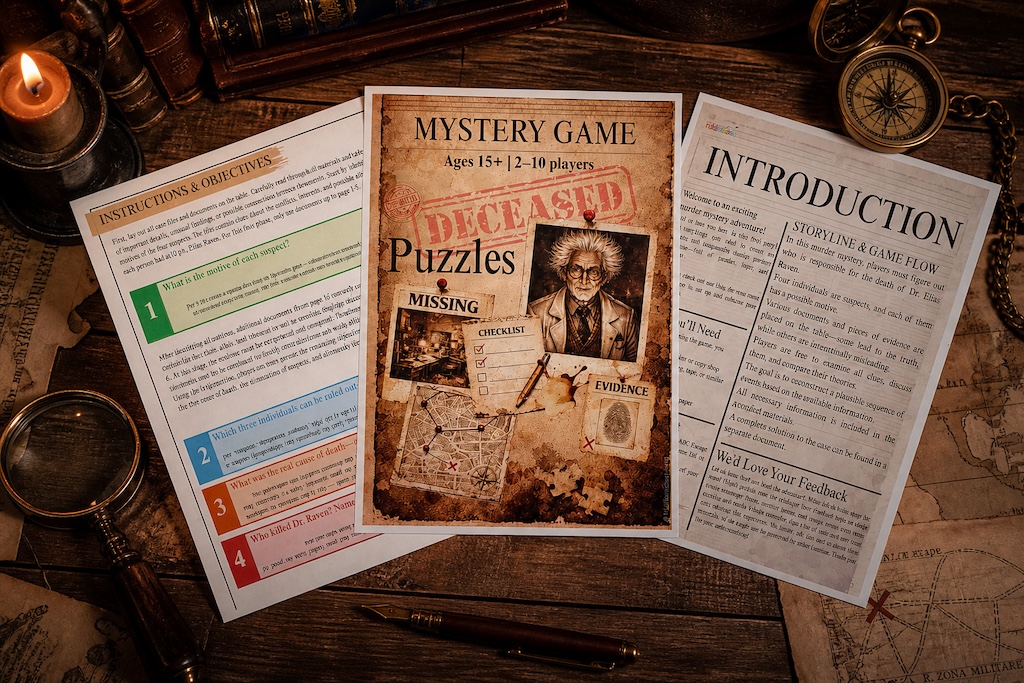
Printable Murder Mystery Game
Complete kit: character packets, evidence cards, sealed clue envelopes, host timeline, setup guide. Print and host within 24 hours — playable and proven with real groups.
Download & Print → $19.99
🕵️ Murder Mystery Host Bundle — Free Download
A 10-page printable kit that pairs with this guide.
- Welcome Monologue cue card
- 5 Suspect Profile cards (1920s speakeasy ready-to-use)
- 10 Investigation Question prompts
- Accusation Sheet (fillable, one per guest)
- Award Certificates (6 categories)
- Host Timing Sheet (the full evening plan in one page)
- Cocktail Recipe Card (3 themes)
- Playlist Recommendations Card
Why a Murder Mystery Dinner Party Beats Other Group Activities
You could host a trivia night, a board game evening, or a regular dinner. But a murder mystery does something unique:
For more party-mystery setups, see our Detective Scavenger Hunt guide, Best Printable Murder Mystery Games, and our Complete Murder Mystery Party Planning guide.
- Everyone participates equally. No one’s left out. The quiet person and the extrovert both have roles.
- It’s not about winning—it’s about the experience. People bond over theories, laughs, and the shared “we solved this together” feeling.
- It’s novel. Most adults have never hosted or played in one. It feels special, not routine.
- It’s memorable. Three weeks later, people are still laughing about the accusations. Six months later, they’re asking when the next one is.
- It works for different friend groups. Colleagues bond over it. Long-distance friends deepen connections. Family dynamics shift when everyone plays a role outside themselves.
This is why the most successful hosts repeat the experience. Once you’ve run one, you’ll want to run another. —
Ready to Host Your First Murder Mystery?
The Murder Mystery Dinner Party Kit includes everything: complete character packets with backstories, evidence cards, sealed clue envelopes, detailed host timeline, and setup guide. Download, print, and host within 24 hours. Professional, playable, and proven with real groups.
—