
Blog
🦊 Forest animals – explained for children & packed as…
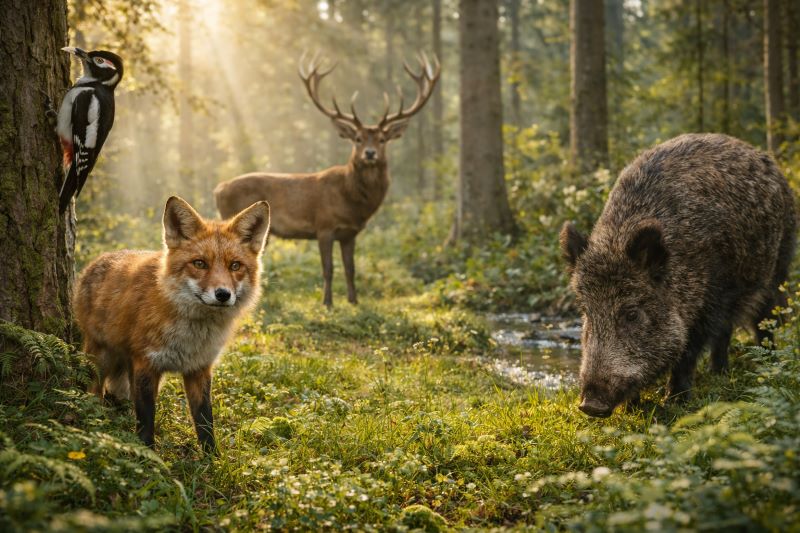
![forest animals — fox, deer, boar and woodpecker — in a sunny woodland clearing, child-friendly cartoon style]](https://riddlelicious.com/wp-content/uploads/2025/05/Forest-Animals-for-Kids-Learn-About-Woodland-Animals-in-a-Fun-Way.jpg)
Last updated: April 2026 | Reading time: 12 min
These riddles have been carefully crafted and tested with children across different age groups to ensure they are both educational and age-appropriate. Each animal fact has been verified against wildlife reference sources, and the riddles are designed to boost nature awareness and critical thinking skills.
What left those muddy tracks near the stream? Who drilled that perfect little hole in the oak tree? And which creature sleeps through the entire winter curled up in a ball of leaves?
The forest is full of fascinating animals, and there is no better way to learn about them than through riddles that make kids think, observe, and discover. In this article, you will find 15 original forest animal riddles, each paired with fun facts that turn every guess into a mini nature lesson.
Whether you are planning a forest scavenger hunt, a nature walk with your class, or simply looking for a rainy-day activity, these riddles work brilliantly for children aged 4 to 12 and beyond.
Ready for a Forest Adventure?
Get the complete Forest Treasure Hunt — printable, ready in minutes, no prep stress!
Why Forest Animal Riddles Are Perfect for Kids
Riddles do more than entertain. When a child listens to three clues about a forest animal and tries to puzzle out the answer, they are practicing logical reasoning, active listening, and recall — all without realising they are learning. Combine that with real animal facts, and you have an activity that ticks every box:
- Nature knowledge: Kids learn where animals live, what they eat, and how they behave.
- Respect for wildlife: Understanding an animal builds empathy and care for it.
- Observation skills: Riddles teach children to look for clues in the world around them.
- Screen-free fun: Perfect for car rides, forest walks, or classroom warm-ups.
Print the riddles on index cards before your walk. At each new stop in the forest, read the clues aloud and let the children guess. If they spot the actual animal (or its tracks, burrow, or feathers), award bonus points! This turns an ordinary walk into a scavenger hunt the whole family will remember.
Forest Animals You Might Spot
Let us start with the animals you are most likely to encounter — or at least find evidence of — on a woodland walk. These riddles are great for younger children (ages 4-8) because the animals are well-known and the clues are straightforward.
1. Red Fox
The red fox is one of the most adaptable animals on the planet. It can live in forests, fields, mountains, and even cities. Foxes have incredible hearing — they can detect a mouse moving under 30 centimetres of snow and pounce with pinpoint accuracy. Their bushy tail, called a “brush,” helps them balance when running and keeps them warm on cold nights.
What Am I? — 3 Clues:
- My fur is the color of autumn leaves.
- I hunt at dawn and dusk, and my bark echoes through the trees at night.
- My bushy tail is almost as long as my body.
Show Answer
A Red Fox!
2. Wild Boar
Wild boars are surprisingly intelligent and have an extraordinary sense of smell — up to seven times stronger than a dog’s. They use their tough snouts to root through the forest floor searching for acorns, mushrooms, roots, and insects. Baby boars (called piglets) are born with adorable brown-and-cream stripes that help them hide in the undergrowth.
What Am I? — 3 Clues:
- I dig up the forest floor with my strong, flat nose.
- My babies wear stripy pyjamas.
- I am the wild ancestor of the farmyard pig.
Show Answer
A Wild Boar!
3. Badger
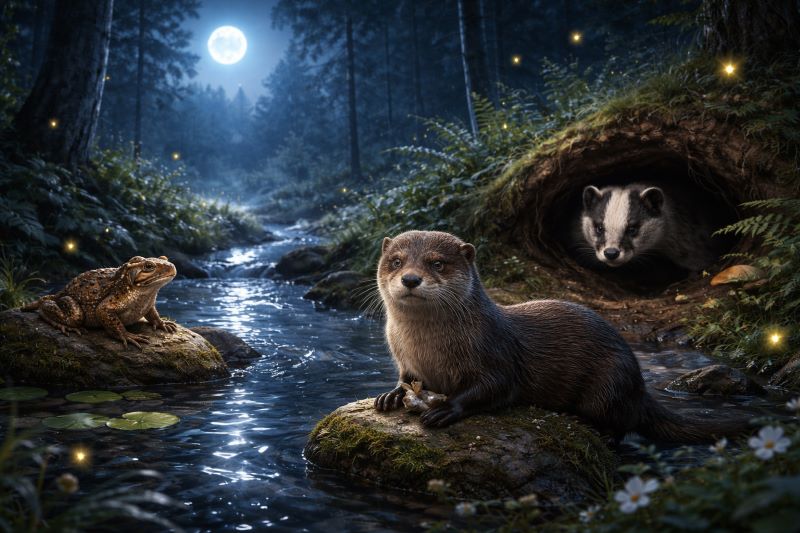
Badgers are champion diggers. They build complex underground tunnel systems called “setts” that can have over 50 entrances and be hundreds of years old — passed down through generations. Badgers are clean animals: they dig separate toilet pits away from their sett and regularly change their bedding of dry grass and leaves.
What Am I? — 3 Clues:
- I have a black-and-white striped face that looks like a mask.
- My underground home has dozens of rooms and tunnels.
- I come out at night and love to eat earthworms.
Show Answer
A Badger!
4. Woodpecker
Woodpeckers can drum on a tree trunk up to 20 times per second, and their heads experience forces of over 1,000 G — yet they never get a headache. A special spongy bone structure in their skull absorbs the shock. Their tongue is so long it wraps around the back of their skull, and the sticky tip is perfect for fishing insects out of bark crevices.
What Am I? — 3 Clues:
- You can hear me drumming on trees from far away — rat-a-tat-tat!
- I use my extra-long tongue to catch insects hiding in the bark.
- I carve my nest hole right into a tree trunk.
Show Answer
A Woodpecker!
5. Stag (Red Deer)
The red deer is one of the largest wild animals in European forests. Male deer — called stags — grow a magnificent set of antlers every year, which can weigh up to 5 kilograms each. In autumn, stags roar loudly to compete for mates; the deeper and louder the roar, the more impressive the stag. Their antlers fall off in spring and regrow over summer, bigger each year.
What Am I? — 3 Clues:
- I wear a crown of bone on my head that grows back every year.
- In autumn, my loud roar echoes through the entire forest.
- I am one of the biggest wild animals you can meet in European woods.
Show Answer
A Stag (Red Deer)!
Forest Treasure Hunt
Printable forest treasure hunt – explore nature with animal clues. Ages 4-12.
Download & Print → $14.99
Trickier Forest Riddles
Ready to step deeper into the woods? These animals are a little harder to spot — and the riddles are a bit more challenging. Perfect for children aged 7-12 who already know the basics and want to test their nature knowledge.
6. Dormouse
The dormouse is one of the sleepiest animals in the forest. It hibernates for up to seven months of the year — sometimes even longer if the weather stays cold. Dormice weigh only about 20 grams (roughly the same as a handful of grapes), and they build neat, round nests woven from bark strips and honeysuckle. Their name comes from the French word “dormir,” which means “to sleep.”
What Am I? — 3 Clues:
- I sleep for more than half the year, curled up in a tiny ball.
- I am so small I can sit comfortably on your thumb.
- My name literally means “sleepy mouse.”
Show Answer
A Dormouse!
7. Pine Marten
Pine martens are acrobatic hunters that spend much of their life in the treetops. They can leap up to four metres between branches and use their long, fluffy tail for balance — almost like a tightrope walker’s pole. Despite being fierce predators of squirrels and birds, pine martens have a sweet tooth: they love berries, honey, and even jam if they can find it.
What Am I? — 3 Clues:
- I leap between treetops as easily as you walk across a room.
- I have chocolate-brown fur and a creamy yellow bib on my chest.
- I am related to weasels and otters, but I live high up in the trees.
Show Answer
A Pine Marten!
8. Jay
The jay is sometimes called the “gardener of the forest” — and for good reason. Every autumn, a single jay buries up to 5,000 acorns in the ground as a food store for winter. It forgets about many of them, and those forgotten acorns sprout into new oak trees. Jays are also brilliant mimics: they can copy the calls of buzzards, cats, and even ringing telephones.
What Am I? — 3 Clues:
- I have a flash of bright blue on my wings that you can spot as I fly between the trees.
- I bury thousands of acorns every year — and accidentally plant new oak trees.
- I can mimic the sounds of other birds and even human-made noises.
Show Answer
A Jay!
9. Grass Snake
Grass snakes are completely harmless to humans — they have no venom and no fangs. When threatened, they have a dramatic defence trick: they roll onto their back, go limp, let their tongue hang out, and even release a smelly liquid to pretend they are dead. Grass snakes are also excellent swimmers and love hunting frogs and newts near ponds and streams.
What Am I? — 3 Clues:
- I have no legs, no arms, and no venom — but I can swim across a lake.
- I wear a yellow-and-black collar behind my head like a little necklace.
- When I am scared, I play dead so convincingly that even predators walk away.
Show Answer
A Grass Snake!
10. Mole
Moles spend almost their entire lives underground, digging tunnels at a rate of about 4 metres per hour. Their powerful, spade-shaped front paws are perfectly designed for shovelling soil. Although moles are nearly blind, they have an incredible sense of touch — the tiny pink tentacles on their nose can detect the faintest vibration of a worm crawling through the earth.
What Am I? — 3 Clues:
- You almost never see me, but you see the little hills of earth I leave behind.
- My big, shovel-shaped paws help me dig tunnels all day long.
- I live in complete darkness underground and find my food by touch.
Show Answer
A Mole!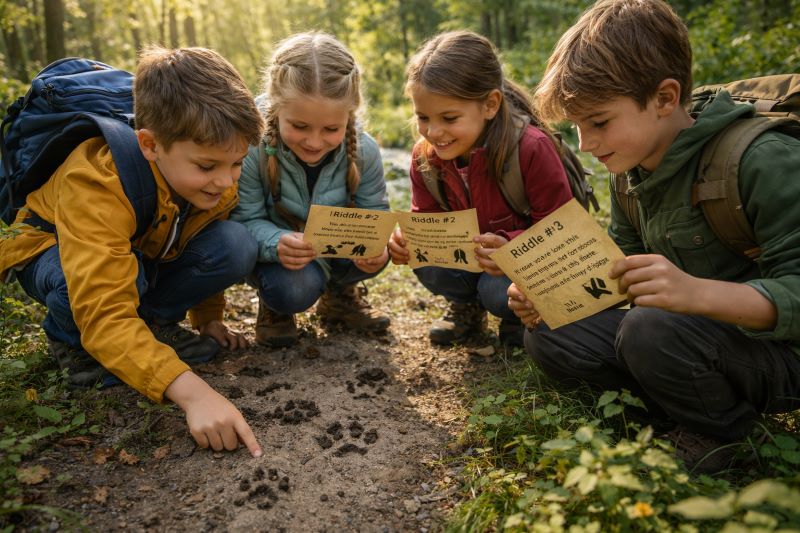
Turn these riddles into a proper forest scavenger hunt! Write each riddle on a separate card and hide them along a trail. At each station, kids solve the riddle and look for real signs of that animal — tracks, feathers, burrows, or droppings. Award a stamp or sticker for each correct answer. For a ready-made version with maps and clue sheets, check out our printable scavenger hunt kits.
Night-Time Forest Creatures
When the sun goes down, a completely different cast of characters takes the stage. These five animals are mostly active at dusk and after dark, which is why many people have never seen them in the wild. The riddles below bring these mysterious creatures to life — even in broad daylight.
11. Dragonfly
Dragonflies are among the oldest insects on Earth — their ancestors were already zooming around 300 million years ago, long before the dinosaurs. They are phenomenal hunters with a 95% catch rate (for comparison, a lion succeeds only about 25% of the time). Each of their enormous compound eyes contains up to 30,000 tiny lenses, giving them nearly 360-degree vision.
What Am I? — 3 Clues:
- I have four see-through wings and can hover, fly backwards, and change direction in a flash.
- My huge eyes can see in almost every direction at once.
- I lived on Earth millions of years before the dinosaurs did.
Show Answer
A Dragonfly!
12. Otter
Otters are the playful clowns of the waterways. They slide down muddy riverbanks for fun, wrestle with their siblings, and juggle pebbles between their paws — a behavior scientists believe helps them practice their dexterity. An otter’s fur is the densest of any mammal: up to 100,000 hairs per square centimetre, creating a waterproof layer that keeps the animal warm even in icy rivers.
What Am I? — 3 Clues:
- I slide down muddy banks into the water just for the fun of it.
- My fur is so thick and waterproof that my skin stays completely dry when I swim.
- I catch fish with my paws and eat them floating on my back.
Show Answer
An Otter!
13. Wren
The wren is one of the smallest birds in Europe, weighing less than a 10-gram coin, yet it has one of the loudest songs relative to its body size. A wren’s song can reach 90 decibels — roughly as loud as a lawnmower. Male wrens are enthusiastic builders: they construct up to 12 different nests each spring, and the female inspects them all before choosing her favorite one to line with feathers.
What Am I? — 3 Clues:
- I am tinier than your fist, but my song is louder than many birds ten times my size.
- I hold my short tail bolt upright like a little flag.
- The male of my species builds lots of nests, but only one gets used.
Show Answer
A Wren!
14. Toad
Toads might not win any beauty contests, but they are true garden heroes — a single toad can eat up to 10,000 insects in one summer, including slugs, mosquitoes, and beetles. Unlike frogs, toads have dry, bumpy skin and prefer to walk rather than hop. Every spring, toads make an incredible journey back to the pond where they were born, sometimes travelling over a kilometre to get there.
What Am I? — 3 Clues:
- I look like my cousin the frog, but my skin is dry and bumpy, not smooth and wet.
- I walk slowly instead of hopping, and I prefer to hunt on land at night.
- Every spring, I travel a long way back to the same pond where I was born.
Show Answer
A Toad!
15. Roe Deer
The roe deer is the smaller, shyer cousin of the red deer. It stands only about 65 centimetres tall at the shoulder — roughly the height of a golden retriever. Roe deer are one of the few animals that can delay their pregnancy: after mating in summer, the embryo pauses its development for several months and only starts growing again in winter, so the fawn is born in the warm days of late spring.
What Am I? — 3 Clues:
- I am a small, elegant deer with a white patch on my bottom that flashes when I run away.
- I bark like a dog when I sense danger — short, sharp, and surprisingly loud.
- My antlers are small and have only three points on each side.
Show Answer
A Roe Deer!
 Tips for Using Forest Animal Riddles
Whether you are a parent, teacher, or scout leader, here are tried-and-tested ways to get the most out of these riddles:
On a Nature Walk or Forest Scavenger Hunt
- Print before you go: Cut out each riddle on a separate card. Laminate them if you plan to reuse them.
- Match riddles to the trail: If your route passes a pond, save the otter, grass snake, and toad riddles for that spot.
- Add a detective element: Bring a magnifying glass and let kids search for real animal signs — tracks, feathers, nibbled bark, or spider webs.
- Award “Nature Explorer” certificates: Kids who solve all 15 riddles earn the title. Our Forest Treasure Hunt kit includes printable certificates.
In the Classroom or at Home
- Read one riddle per day: Use it as a morning warm-up during a nature unit.
- Let kids write their own: After solving a few riddles, challenge children to pick an animal and write three clues. This builds descriptive writing and research skills.
- Create an animal fact wall: Pin each riddle card on a board and add drawings or photos as kids learn more about each creature.
At a Birthday Party or Outdoor Event
- Team quiz: Split kids into teams and read the clues one at a time. Award 3 points for a correct guess after clue 1, 2 points after clue 2, and 1 point after clue 3.
- Combine with a scavenger hunt: Hide riddle cards around the garden. Each solved riddle reveals the location of the next card.
- Themed decorations: Use forest animal cutouts and green bunting to set the scene. Check our birthday games guide for more party ideas.
More Forest and Nature Riddles
Enjoyed these riddles? We have plenty more where these came from:
- Forest Riddles for Children (Ages 4-12) — More woodland-themed brain teasers
- 50+ Animal Riddles for Kids — From farm animals to ocean creatures
- Themed Riddles for Clever Kids — Animals, planets, countries, and more
- Riddles for Kids: The Ultimate Collection — Our complete riddle hub for all ages
- Scavenger Hunt for Kids: The Ultimate Guide — 100+ ideas including forest hunts
Frequently Asked Questions
What age group are these forest animal riddles suitable for?
The riddles in the first section (“Forest Animals You Might Spot”) work well for children aged 4-8 because the animals are familiar and the clues are concrete. The “Trickier Forest Riddles” and “Night-Time Forest Creatures” sections are designed for children aged 7-12 who enjoy a challenge. You can always adjust by reading fewer clues to make a riddle harder or giving extra hints to make it easier.
Can I use these riddles for a forest scavenger hunt?
Absolutely — that is one of the best ways to use them! Print each riddle on a card, hide the cards along a forest trail, and let children solve each riddle at a different station. Bonus: have them search for real-life evidence of the animal (tracks, burrows, feathers) at each stop. For a complete ready-to-print forest scavenger hunt with maps, clue sheets, and certificates, visit our shop.
Are the animal facts accurate and child-friendly?
Yes. Every fact in this article has been checked against reliable wildlife sources, including the Woodland Trust, RSPB, and the Wildlife Trusts. We present facts in language that children can understand while keeping them scientifically accurate. If a child wants to know more, the facts make great starting points for further research or a school project.
How many riddles should I use at once?
For younger children (ages 4-6), 5-7 riddles per session is plenty. For older children (ages 7-12), you can comfortably use all 15 in one sitting or across a scavenger hunt. At a birthday party, 8-10 riddles as a quiz round works well and takes about 10-15 minutes. The key is to stop while kids are still having fun — leave them wanting more!
Want a Ready-Made Forest Adventure?
Our printable Forest Treasure Hunt includes beautifully designed riddle cards, a treasure map, station signs, and certificates — everything you need for an unforgettable outdoor adventure. Just print, hide, and play!
Download the Forest Treasure Hunt →
Instant PDF download • Ages 4-10 • Ready in minutes
Written by the Riddlelicious Team
We create original riddles, scavenger hunts, and party games for children of all ages. Every riddle on this site is written and tested by our team of parents and educators who believe that the best learning happens through play. Have a question or suggestion? Get in touch.
Sources & Further Reading
Last updated: March 2026 | All riddles are original content © Riddlelicious.com
Discover More Riddle Posts!