

Blog
Tribe Adventure Scavenger Hunt: 8 Wilderness Survival Challenges for an Outdoor Birthday Party
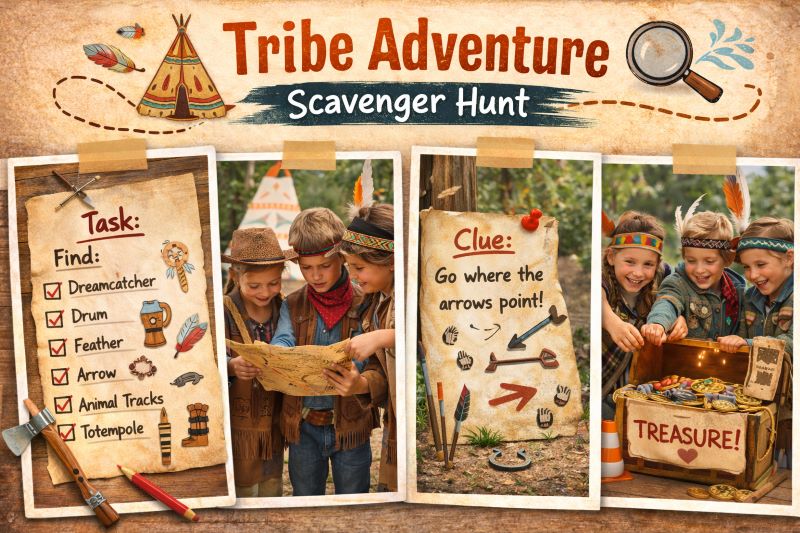
Last updated: April 2026 | Written by Arne, founder of Riddlelicious
About this guide: The wilderness survival format used here is based on the US Air Force SERE program (Survival, Evasion, Resistance, Escape) adapted for civilian youth use, combined with the Boy Scouts of America wilderness skills curriculum. Every technique taught at these stations is real and practically useful — not wilderness trivia, but skills that could genuinely help a kid in an unexpected outdoor situation.
The average American kid spends less than 10 minutes a day outdoors unsupervised. That’s a historical anomaly — for most of human history, navigating natural environments was a basic competency every child developed. The skills haven’t changed; only the opportunity to practice them has declined.
The Wilderness Survival Corps gives every kid 8 genuinely practical outdoor skills in a structured, competitive format. Teams earn merit badges for each completed skill — just like the Scouts, but in 90 minutes at a birthday party instead of a year of weekly meetings.
Quick Facts
- Ages: 6–12
- Players: 4–20 (survival teams of 3–4)
- Duration: 80–95 minutes
- Location: Outdoor required — backyard, park, or nature area
- Equipment: Compass, rope/paracord, tarp, water, purification tablets, signal mirror
- Skills: Navigation, shelter, water, fire (friction theory), first aid, signaling, foraging safety, knot tying

The Wilderness Survival Corps Setup
Each team receives a Survival Kit Bag at arrival: a paracord bracelet they’ll braid during Station 3, a compass, a laminated reference card (knots, plant warning signs, distress signals), and their Merit Badge Log — a booklet with 8 badge sticker slots. Earning all 8 makes them a Wilderness Corps Certified Survivor.
The challenge is framed as a real scenario: “Your team’s helicopter has made an emergency landing in a remote area. You have 90 minutes to demonstrate you have the skills to survive until rescue arrives.” This scenario framing keeps every station purposeful — kids aren’t just completing tasks, they’re preparing for a specific situation.
Want Printable Adventure Cards for the Outdoor Hunt?
Our Safari Scavenger Hunt includes 8 outdoor adventure station cards, team dossier template, and field guide reference sheet — perfect for nature and adventure themes. Instant download.
The 8 Survival Skills Stations
Navigation Without Technology
Skill: Compass reading + sun navigation + natural indicators
A compass works by detecting Earth’s magnetic field — the needle aligns with magnetic north (which differs slightly from geographic north, but for wilderness navigation the difference is negligible). Without a compass, the sun’s position provides direction: it rises roughly east, is due south at noon (Northern Hemisphere), and sets roughly west.
Task: Teams must navigate a 5-point course using only compass bearings — no GPS, no landmarks named. The course is marked with numbered cones; teams use compass bearings provided on a card (N 35°, E 22°, etc.) to find each cone in sequence. Time the course. Fastest route completion wins this challenge. Bonus: complete the last segment using sun position only (no compass).
Emergency Shelter Construction
Skill: Hypothermia prevention — insulation principles and wind break design
Hypothermia (dangerous body temperature drop) is the leading cause of wilderness fatalities. A body loses heat through conduction (contact with cold ground), convection (wind), radiation (infrared), and evaporation (wet clothing). An effective emergency shelter blocks wind, insulates from the ground, and retains body heat. It doesn’t need to be beautiful — it needs to work.
Task: Each team receives a tarp (8×10 ft), 4 stakes, and 20 feet of paracord. They have 8 minutes to build a lean-to shelter large enough for all team members to fit inside. Judged on: (1) wind block — can a judge hold a paper next to the open side and see it deflect? (2) ground insulation — is there a layer between the ground and occupants? (3) capacity — do all team members fit inside?
Knot Tying — Essential Hitches
Skill: 4 fundamental wilderness knots
Four knots cover 95% of wilderness rope needs: the square knot (joins two ropes of equal diameter), the bowline (creates a fixed loop that won’t tighten under load — used for securing to a tree or yourself), the clove hitch (attaches rope to a post, adjustable), and the half hitch (quick securing knot, fast to tie and untie). Each knot was designed for a specific load condition.
Task: Teams learn all 4 knots using a demonstration and reference card. Then a timed test: tie all 4 knots in sequence on a rope, correctly and without looking at the reference. Time starts when they reach for the rope; stops when the last knot is complete. Also: braid a paracord bracelet using the cobra knot — the bracelet itself becomes a wearable 8-foot length of emergency cord.

Water Safety — Finding and Treating
Skill: Water source assessment + purification methods
A human can survive approximately 3 days without water — compared to 3 weeks without food. Contaminated water (bacteria, Giardia, Cryptosporidium) is more dangerous than thirst in most wilderness scenarios. Water from any natural source should be treated before drinking. Purification options: boiling (1 minute at sea level kills all pathogens), chemical tablets (iodine or chlorine), filtration (down to 0.2 microns), or UV light treatment.
Task: Examine 4 water samples (clear water, turbid/cloudy water, water with visible debris, water from a “flowing source” vs. “stagnant source”). Using a Water Safety Reference Card, teams rank the samples from safest to most dangerous and explain the treatment required for each. Teams also demonstrate iodine tablet purification on one sample — observe the color change and calculate waiting time.
Fire Starting — Friction and Spark Methods
Skill: Fire triangle + friction fire theory (no actual fire for kids)
Fire requires three elements: fuel (something that burns), oxygen (air), and heat (ignition temperature). Remove any one element and the fire extinguishes. Friction fire (the bow drill method) works by rubbing a wooden spindle against a fireboard at high speed — the friction raises the temperature above the ignition point of wood, producing an ember that can be transferred to a tinder bundle.
Task (no actual fire): Teams assemble a bow drill kit (spindle, fireboard, handhold, bow) and demonstrate the correct technique — they don’t light a fire but must produce visible smoke from the friction within 60 seconds (this requires correct wood selection and technique). The science: measure the fireboard temperature with an infrared thermometer before and after 30 seconds of drilling. The temperature difference demonstrates the physics.
Alternative: use a magnesium fire starter (produces sparks only) to ignite a steel wool pad — the steel wool burns safely and visually demonstrates the ignition concept without producing an open flame.
Foraging Safety — Edible vs. Dangerous
Skill: Plant identification — the “universal edibility test” and avoidance rules
The most important wilderness foraging skill is not knowing which plants are edible — it’s knowing which are definitively dangerous. Three plants cause the majority of wilderness poisonings: poison ivy/oak/sumac (rash, not fatal but miserable), water hemlock (resembles wild carrots, extremely toxic), and death camas (resembles wild onion). Knowing these by sight prevents most foraging emergencies.
Task: Display 8 plant photographs (mix of edible, non-edible but safe, and dangerous). Using a Field ID Guide, teams classify each: Safe (known edible) / Unknown (don’t eat without testing) / Avoid (known dangerous). Correct identification of the 3 dangerous plants earns maximum points — the dangerous ones matter most. The Universal Edibility Test procedure is explained and memorized: skin contact test → lip test → tongue test → small taste → wait 8 hours.
Wilderness First Aid — Injury Response Protocol
Skill: Wilderness first aid priorities — the STOP protocol and primary assessment
Wilderness first aid differs from urban first aid because help is not immediately available. The STOP protocol (Stop, Think, Observe, Plan) prevents panic-driven decisions that worsen the situation. The primary assessment order: (1) scene safety — is more danger coming? (2) airway, (3) breathing, (4) circulation (bleeding control), (5) disability (spine injury risk?), (6) environment (hypothermia risk?). In that order, always.
Task: Teams respond to 3 wilderness injury scenarios (cards describing situations) using the STOP protocol and primary assessment order. For each scenario, they must: identify the immediate priority, list the first 3 actions in correct order, and explain what they would do if the injured person is unconscious. Correct protocol order = full points; incorrect order = partial credit.
Distress Signaling — Getting Found
Skill: The international distress signal system + signaling tools
The international distress signal is 3 of anything: 3 whistle blasts, 3 fires in a triangle, 3 flashes of a mirror. Search and rescue teams are trained to respond to any group of 3. Signal mirrors can reflect sunlight up to 16 miles on a clear day — a helicopter crew can see a mirror flash from 100+ miles in ideal conditions.
Task: Teams practice the signal mirror technique (aim reflected sunlight at a specific target), learn the Morse SOS pattern (3 short — 3 long — 3 short), and create a ground-to-air signal (large X or V made from visible materials) that search aircraft would recognize. They also calculate: if you’re lost 3 miles from a road, how long would it take searchers to find you if you signal vs. if you don’t? (Statistical data provided.)
Award categories: Fastest Navigation Course | Best Shelter Design | Most Knots Tied Correctly | Best Plant ID Score | Best Distress Signal Visibility
Decoration Ideas
- Survival kit display: All the real wilderness tools laid out on a “gear table” before the party — compass, paracord, tarp, first aid kit, signal mirror — kids love examining them
- Topographic map backdrop: A large printed topo map of a nearby trail or national park pinned to a wall
- Merit badge wall: A cork board showing all 8 merit badges — teams add their stickers as they complete each station
Snacks
- Trail rations: GORP (Good Old Raisins and Peanuts) in individual bags — the original wilderness snack, explain its caloric density
- Jerky station: Beef jerky as “emergency protein” with a brief explanation of why dried meat is a perfect survival food (calorie-dense, preserved without refrigeration)
- Survival cake: A camouflage-patterned cake (green and brown swirl frosting) with a small fondant compass topper
Age Calibration
Ages 6–7
Focus on shelter building (most hands-on and fun), knot tying (2 knots only), and distress signaling (whistle SOS practice). Skip the water chemistry and Universal Edibility Test. The paracord bracelet is the highlight at this age.
Ages 8–10
Full program as described. Navigation course with compass is excellent at this age. Plant identification generates genuine discussion. Shelter construction is competitive and engaging with teams working together.
Ages 11–12
Add: navigate by sun position only (no compass) on the course, calculate SODIS treatment time based on UV Index, and research one local plant species that could be confused with a dangerous look-alike in their region.
Download the Safari Scavenger Hunt
8 outdoor adventure station cards, team field dossier, wildlife reference guide — ages 5–12, instant download, print and explore.
Frequently Asked Questions
Is the fire station safe?
Yes — the bow drill station produces friction heat and smoke but no open flame when done correctly by kids. The alternative (steel wool + spark) produces a brief controlled burn in the steel wool that extinguishes quickly. An adult supervises both methods. The emphasis is on demonstrating the physics (friction = heat, heat + fuel + oxygen = fire) rather than actually lighting a campfire.
What if we don’t have a backyard?
Most stations work in a public park. The shelter station needs open space (about 20 sq ft per team). The navigation course needs about 50 meters of clear space. The water stations work on any outdoor table. The foraging station uses photographs, not real plants, so it works anywhere.
Sources & Further Reading
- US Air Force SERE School — survival skills curriculum (public version)
- Boy Scouts of America Wilderness Survival Merit Badge requirements — scouting.org
- WHO Solar Disinfection (SODIS) Guidance — who.int
- US Army Survival Manual FM 21-76 (public domain, freely available)
- NOLS (National Outdoor Leadership School) — Wilderness First Aid curriculum