

Blog
Horse Ranch Scavenger Hunt: 8 Equestrian Academy Challenges for a Riding Birthday Party
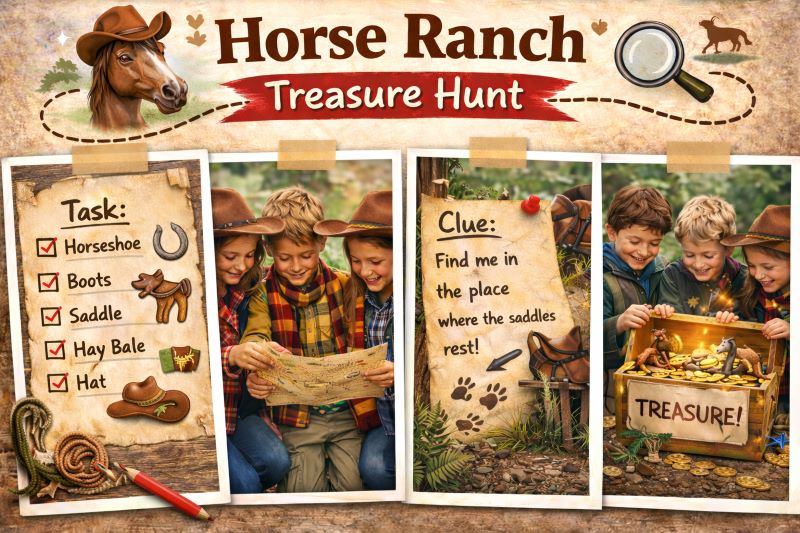
Last updated: April 2026 | Written by Arne, founder of Riddlelicious
About this guide: The 8 Equestrian Academy stations are based on documented United States Pony Club (USPC) D-Level and C-Level certification content, the Merck Veterinary Manual equine nutrition standards, Henneke’s Body Condition Scoring system (1983), USPC tack fitting guidelines, and published equine biomechanics research on gait mechanics. The USPC, founded 1954 in the US (based on the UK Pony Club 1929), is the world’s largest equestrian educational organization with over 600 clubs.
Professional equestrians don’t just ride — they study anatomy, nutrition, gait mechanics, behavioral psychology, tack fitting, and health assessment as a complete scientific discipline. The United States Pony Club certification system (D through A levels) requires passing both riding and horse management knowledge tests. The management knowledge is as demanding as the riding itself: a C-Level rider must understand nutrition, shoeing cycles, emergency first aid, and basic veterinary assessment.
The Equestrian Academy runs every young rider through 8 real horse science challenges drawn from the Pony Club curriculum. Complete all 8, demonstrate your knowledge, and earn your D-Level pin and Horsemanship Certificate at graduation.
Quick Facts
- Ages: 5–14 (works especially well for horse-obsessed kids at any level)
- Players: 4–20 (stable crews of 2–4)
- Duration: 75–90 minutes
- Location: Stable visit ideal; indoor or backyard works with printed props
- Equipment: Horse anatomy diagram, tack picture cards, vital signs reference card, stethoscope (for checking gut sounds at a stable), small scale, printed hoof diagram
- Skills: Anatomy, conformation, nutrition, tack identification, health assessment, learning theory, gaits, graduation ceremony

Equestrian Academy Setup
At arrival, each recruit receives their Barn Number (a horse name badge — choose historic famous racehorses: Secretariat, Seabiscuit, Ruffian, American Pharoah), their Stable assignment (Chestnut Barn, Bay Barn, Grey Barn), and their Horsemanship Log. The Head Trainer (host) opens with a 2-minute briefing: “Before anyone rides, they know their horse. The Pony Club teaches horsemanship before riding — because a good rider understands the animal they sit on. Let’s begin.” Tone: calm, knowledgeable, horse-centric.

Want Printable Horse Scavenger Hunt Cards?
Our Horse Scavenger Hunt includes 8 equestrian challenge cards, a horse anatomy diagram, and a Horsemanship Certificate — instant download, print and ride.
The 8 Equestrian Academy Stations
Equine Anatomy — Know Your Horse
The science: The equine skeleton has three main regions: the forehand (head, neck, shoulders, forelegs), the barrel (back, ribs, belly), and the hindquarters (hip, hindlegs). The “points of the horse” is the Pony Club D-Level requirement — 20 specific anatomical locations every rider must name accurately. Key points to learn: withers (the prominent bony ridge where neck meets back — the reference point for measuring height in “hands” — 1 hand = 4 inches), hock (the angle joint in the hindleg, equivalent to the human ankle), fetlock (the joint above the hoof, equivalent to the human ankle-foot joint), cannon bone (the lower leg bone between knee and fetlock), poll (the highest point of the skull behind the ears — the most sensitive pressure point for headgear fitting), and croup (the highest point of the hindquarters).
Challenge: Teams receive a blank horse diagram with 12 numbered points. They label each point from the provided word list. Then: a “point me there” relay — one team member calls a point name, the partner touches that location on a horse poster. Speed and accuracy scored. Bonus: name the human anatomical equivalent for each equine point.
Conformation — Structure Predicts Performance
The science: Conformation refers to the shape and proportions of a horse’s skeleton and musculature. Correct conformation distributes weight and movement stress evenly across the skeleton; faults create areas of excessive loading that lead to lameness. Key faults: “cow hocks” (hind legs angle inward at the hocks — creates uneven stress in the hock joint, predisposes to spavin); “bench knees” (the cannon bone is offset to the outside of the knee — creates uneven loading); “parrot mouth” (overshot upper jaw — prevents correct grazing); “long pasterns” (the pastern angle is too low — predisposes to tendon strain). Different disciplines tolerate different conformational faults: a stock horse used for roping needs a very different build from a thoroughbred racehorse.
Challenge: Teams receive 6 horse picture cards (showing correct and faulty conformation in various leg views). They identify which conformational fault each horse has using a reference guide, then predict which sport/discipline each horse is best suited for. Discuss: why does a Quarter Horse (built for speed in short distances) have a different body shape than a Hanoverian warmblood (built for dressage)?
Feed & Nutrition — What Horses Actually Eat
The science: Horses are non-ruminant herbivores with a hindgut fermentation system — unlike cattle (which ferment in the foregut rumen), horses ferment in the cecum and large intestine. A 1,000-pound horse requires 1.5–2.5% of body weight in dry matter daily (15–25 pounds of hay + water). The Merck Veterinary Manual specifies: water requirements are 10–12 gallons per day at rest, up to 30+ gallons during heavy work. Hay types matter: alfalfa hay has high protein (18–20%) and high calcium — suitable for growing young horses and lactating mares, but excess protein in mature horses creates ammonia load on the kidneys. Grass hay (timothy, orchard grass) has lower protein (8–12%) — better for maintenance feeding. Colic risk factors: sudden feed changes (alter hindgut microbiome), dehydration (impaction colic), sand ingestion, parasites, and dental problems preventing proper chewing.
Challenge: Teams receive “feed scenarios” — 5 horses with different life stages and workloads (foal, lactating mare, retired pleasure horse, eventing horse, draft horse at full work). Teams match each horse to its appropriate diet from 5 options. Then: a feed math calculation — how many pounds of hay does a 1,200-pound horse need per day at 2% body weight? Calculate water needs for a three-day trail ride.
Tack Identification — The Right Gear for Horse and Rider
The science: Proper tack fitting prevents injury. An ill-fitting saddle creates pressure points on the horse’s back: USPC fitting standards require 3 fingers of clearance between the pommel and the horse’s withers (saddle must never rest on the spine), panel contact must be even across the entire panel surface (uneven contact = pressure points = back muscle atrophy), and the saddle must not restrict shoulder rotation during movement. Bridle fitting: the bit must be the correct width (1/4″ wider than the mouth on each side), noseband should allow 2 fingers’ width of space. Key tack parts every D-Level rider must name: pommel, cantle, stirrup leathers, irons, girth, knee rolls on the saddle; crown piece, cheek pieces, noseband, browband, throatlatch, bit, and reins on the bridle.
Challenge: Teams receive a labeled tack diagram (saddle and bridle) with 10 parts numbered. They name each part from the word list. Then: 3 “fitting check” scenario cards — each shows a saddle or bridle fit issue. Teams identify the problem and explain what it could cause (too-narrow saddle = withers pressure = fistula; too-wide noseband = restricts breathing/chewing). Check against Pony Club fitting standards.
Health Assessment — Vital Signs of a Horse
The science: A horse health check uses five vital measurements. Heart rate: normal at rest is 28–44 bpm; measured with a stethoscope behind the left elbow or on the digital pulse at the fetlock. Respiratory rate: normal at rest is 8–16 breaths/minute; elevated respiration with no exercise is a serious sign. Temperature: normal is 99–101.5°F (37.2–38.6°C) rectally; fever above 103°F = call the vet. Capillary refill time (CRT): press a thumb on the gum above the upper incisors, release — color should return within 2 seconds; longer = circulatory compromise. Gut sounds: using a stethoscope on the left flank, you should hear gurgling sounds in all 4 quadrants every 2–3 minutes; absence of gut sounds suggests impaction colic. The mnemonic is TPRCRT (Temperature, Pulse, Respiration, CRT, + Gut Sounds).
Challenge: Teams receive 6 “patient report” cards — each lists vital sign measurements for a fictional horse. Teams classify each as “normal,” “slightly elevated — monitor,” or “call the vet immediately.” Then: practice measuring heart rate on themselves (radial pulse at wrist) for 15 seconds × 4 = bpm. Compare your resting heart rate to a horse’s. Why is the horse’s normal range lower? (Answer: larger heart, greater stroke volume — same principle as athletes having lower resting heart rates.)
Horse Psychology — How Horses Learn
The science: Horses are prey animals, which shapes their psychology fundamentally. Their visual field is approximately 350° (wide-angle monocular vision on each side) with binocular vision only in a narrow forward band — and two blind spots: directly behind and directly in front of the nose. The flight response occurs in 0.3 seconds — hardwired, not learned. Horse training works almost entirely through pressure-release learning (negative reinforcement — removing an aversive stimulus when the horse performs the desired behavior) and classical conditioning (associating a neutral stimulus with an already-meaningful one). Monty Roberts’s Join-Up technique uses Equus body language to communicate trust. Research shows that punishment-based training (positive punishment) produces higher cortisol levels, more flight/fight behavior, and worse retention than pressure-release methods.
Challenge: Teams receive 5 “training scenario” cards, each describing a horse behavior problem and a training approach. They evaluate: is this approach based on pressure-release (effective, horse-friendly) or punishment (stressful, counterproductive)? Then: a simple human demonstration of pressure-release — one team member is “the horse,” the other is “the trainer.” The trainer applies gentle arm pressure until the “horse” moves in the correct direction, then immediately releases. How quickly does the “horse” learn what to do? Discuss: why does release timing matter so much?
Gaits & Biomechanics — How Horses Move
The science: Horses have four natural gaits with distinct footfall patterns. The walk (4-beat: LH → LF → RH → RF) is the only gait with no suspension phase — at least one foot is always on the ground. The trot (2-beat: diagonal pairs — LH+RF land together, then RH+LF) has a brief suspension phase between beats. The canter/lope (3-beat with a leading leg: outside hind → inside hind+outside fore together → inside fore, then suspension) — the leading foreleg determines the circle direction and balance. The gallop (4-beat with an extended suspension phase) is the racehorse gait — Secretariat’s 1973 Belmont Stakes record of 2:24 flat remains the world record for 1.5 miles. Stride length, not stride frequency, differentiates fast horses: Secretariat’s stride was 24.5 feet.
Challenge: Teams receive footfall sequence diagrams for all 4 gaits (blanks where the letters should go) and fill in the correct sequence. Then: act it out — teams walk the footfall pattern themselves at human speed, tapping each “foot” in the correct sequence for walk, then trot (with hop = suspension), then canter. Which gait was hardest to coordinate? Why does the trot require diagonal coordination? (Same reason humans swing opposite arm and leg when walking — diagonal cross-pattern provides balance.)
Graduation — Pony Club D-Level Ceremony
The tradition: The United States Pony Club (USPC) was founded in 1954 based on the British Pony Club established in 1929 by the British Horse Society. The Pony Club’s mission: “to develop in young people through their association with horses and ponies the finest qualities of citizenship, sportsmanship, and moral character.” The D-Level certification — the entry level — requires identifying 20 points of the horse, demonstrating safe handling, explaining basic feeding and care, and completing a basic riding test. The D-Level Pin — a small gold horseshoe — is one of the most meaningful achievements in junior equestrian sports because it represents genuine knowledge, not just participation. Over 600 USPC clubs operate in the US today.
Graduation: The Head Trainer tallies each stable crew’s Horsemanship Log scores. All recruits who completed at least 6 stations stand for the D-Level ceremony. The Head Trainer reads: “The Pony Club believes that understanding your horse is the foundation of all horsemanship. You have proven that you understand your horse today.” Each recruit receives their Horsemanship Certificate and a gold horseshoe sticker (their D-Level Pin). Group photo in gear.
Download Ready-Made Horse Hunt Materials
Our Horse Scavenger Hunt gives you all 8 equestrian challenge cards, a horse anatomy diagram, tack identification sheet, and a Horsemanship Certificate. Instant download.
Age Calibration
Ages 5–7
Focus on anatomy labeling (with picture prompts), gait acting-out, and the health vital signs with simplified “normal vs. not normal” cards. Skip tack fitting details and conformation faults.
Ages 8–11
All 8 stations at standard complexity. The gait footfall patterns are perfect for this age. Include the nutrition math calculation and the training scenario cards.
Ages 12–14
Full Pony Club D-Level content. Challenge: design a complete feeding program for a specific horse with a stated workload, life stage, and hay type available. Explain the reasoning.
Frequently Asked Questions
Does this need to be held at a stable?
No — though a stable visit makes it magical. All 8 stations work with printed props in any indoor or outdoor space. If you can arrange a stable visit or pony ride, combine Stations 1 (anatomy) and 5 (vital signs) with the actual horse for a hands-on experience that kids remember for years. Contact a local riding school about birthday party visits — many offer horse-interaction packages.
My child is horse-obsessed but has never ridden — is this appropriate?
This party is ideal for horse-obsessed kids at any experience level. The science content is structured so that a child who has only watched horse videos can succeed, while a child who has had years of lessons will find genuinely new information in the conformation, nutrition, and biomechanics stations. Both experience levels will enjoy it equally.
Where do I get printed horse anatomy diagrams?
The USPC (ponyclub.org) offers free downloadable educational materials including anatomy diagrams. The Merck Veterinary Manual online (merckvetmanual.com) has high-quality equine anatomy illustrations. Our Horse Scavenger Hunt download includes a ready-to-print labeled anatomy diagram and blank version for the challenge.
Can this combine with an actual riding lesson?
Yes — it works perfectly as a 90-minute pre-ride education session before a birthday party riding lesson. Complete all 8 stations in the first 75 minutes, then graduate and ride as the culminating activity. The stations prepare kids to understand what they’re feeling and asking the horse to do during the lesson.
Sources & References
- United States Pony Club (2023). USPC Horse Management Handbook, D-Level Standards. ponyclub.org
- Henneke, D. R., Potter, G. D., Kreider, J. L., & Yeates, B. F. (1983). Relationship between condition score, physical measurements, and body fat percentage in mares. Equine Veterinary Journal, 15(4), 371–372.
- Reed, S. M., Bayly, W. M., & Sellon, D. C. (2010). Equine Internal Medicine (3rd ed.). Elsevier.
- Merck Veterinary Manual (2023). Nutrition: Horses. merckvetmanual.com
- McLean, A. N., & Christensen, J. W. (2017). The application of learning theory in horse training. Applied Animal Behaviour Science, 190, 18–27.
- Back, W., & Clayton, H. M. (2013). Equine Locomotion (2nd ed.). Elsevier.
Ready for Your Horse Party?
The Horse Scavenger Hunt gives you all 8 equestrian challenge cards, a horse anatomy diagram, tack ID sheet, and a Horsemanship Certificate. Instant download — saddle up.