

Ninja Party for Kids: Complete Guide + Free Printables
Last updated: May 2026 | Curated by Arne, founder of Riddlelicious
About this hub: Our Ninja Scavenger Hunt is one of the highest-rated products in our shop, used by families and after-school programs since 2024. The dojo training plan below is built from running real ninja parties — plus the parts that actually worked from Smart Party Planning, Bird’s Party and Goshukan Karate Academy’s child-friendly ninja guide. The under-rated insight: the belt progression system is what holds a 90-minute party together. Without it, ninja parties drift into “kids kicking balloons” within 20 minutes.
A ninja birthday party is one of the most physically active themes you can run, and it suits energetic kids who would normally not sit still for a typical “sit and craft” party. It also works at almost any age — 4 to 12 — because each station can scale from easy (paper-star toss) to hard (string maze with timed run).
This hub gathers every ninja resource on Riddlelicious — scavenger hunts, riddles, party plans, printables — plus a full dojo-style host plan. Jump straight to 8 best ninja training games if you already have the setup.
Ninja Party at a Glance
- Ages: Works for 4–12. Sweet spot is 6–10.
- Group size: 4–14 kids. Above 8, run two “training squads” in parallel.
- Total runtime: 90–120 minutes including belt ceremony and cake.
- Prep time: 30–45 minutes if you use a printable kit; 2–3 hours from scratch.
- Budget: $0–$50. Most “ninja gear” can be made from black craft paper and old fabric.
- Space needed: Living room or backyard. Activities use roughly 4×4 meters of clear space at peak.
Why the Belt-Progression System Works So Well
Most ninja-party guides on the web list 6 to 8 games as a flat list. That works as a list — but it does not work as a party, because kids hit decision fatigue after activity 4 and the energy drops.
The fix is the white-to-black belt progression that real dojos use. Every kid arrives with a white paper headband. After each completed station, they earn a coloured stripe (white → yellow → green → blue → red → black). Suddenly every station has stakes, and the kids stay locked in because they are earning something visible.
This is the same psychology behind Scout merit badges and Duolingo streaks — small visible progress markers compound engagement. It is also the difference between a forgettable party and one the kids talk about for weeks.
Build Your Ninja Party in 5 Stages
Stage 1: Choose the Storyline
Pick one:
- The Dojo Test — the dojo has been challenged; the trainees must prove themselves by completing 6 trials to defend honour. Works ages 6–12.
- The Stolen Scroll — a sacred scroll has been hidden in the dojo. Each training task gives a clue to where. Works ages 5–10.
- The Master’s Final Test — to graduate, each trainee must earn 5 stripes by completing 5 unique challenges. Works ages 4–12.
- The Shinobi Scavenger Hunt — our printable version with 8 stations and a treasure map.
Stage 2: Build the Dojo
Three visual elements transform any room into a dojo:
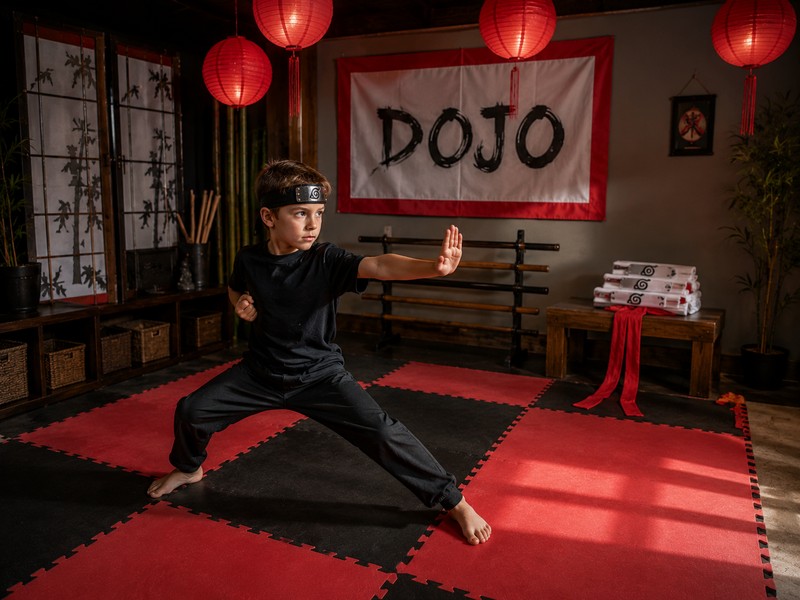
- Red paper lanterns — strung in a row along the ceiling or a curtain rod (Amazon ~$6 for a pack of 10).
- Black-and-red wall banner with “DOJO” in faux-brush lettering — print one of our free templates or hand-letter on craft paper.
- Floor mats or yoga mats as the “training mat” — visually defines the activity zone and protects the floor for tumbling stations.

Stage 3: Outfit the Trainees
Each trainee gets at the door:
- A black or white headband (“hachimaki”) — strips of fabric tied behind the head
- A “ninja name” sticker — Shadow, Whisper, Crane, Tiger
- A blank belt scroll where stripes will be drawn or stickered as they earn them
- (Optional) a black or red eye mask
Budget: a roll of black T-shirt fabric ($5) cut into 6×30 cm strips makes 12 hachimaki with leftover. Sticker rolls and a fabric marker for stripes ($3 total).
Stage 4: Run the Training Stations
Rotate through 5–6 of the 8 stations below. Each takes 8–12 minutes. After each station, the master (you) ceremonially adds a stripe to that trainee’s belt. The ceremony matters — the second-long “you have earned the yellow stripe” beat is what makes the kids work hard at the next station.
Stage 5: Black Belt Graduation
Final 10 minutes: every trainee receives the black stripe in a short bow-ceremony. Hand out printable “Ninja Master” certificates. Cake.
8 Best Ninja Training Games
Ordered from easy → hard so the belt progression rewards genuine effort. Each station is short, clear and physical.
Silent Walking
Skill: Body awareness · Age: 4+ · Time: 6 min
Cover the floor with a tarp of crinkled newspaper (or bubble wrap if you want a laughs-version). Each trainee must cross the room without making a sound. Trainees who crinkle restart. Best ninja-party warm-up — instantly establishes the “ninjas are quiet and patient” frame.
Throwing Star Toss
Skill: Aim · Age: 5+ · Time: 8 min
Fold paper origami shuriken (we have a template) or use cheap foam stars. Each trainee gets 5 throws at a wall target — three concentric circles drawn on a cardboard backing. Bullseye = 3 points, middle = 2, outer = 1. Top scorer gets a small extra reward; everyone gets the stripe.
The String Maze
Skill: Flexibility · Age: 5+ · Time: 10 min
String yarn between two chair-backs at different heights — high to step over, low to crawl under, diagonal to weave through. Trainees must cross without touching any string. Add a stopwatch for older kids.
Chopstick Pickup
Skill: Fine motor · Age: 6+ · Time: 8 min
Bowl of small objects (jellybeans, marshmallows, pom-poms). 60 seconds with chopsticks to move as many as possible into a target bowl. Counts toward the team total. Hardest station for the under-6 crowd — pre-train with pre-grippable chopsticks for younger.
Ninja Riddle Round
Skill: Mental focus · Age: 5+ · Time: 10 min
Read 8 of our ninja riddles aloud. Each trainee writes their answer on a small slate. First answer not allowed — the ninja way is to think first, speak second. This builds in a brief calm-down between physical stations.
Obstacle Course Run
Skill: All combined · Age: 5+ · Time: 12 min
The course combines four mini-challenges: leap over a “river” (blue tape), tunnel through a row of chairs, balance walk on a beam (tape line on the floor), and finish with one star throw at a final target. Best time wins a small bonus.
The Shinobi Scavenger Hunt
Skill: Problem-solving · Age: 6+ · Time: 15 min
Hidden riddle scrolls around the house lead to a final “treasure” (a small chest of sweets, mini katanas, etc.). Our printable Ninja Scavenger Hunt includes 8 riddle scrolls, a treasure map, ninja name tags and a graduation certificate.
The Black Belt Bow
Skill: Honour · Age: All · Time: 8 min
Each trainee receives the final black stripe in a short ceremony, bows to the master, and signs the dojo’s “Honour Scroll”. Big moment. Cake follows.

Skip the Prep — Get the Ninja Scavenger Hunt
Our printable kit is the dojo-style version of this format. 8 riddle scrolls, treasure map, ninja headbands, belt scroll, graduation certificate. Print at home, play in 30 minutes.
Ninja Snacks & Treats
- “Throwing star” sandwiches — cut sandwiches with a star-shaped cookie cutter.
- Black-and-red cupcakes — dark chocolate cupcakes with red velvet swirl frosting; top with an edible paper ninja silhouette.
- Sushi-style snacks — rice balls or California-roll-style snacks (cucumber + cream cheese in a tortilla wrap).
- “Smoke bomb” popcorn — popcorn served in black paper cones.
- Watermelon “katana” skewers — long thin slices of watermelon on bamboo skewers.
- Ninja cake — round black-frosted cake with a red “ninja eye-mask” piped in icing.
Decor That Reads “Dojo” in 10 Minutes
- Red paper lanterns across the doorway.
- Black + red balloon arch over the food table.
- Black craft-paper wall banner with “DOJO” in white brush lettering.
- Yoga mats defining the training zone on the floor.
- Battery tea lights in red cellophane — instant lantern atmosphere.
Free Ninja Resources on Riddlelicious
- Ninja Scavenger Hunt: 8 Dojo Stations + Free Party Guide — pillar guide
- 30 Ninja Riddles for Kids: Stealth Missions + Free PDF
- Ninja Scavenger Hunt — Printable Product ($14.99)
- Scavenger Hunt for Kids: Ultimate 2026 Guide
- 50+ Scavenger Hunt Tasks & Challenges — for slotting between stations
- 15 Secret Codes for Kids — pair with the “stolen scroll” storyline
Coming Soon to This Hub
Get the newsletter to know when one drops.
- Ninja Birthday Party: Complete Planning Guide + Dojo Setup Checklist
- How to Make a No-Sew Ninja Headband + Mask From One T-Shirt
- Ninja Obstacle Course Ideas: 8 Stations for Backyard or Living Room
- Stealth Games for Kids: 10 Quiet-Mode Activities That Train Focus
- Famous Real Ninja History for Kids: 7 Facts From Feudal Japan
- Ninja Party Snack Ideas: 8 Sushi-Inspired Treats Kids Will Love
Frequently Asked Questions
What age is best for a ninja birthday party?
Six to ten is the sweet spot. Four and five-year-olds enjoy the physical stations but cannot do chopsticks or the string maze cleanly — simplify those. Eleven and twelve-year-olds enjoy the harder timed versions and the riddle round.
Is a ninja party too violent for kids?
No — frame it around stealth, patience, focus and discipline, not fighting. The historical ninja was an intelligence operative, not a brawler. Our entire activity set is built around quiet skills (silent walking, aim, balance, riddles) which is exactly the right framing for ages 4-12.
How long should a ninja party run?
90 to 120 minutes total. Suggested split: 15 min arrival + headband tying, 60-75 min stations, 15 min black belt ceremony, then cake.
Do I need a large space?
4×4 meters of clear floor space is enough — about a normal living room with the coffee table pushed aside. Outdoor adds room for the obstacle course but the entire format runs indoors. Several of the stations (chopstick pickup, riddles, star toss) need no floor space at all.
What is the cheapest ninja setup?
Under $20: T-shirt fabric for headbands ($5), foam stars or origami paper ($3), red yarn for the maze ($2), printable belt scrolls from our free templates ($0). Add $15 if you want our printable Scavenger Hunt kit.
Can boys and girls both enjoy a ninja party?
Yes — ninja is one of the most gender-neutral themes we run. The activity set is action-based and skill-based, which appeals across the board. Our customer reviews split very evenly between sons’ and daughters’ parties.
Sources & Further Reading
- Smart Party Planning — 10 Ultimate Fun Ninja Party Games For Kids
- Queen of Theme Party Games — DIY Ninja Party Games
- Bird’s Party Blog — A Japanese Origami Dojo Ninja Birthday Party
- Creating Mary’s Home — Ninjago Party (Ninja Training Games & Activities)
- Goshukan Karate Academy — Throw a Ninja Birthday Party: Tips and Tricks