

Blog
Ninja Scavenger Hunt: 8 Shinobi Dojo Training Stations for a Martial Arts Birthday Party
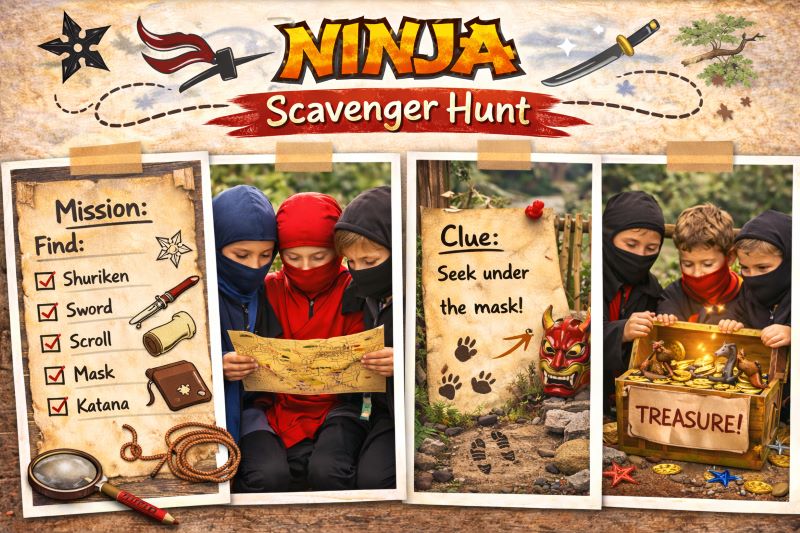
Last updated: April 2026 | Written by Arne, founder of Riddlelicious
About this guide: The 8 Shinobi Dojo stations are grounded in documented historical sources: the Bansenshūkai (万川集海, 1676) — the primary surviving shinobi operational manual compiled by Fujibayashi Yasutake; academic research on Iga and Kōka clan history (15th–17th century Japan); Antony Cummins and Yoshie Minami’s translations of period ninja manuscripts; and sports science research on balance, proprioception, and controlled movement. Historical ninja were intelligence operatives, not movie assassins — the real story is more interesting.
Movie ninjas are fictional. Historical shinobi were trained intelligence operatives working in feudal Japan’s Iga and Kōka provinces — experts in information gathering, infiltration, disguise, and disruption. The Bansenshūkai (1676), the most complete surviving ninja manual, devotes most of its pages to psychology, strategy, and covert communication — not combat. The real curriculum is sophisticated, scientific, and genuinely fascinating.
The Shinobi Dojo runs every recruit through 8 real training stations drawn from historical shinobi curriculum. Complete all 8, earn your training name, and receive your Dojo Rank at the graduation ceremony.
Quick Facts
- Ages: 5–12
- Players: 4–20 (shinobi teams of 2–4)
- Duration: 70–90 minutes
- Location: Backyard obstacle course + indoor stations
- Equipment: Balance beam (plank or tape line), blindfolds, soft rope, lemon juice for invisible ink, candle or heat lamp, star map, obstacle materials
- Skills: Historical knowledge, balance/movement, knot work, stealth science, disguise, cipher writing, navigation, graduation ceremony

For the wider celebration, explore our ninja party planning guide: choose a storyline, plan your activity space and connect the training games to a party schedule.
Shinobi Dojo Setup
At arrival, each recruit receives their Training Number (written in Japanese numerals on a wristband), their Clan assignment (Iga Clan, Kōka Clan — the two historic ninja provinces), and their Mission Log. The Sensei (host) opens with a 2-minute briefing: “The Dojo accepts new recruits by challenge only. Complete 8 stations. Move in silence. Think before acting.” Tone: quiet, disciplined, focused.

Want Printable Ninja Scavenger Hunt Cards?
Our Ninja Scavenger Hunt includes 8 dojo challenge cards, shinobi cipher key, and a Dojo Rank Certificate — instant download, print and train.
The 8 Dojo Training Stations
Shinobi History — Who They Really Were
The history: Historical ninja (shinobi-no-mono — “those who act in stealth”) were primarily information operatives working for feudal Japanese lords during the Sengoku period (15th–17th century). The major shinobi clans were based in Iga Province (modern Mie Prefecture) and Kōka Province (modern Shiga Prefecture). The famous Hattori Hanzō was a real person — a skilled samurai-ninja operative in service of Tokugawa Ieyasu who helped him escape the Iga region after the assassination of Oda Nobunaga in 1582. The Bansenshūkai (1676), compiled by Fujibayashi Yasutake, devotes its most detailed chapters to: selecting recruits, psychology of infiltration, weather reading for mission timing, and covert communication — not martial arts combat.
Challenge: Teams receive 6 “shinobi fact” cards — 3 real historical facts, 3 movie myths. They sort each into “Historical Fact” or “Movie Myth.” Examples of myths: “Ninja always wore black” (actual shinobi wore civilian disguises), “Ninja were assassins” (primary role was intelligence), “Ninja had supernatural powers” (skills were practical and trained). Discuss: why did the myths develop? (Answer: theatrical kabuki plays exaggerated shinobi stories for entertainment, similar to how Western movies exaggerated cowboys.)
Stealth Movement — Body Physics
The science: Silent movement requires controlling three physical factors: impact force (heel-strike walking generates approximately 1.5–2.0× body weight; toe-first walking spreads load across the entire foot, reducing peak force by 40–50%), surface awareness (hard floors transmit vibration; soft cotton socks absorb sound better than bare feet on hardwood), and weight distribution (slow, deliberate steps allow moment-by-moment adjustment of center of mass — the same principle used in rock climbing “quiet feet” technique). The Bansenshūkai describes specific walking techniques: Nuki-ashi (silent stepping), Suri-ashi (sliding foot), and Shime-ashi (controlled pressure stepping).
Challenge: Place sheets of aluminum foil, dried leaves, and bubble wrap on the floor path. Teams must cross the obstacle course without making sound — using toe-first or sliding foot technique. Score: each noise = 1 penalty point. Compare heel-strike vs. toe-first crossing on the same materials. After the challenge: discuss why ancient Japanese floors (nightingale floors, uguisubari) were deliberately designed to squeak — to detect shinobi.
Rope Skills — Shinobi-Gashira Techniques
The science: Historical shinobi used rope (nawa) as a primary operational tool. The kaginawa (hook + rope) was used for scaling walls; the torinawa (restraint rope) for immobilizing targets; and standard climbing ropes for ascending trees and structures. Quick-release knots were essential — a shinobi who couldn’t escape their own restraints in seconds was compromised. The principle: a good shinobi knot holds under tension but releases instantly under a specific action. This is the mechanical basis of the “trick knot” used in restraint escape — applying tension in the correct direction releases the locked loop.
Challenge: Recruits learn the bowline (fixed loop that won’t tighten — same as used by firefighters) in 2 minutes. Then: a blindfolded knot challenge — tie the bowline with eyes closed (the Bansenshūkai emphasizes that operatives must perform all tasks in darkness). Finally: learn one quick-release slip knot and demonstrate how to free your own wrists from a loose loop restraint by applying the correct directional tension.
Secret Codes — Hidden Message Science
The science: Historical shinobi used several covert communication methods documented in the Bansenshūkai. Invisible ink: messages written in plum juice, rice water, or diluted tannic acid are invisible when dry but appear when heated (the organic compounds oxidize and darken at high temperature — same chemistry as caramelizing sugar). Steganography (hiding a message within an innocent-looking text): a poem’s first character of each line, or every 7th character in a longer text, spells the real message. Knot codes: position and type of knots on a rope encoded numbers. These techniques predate Western cryptography by centuries.
Challenge: Recruits receive a plain-looking letter. Hold it over a warm lamp (or microwave a damp-written card for 10 seconds) — the hidden message (written in lemon juice, which works exactly like plum juice) appears. Then: decode a steganographic poem — the first letter of each line spells a location clue. Finally: write your own invisible ink message to your partner using lemon juice and a cotton swab.
Balance Training — Proprioception Science
The science: Balance is controlled by three sensory systems: the vestibular system (inner ear detects head position and acceleration), visual system (visual cues anchor spatial orientation), and proprioception (sensory receptors in muscles, joints, and tendons detect position). Removing visual input (eyes closed) forces the body to rely on vestibular + proprioceptive information alone — which degrades balance by 30–50% in untrained individuals. Shinobi training emphasized controlled falls (ukemi) and balance recovery: the ability to stabilize from any unexpected angle using core muscle activation. Research shows proprioceptive training significantly reduces the risk of ankle sprains and improves athletic performance across all sports.
Challenge: Station 1: balance on a beam or tape line for 10 seconds (eyes open). Station 2: same balance test, eyes closed (proprioception only). Station 3: balance on one foot, eyes closed, for 5 seconds. Compare times and wobble between open and closed eye conditions. Teams discuss: which condition was harder? How would this training help a shinobi move on rooftops in darkness?
Disguise — The Shichi-Ho-De
The history: The Bansenshūkai documents seven traditional shinobi disguise roles called Shichi-Ho-De (七方出 — “seven ways of going out”): Buddhist monk (komusō — playing a shakuhachi flute with a basket hat covering the face), Shinto priest, merchant, performer/entertainer, traveling actor (sarugaku), common traveler, and rōnin (masterless samurai). The principle behind each disguise: blend with what is expected. A komusō monk was expected to travel alone, play music publicly, and keep face covered — the disguise was built into the social context. The best disguise doesn’t hide you from view; it makes you unremarkable.
Challenge: Teams receive a mission scenario (a shinobi must observe a castle entrance without being noticed) and 6 disguise option cards. They select which Shichi-Ho-De disguise is most effective for the specific scenario and explain why — considering: expected presence in that location, cover reason for loitering, face concealment, equipment that can be hidden. Then: each recruit chooses their own shinobi disguise identity and writes their cover story in 2 sentences.
Tenmon — Star Navigation
The science: The Bansenshūkai dedicates an entire chapter to tenmon (天文 — astronomy/navigation), recognizing that shinobi operated primarily at night and needed reliable navigation without maps or lanterns. Key navigation anchors: Polaris (the North Star) sits within 0.75° of true geographic north at all Northern Hemisphere latitudes — found by extending the outer edge of the Big Dipper’s “cup” approximately 5× the cup’s width. The moon phase calendar — documented shinobi planned infiltrations on new moon nights (maximum darkness; no lunar shadows). Additional tenmon skills: reading cloud patterns for weather prediction, recognizing the direction of morning dew (north-facing surfaces dry last), and orienting by moss growth (highest on north-facing tree surfaces in Northern Hemisphere due to reduced direct sunlight).
Challenge: Outdoors at night (or using a printed star map indoors): teams locate the Big Dipper and use it to find Polaris. Then: which direction is north? Confirm with a compass. Indoors alternative: use a printed planisphere to identify 5 constellations visible in the current season. Bonus: which moon phase is tonight? Using a moon phase chart, determine the best night this month for a shinobi mission (the new moon night).
Dojo Graduation — Training Name & Rank
The tradition: In historical shinobi lineages, a recruit completed training not when a set number of years passed, but when they could successfully execute a real mission. There were no formal belt ranks — the concept of belt ranks in Japanese martial arts was introduced by Jigoro Kano for Judo in 1883. Historical shinobi received a training name (a shinobi alias) upon acceptance into a clan — often combining a natural element with a virtue: “Still Water,” “Shadow Cedar,” “Mountain Wind.” The name was never used publicly — it existed only within the clan, as a symbol of identity separate from civilian life. The Dojo Bow (Rei) — a 45° bow held for 3 seconds — is the universal sign of respect in Japanese martial arts: you bow to your training partner after every round, regardless of outcome.
Graduation: The Sensei announces each recruit’s Mission Log score. Every recruit who completed 6 or more stations receives their training name (printed on their Dojo Certificate — the Sensei assigns each one individually based on something observed during training: “Quick Shadow,” “Still Mountain,” “Silver Rain”). Group Dojo Bow. Certificate photo.
Download Ready-Made Ninja Hunt Cards
Our Ninja Scavenger Hunt gives you all 8 dojo challenge cards, a shinobi cipher key, star map reference, and a Dojo Rank Certificate. Instant download.
Age Calibration
Ages 5–7
Focus on Stations 2 (stealth walk), 4 (lemon juice invisible ink), and 5 (balance). Skip historical analysis. The disguise station works great as a dress-up activity — simple and imaginative.
Ages 8–10
All 8 stations. Use the star map indoors. The steganographic poem is perfect for this age — they love finding hidden messages. Include the full shinobi history sort.
Ages 11–12
Add the full proprioception science explanation and challenge them to create their own steganographic poem with a hidden first-letter message. Include the moon phase calculation from tonight’s actual phase.
Frequently Asked Questions
Do the kids need to know martial arts?
No martial arts experience needed. This party is about the intelligence-operative side of shinobi training — stealth, observation, codes, navigation, and disguise — not combat. The physical challenge is the balance station, which requires only basic coordination. The invisible ink and star navigation stations are the most popular with non-athletic kids.
How do I make lemon juice invisible ink messages in advance?
Write the messages with a cotton swab dipped in lemon juice on white paper. Let dry completely (at least 20 minutes) — it becomes fully invisible. When heat-activated (hold 6 inches above a warm lamp for 30 seconds, or microwave on a microwave-safe plate for 10 seconds), the message appears brown. Prepare these 1–2 hours before the party so the ink is fully dry.
Can this work for a nighttime outdoor party?
Absolutely — and it’s more atmospheric. The stealth walk on rustling leaves is more dramatic outside. Station 7 (star navigation) becomes a real sky observation. Add glow sticks to the obstacle course for a “sensor beam” effect. Nighttime ninja parties are particularly memorable for older kids (ages 8+).
How do I assign training names?
Before the party, prepare 20+ training name cards (nature + virtue combinations: “Quiet Storm,” “Iron Leaf,” “Swift River,” etc.) and draw one per recruit at the ceremony. Alternatively, prepare personalized names based on each child’s behavior during training — “Careful Balance” for the kid who was most focused on Station 5, “Swift Code” for the fastest cipher breaker. Personalized names are more memorable but require observation during the party.
Sources & References
- Fujibayashi, Y. (1676). Bansenshūkai (万川集海). [Translated by Cummins, A. & Minami, Y. (2013). True Path of the Ninja. Tuttle Publishing.]
- Turnbull, S. (2003). Ninja: The True Story of Japan’s Secret Warrior Cult. Firebird Books.
- Cummins, A. (2012). Iga and Koka Ninja Skills. History Press.
- Winter, D., Patla, A., & Frank, J. (1990). Assessment of balance control in humans. Medical Progress Through Technology, 16(1–2), 31–51. [Proprioception and balance science]
- Munn, J., Sullivan, S. J., & Schneiders, A. G. (2010). Evidence of sensorimotor deficits in functional ankle instability. Journal of Science and Medicine in Sport, 13(1), 2–12.
Ready for Your Ninja Party?
The Ninja Scavenger Hunt gives you all 8 dojo challenge cards, a shinobi cipher key, a star map reference, and a Dojo Rank Certificate. Instant download — train in silence.