

Blog
Murder Mystery Team Building: A Fresh Idea for Your Next Office Event
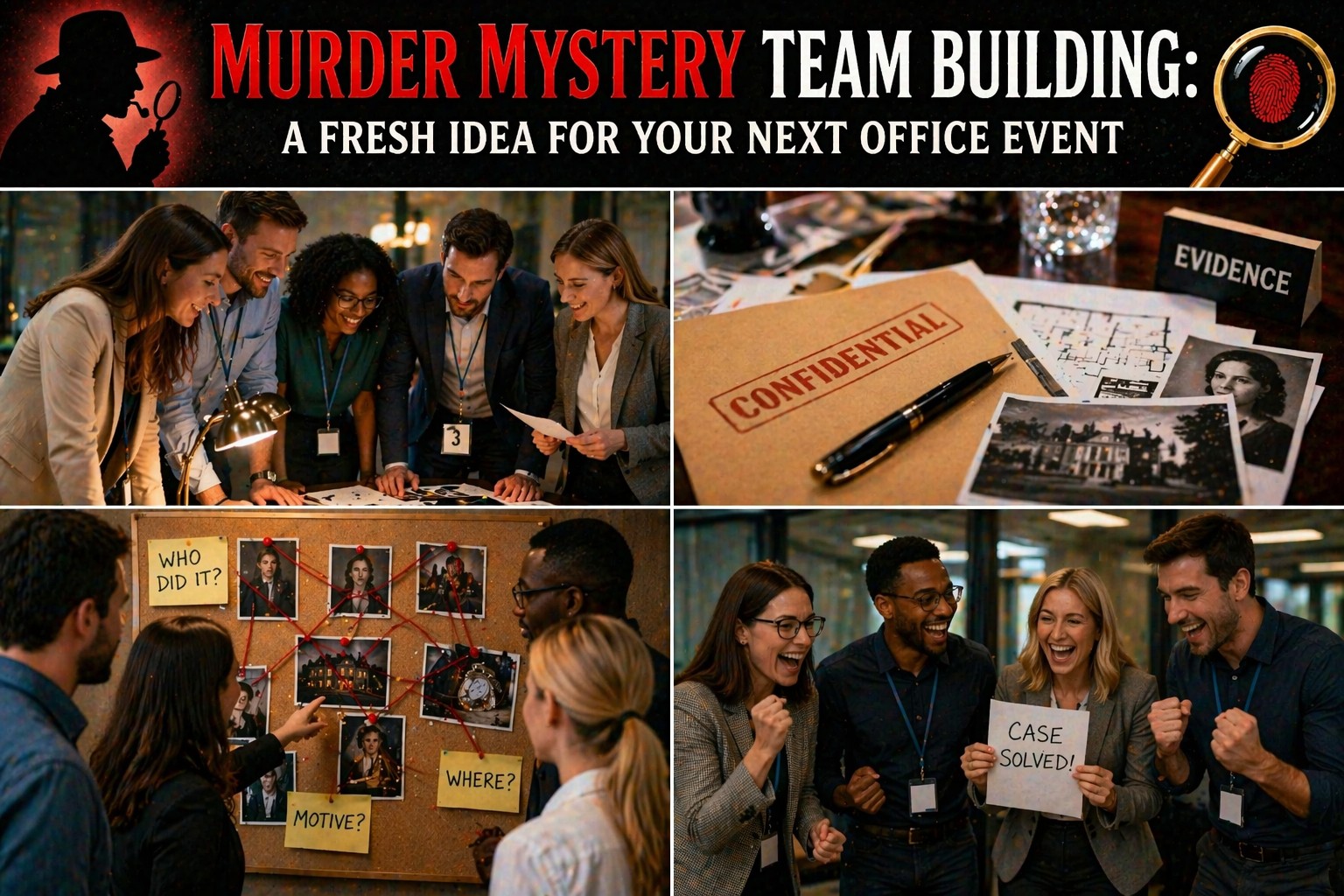
Murder Mystery Team Building: Why It Works Better Than Trust Falls
Arne Boetel · 12 min read · Published: July 03, 2026
Trust falls, group stretches, and awkward ice-breaker games have dominated corporate team building for decades. Yet here’s the uncomfortable truth: most employees dread them. A 2022 survey by Harvard Business Review found that 74% of workers view traditional team building activities as “uncomfortable” or “ineffective.” The problem isn’t the goal—teams genuinely need better communication, collaboration, and trust. The problem is the method. When activities feel forced or artificial, people disengage. That’s where murder mystery team building changes the equation. Unlike trust falls that require vulnerable physical contact, murder mysteries create genuine collaboration through a common goal: solving an engaging puzzle. Teams naturally communicate, listen actively, and work through evidence together—because they’re actually invested in the outcome. No facilitator needed. No awkward vulnerability. Just authentic teamwork that happens to be genuinely fun.The Problem with Traditional Team Building (And Why Mystery Works)

Murder Mystery Game for Teams — Print Multiple Copies, One Price
One PDF download runs your entire team — split into groups, compete to solve the case. No facilitator required. ⚡ Instant Download · 🖨️ Print at Home · ⭐ 4.8/5 from 323+ Reviews Get the Murder Mystery Game →Murder Mystery as Team Building: How It Develops Real Skills
The genius of murder mystery team building isn’t that it’s fun (though it is). It’s that the game structure forces teams to develop the exact skills that matter in a real workplace. Communication: When your team is puzzling through evidence, communication isn’t optional—it’s essential. Someone reads a suspect’s alibi. Someone else connects it to a timeline. A third person asks clarifying questions. People interrupt, debate, and refine ideas. This is raw, unfiltered communication under genuine pressure. And here’s the payoff: teams that communicate effectively during a mystery are practicing the same communication patterns they need in project meetings, problem-solving sessions, and conflict resolution. Active Listening: In many meetings, people wait for their turn to talk. In a murder mystery, someone’s casual comment (“Wait—she said she was at home, but the witness saw someone at the office at midnight”) might crack the case. Teams learn that everyone’s input matters. More importantly, they listen—really listen—because they don’t want to miss the clue that solves the mystery. Critical Thinking: A suspect has a motive and an opportunity. But does the evidence support their guilt? Maybe not. Teams must weigh competing theories, spot logical fallacies, and demand proof. Someone will propose a wild theory. Someone else will say, “But the timeline doesn’t work.” This back-and-forth refines thinking. It’s the exact same skill used in strategic planning, process improvement, and executive decision-making—except it’s happening in a context where people are genuinely engaged. Evidence Analysis: Murder mysteries require teams to sort through information and extract what matters. A document mentions three facts. Which two are red herrings? Which one is critical? Employees practice filtering signal from noise—a skill that translates directly to data analysis, client communications, and complex projects where information overload is the norm. Collaborative Decision-Making: At the end of a mystery, your team has to make a call: who did it? They can’t split the vote. They have to discuss, challenge assumptions, and reach consensus. Unlike abstract exercises, this decision has a real outcome—they either solve the case or they don’t. The team experiences the consequences of both strong consensus and poor reasoning. That’s the friction that builds better decision-making habits. The difference between murder mystery team building and, say, a trust fall is that the skills developed here transfer directly to work. You’re not practicing how to catch someone falling. You’re practicing how to solve complex problems together—which is literally the job.Running a Murder Mystery for Your Team: A Practical Guide

Murder Mystery Team Building for Different Group Sizes
One of the strengths of mystery-based team building is scalability. Here’s how to adapt for different group sizes. Small Teams (2–5 people): One evidence set. Everyone gathers around the same table. With fewer people, there’s more individual ownership of the outcome. Someone might dominate the conversation, but with only 4 people, it’s obvious and usually self-corrects. The intimacy can actually deepen the team bonding—everyone’s voice is heard or quickly missed. Medium Teams (6–20 people): Split into two or more competing investigation teams. Each group gets a printed copy of the mystery. The competition element heightens engagement: people care about getting it right so their team “wins.” You can score it (fastest correct answer wins) or just compare reasoning. This size is ideal because it balances inclusion with manageable group dynamics. If you have 12 people, two teams of 6 is perfect. Large Groups (20+ people): This is where the printable format truly shines. You can print multiple copies from a single PDF purchase—no licensing restrictions. Divide into teams of 4–6. Similar to how you’d organize a scavenger hunt for large groups, you can run multiple mysteries in parallel or have all teams solve the same case and compare solutions. You might need more space (a large conference room or team outing venue), but the logistics are straightforward. Three competing teams of 8 each? Three printed copies. Done. The key advantage: one PDF purchase = unlimited reusability across team sizes. This isn’t just cost-effective; it’s practically efficient.Virtual Murder Mystery Team Building (Remote Teams Welcome)

💡 From Our Experience: 45 minutes is the exact right length. At 40 minutes, some teams are still missing obvious clues and feel rushed. At 50 minutes, energy plateaus and conversations start repeating. Right at 45 minutes, there’s urgency without panic, and most teams reach a confident conclusion. If your team is naturally slower-paced, add 10 minutes. But don’t go longer than 55 or the engagement drops noticeably.
Budget Breakdown: Murder Mystery vs. Other Team Activities
Team building has a cost—both money and time. Here’s how murder mystery investigations stack up financially against other common options. Escape Room Experience: $30–50 per person for a 1-hour session. For a 10-person team: $300–500. Includes venue, puzzle design, and facilitation. One-time use. Professional Facilitator (Icebreakers/Trust Building): $500–2000 for a 2–3 hour session, depending on facilitator expertise. Often includes travel time. One event, one team. Team Building Company (Outdoor, Adventure-Based): $1000–5000+ depending on activity complexity and group size. Ropes courses, scavenger hunts, obstacle courses. Weather-dependent. Usually outdoor-only. Printable Murder Mystery (Our Model): $19.99 one-time purchase. Print as many copies as you need from a single PDF. Run it with 5 people or 50. Run it this quarter and again next quarter with different teams. No travel, no facilitator needed, no weather concerns. Cost per person comparison (10-person team):- Escape room: $30–50/person
- Professional facilitator: $50–200/person
- Adventure company: $100–500/person
- Printable mystery: $2/person (one team)
- Printable mystery (used 5 times): $0.40/person
“Our team hasn’t laughed together in months. This mystery had everyone engaged for the whole 45 minutes. People who usually don’t speak up in meetings were defending their theories passionately. Honestly the best team building we’ve done.”
FAQ: Murder Mystery at Work

Can a murder mystery game be used for team building?
Absolutely. Murder mystery investigations require communication, critical thinking, evidence analysis, and collaborative decision-making — all core team skills. Unlike forced icebreakers, teams naturally collaborate because they’re genuinely engaged in solving the mystery. The problem-solving aspect mirrors real workplace challenges, so the skills developed transfer directly to actual job performance.How many people can do a murder mystery team building activity?
Our printable game works for 2–10 investigators per team. For larger groups, split into competing investigation teams and see who solves the case first. The printable format means you can run multiple groups from one PDF download—print it 5 times and you can run 50 people across five teams simultaneously. There’s no upper limit on how many people can participate if you split into smaller teams.Do we need a game master or facilitator?
No. The game is completely self-contained. All the evidence, clues, and answers are in the PDF. Your only role is to print copies, explain the scenario in 5 minutes, set a timer for 45 minutes, and collect their answers. You don’t need to monitor the investigation or answer questions about the case. The team works independently.How long does a murder mystery investigation take?
Budget 70 minutes total: 5 minutes to brief, 45 minutes to investigate, 10 minutes for teams to report their answers, and 10 minutes for optional debrief. You can shorten to 50 minutes if you skip the debrief. For a quick team event during a meeting, 50 minutes is reasonable. For genuine team building with reflection, the full 70 is better.Can we run this with a remote team on Zoom?
Yes. Email the PDF to participants beforehand. Start with a brief 5-minute video call to explain the case. Use breakout rooms to split into investigation teams. After 45 minutes, bring everyone back to the main call and have each team present their conclusion. It works especially well for hybrid teams where some people are in-office and others remote.What’s the learning value for team building?
Murder mysteries develop specific workplace skills: active listening (you miss clues if you don’t pay attention), collaborative problem-solving (no one person has all the answers), consensus-building (the team must agree on a suspect), and evidence-based reasoning (decisions must be justified). These skills directly apply to project work, meetings, and cross-functional collaboration.Can we use this with groups that don’t know each other?
Yes, and it often works better with new groups. The mystery gives them something to bond over from the start. Unlike getting-to-know-you games, the focus is on the external problem (solving the case), not on each other. This makes it less awkward for groups still building rapport.Make Your Next Team Event Actually Memorable
One download. Unlimited teams. No facilitator required.
Get the Murder Mystery Game Kit →Starting at $19.99 · Instant download · Print at home · Unlimited reprints