

Blog
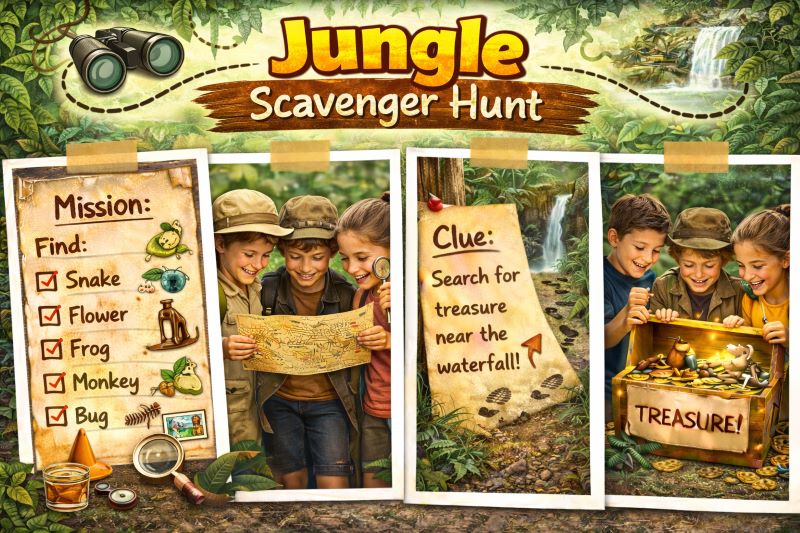
Jungle Scavenger Hunt: 8 Amazon Field Research Challenges for a Wildlife Birthday Party
Last updated: April 2026 | Written by Arne, founder of Riddlelicious
About this guide: The 8 field research challenges here are based on real tropical field biology methods: the IUCN Red List assessment criteria, Bernie Krause’s soundscape ecology framework, Robert Paine’s keystone species research (1969), line transect biodiversity survey protocols, and published Amazon canopy stratification science. The Amazon basin holds approximately 10% of all species on Earth in 0.5% of Earth’s land surface — the real science is extraordinary enough to need no exaggeration.
Real Amazon field researchers don’t just walk through the jungle and look around. They follow protocols: line transects for biodiversity surveys, bioacoustic monitoring for species inventories, body condition scoring for wildlife health, food web mapping to understand ecosystem stability. The science of tropical biology is methodical, specific, and genuinely fascinating — especially for kids who want to move through a forest as scientists, not tourists.
The Amazon Field Research Station sends every junior researcher through 8 real field science challenges. Complete all 8, document your findings, and earn your Junior Field Researcher Certificate and station patch.
Quick Facts
- Ages: 5–12
- Players: 4–20 (field teams of 2–4)
- Duration: 70–90 minutes
- Location: Backyard, park, or indoor with jungle decorations
- Equipment: Magnifying glasses, field notebooks, clipboards, measuring tape, colored string for transects, animal picture cards
- Skills: Observation, classification, sound identification, camouflage detection, food web reasoning, conservation assessment

Amazon Field Research Station Setup
At arrival, each junior researcher receives their Field Research ID (a badge sticker with their researcher number), their team assignment (Alpha Research Team, Beta Research Team), and their Field Notebook. The Station Director (host) delivers a 2-minute mission briefing: “The Amazon Research Station has detected unusual activity in 8 sectors. Your team will investigate, document findings, and report back.” Tone: serious, scientific, exciting.
Want Printable Jungle Scavenger Hunt Cards?
Our Jungle Treasure Hunt includes 8 field research challenge cards, species identification sheets, and a Junior Researcher Certificate — instant download, print and explore.
The 8 Field Research Challenges
Canopy Mapping — Vertical Zonation Science
The science: The Amazon rainforest is divided into four distinct vertical zones, each with its own species community: the emergent layer (trees exceeding 45 meters — harpy eagles, macaws), the canopy (25–45m — howler monkeys, toucans, sloths), the understory (5–25m — jaguar, poison dart frogs, orchids), and the forest floor (below 5m — giant anteaters, bullet ants, fungi). Less than 2% of sunlight reaches the forest floor. Each zone has different temperature, humidity, and light levels — creating essentially four different ecosystems stacked on top of each other.
Challenge: Set up a “canopy map” — a poster or wall chart divided into four zones with animal pictures placed in each. Teams receive 12 animal cards and must correctly place each species in its zone. Scoring: each correct placement = 1 point. Discuss: why would a jaguar live on the forest floor rather than the canopy? (Answer: too heavy for branches, hunts large prey on the ground.)
Biodiversity Survey — The Line Transect Method
The science: Field biologists measure biodiversity using transect surveys: a straight line of known length is established, and researchers count all species within a fixed distance on each side. Standard Amazon protocol: 100-meter transect, 5 meters on each side, record every species encountered. Scientists calculate species richness (total number of species) and species evenness (how equally distributed are the individuals). A healthy forest has high richness AND high evenness — dominated forests where one species crowds out others have low evenness despite high richness.
Challenge: Lay a 10-meter string across the yard/room. Teams walk the transect and record every “species” they spot — use picture cards of animals hidden in the grass, on leaves, or attached to branches. After the survey: How many total species (richness)? Is any single species much more common than others (evenness)? Compare results between teams — why might two teams find different species on the same transect?
Camouflage Detection — Cryptic Coloration Science
The science: Animals use four main camouflage strategies: background matching (color/pattern matches surroundings — walking sticks on bark), disruptive coloration (bold contrasting patterns that break up body outline — zebra stripes, jaguar rosettes), countershading (dark dorsal/light ventral surface — eliminates shadow and flattens appearance when lit from above), and masquerade (mimicking a different object entirely — leaf insects, twig caterpillars). The leaf-tailed gecko (Uroplatus) uses all four simultaneously. Predator vision systems drive the evolution of each strategy.
Challenge: Hide 10 “animal” picture cards in the outdoor environment, each using a different camouflage technique (card description on the back explains which type). Teams have 3 minutes to find as many as possible. After the hunt: examine each card — which camouflage type was it? Which was hardest to find? Why? Teams name one real animal for each camouflage type they can think of.
Bioacoustics — The Soundscape Survey
The science: Bernie Krause (soundscape ecologist) discovered that healthy ecosystems have structured acoustic environments: different species occupy different frequency bands to avoid acoustic overlap — a phenomenon called “acoustic niche partitioning.” He also developed the concept of soundscape ecology, dividing environmental sound into geophony (non-biological: wind, rain, streams), biophony (all biological sounds), and anthrophony (human-made noise). A biologist can assess ecosystem health from a 1-minute recording — declining species richness shows up as gaps in the acoustic spectrum before visual surveys detect population declines.
Challenge: Play a 60-second jungle soundscape audio clip (many free versions on YouTube). Teams identify and document: (a) at least 3 different animal calls, (b) one geophony sound, (c) any anthrophony sound. Teams guess which animal makes each call, then check against an ID sheet. Bonus: which sounds come from the canopy vs. forest floor? (Birds typically high frequency = canopy; frogs/insects = forest floor.)
Plant Adaptations — Tropical Engineering
The science: Tropical plants have evolved extraordinary adaptations to their extreme environment: drip tips (elongated, pointed leaf apices that channel rainfall off the leaf surface, preventing fungal growth in humid conditions), buttress roots (large, fin-like root extensions that provide structural stability in shallow tropical soil — can extend 10 meters from the trunk), epiphytes (plants that grow on other plants without soil, obtaining water from rain and nutrients from decomposing debris — 28,000 species of orchids alone), and cauliflory (flowering directly from the trunk or main branches rather than tips — allows access for large pollinators like bats). The cacao tree is a famous cauliflory example.
Challenge: Set up 5 “plant specimens” — real or illustrated leaves with distinct features. Teams identify which adaptation each specimen shows (drip tip, unusual texture for epiphyte, etc.). Then: find 3 plants in the backyard/room and describe ONE adaptation each plant has to its environment. No tropical plants needed — even a houseplant in a dry room has adaptations worth naming.
Wildlife Tracking — Reading the Evidence
The science: Field biologists rarely see large rainforest mammals directly — animals like jaguars, tapirs, and giant anteaters are nocturnal and secretive. Instead, researchers use spoor analysis: tracks, scat, territorial markings, hair snags, gnaw marks, and feeding signs. Jaguar tracks are identified by three lobes on the hind heel pad (vs. two lobes in dogs) and lack of claw marks (retractile claws). Trail camera trap data — cameras triggered by motion and heat — is the gold standard for rainforest mammal population surveys. The Wildlife Conservation Society’s camera trap program has documented over 700 mammal species across 50 countries.
Challenge: Create 6 “evidence stations” around the play area: a track cast (print jaguar, tapir, and capybara tracks in playdough or sand), scat samples (chocolate-covered raisins, peanuts, or twigs of different sizes), a feather, a piece of chewed bark, and a hair tuft. Teams identify what animal left each piece of evidence and what behavior it suggests (hunting, feeding, grooming, territory marking). Use a provided track identification guide.
Food Web Mapping — Who Eats Whom
The science: Ecologist Robert Paine (1969) discovered the keystone species concept by removing sea stars from a tidal pool and watching 15 other species disappear. The same principle applies in the Amazon: the Brazil nut tree (Bertholletia excelsa) depends entirely on the orchid bee (Eulaema sp.) for pollination (the bee has a body shape that fits only this flower) AND on the agouti (a rodent) for seed dispersal (the only mammal with strong enough teeth to open the seed pod). Lose either species and the tree goes extinct. Lose the tree and dozens of species that depend on it follow. A trophic cascade results when removing one species triggers a chain of extinctions and population explosions across multiple levels.
Challenge: Teams receive 10 animal/plant cards with descriptions of their food relationships. They build a food web by connecting cards with string. Then: remove one card (the keystone species — the orchid bee). Teams trace which other species are affected. How many connections break? This visualizes the trophic cascade. Which removal causes the most cascading damage?
Conservation Status — The IUCN Red List
The science: The International Union for Conservation of Nature (IUCN) Red List assesses species extinction risk using five quantitative criteria: A (population size reduction — >50% decline over 10 years = Endangered); B (geographic range restriction — under 5,000 km² = Vulnerable); C (small population size — under 2,500 mature individuals = Endangered); D (very small population — under 250 mature individuals = Endangered); E (quantitative extinction risk analysis). Species are classified as Least Concern, Near Threatened, Vulnerable, Endangered, Critically Endangered, Extinct in the Wild, or Extinct. As of 2024, over 44,000 species are threatened with extinction on the Red List.
Challenge: Teams receive 8 Amazon species cards, each with population data (declining/stable/increasing), range size, and estimated individual count. Teams apply the IUCN criteria to classify each species on the Red List scale. Check against the real classifications on the answer card. Debrief: which species was most surprising? What can scientists actually do with this information (informs international trade bans, habitat protection laws, captive breeding programs)?
Download the Jungle Hunt — Print in Minutes
Our Jungle Treasure Hunt includes all 8 field challenge cards, species ID sheets, a food web activity, and a Junior Researcher Certificate. Instant download.
Age Calibration
Ages 5–7
Focus on Stations 1, 3, 6 (canopy mapping, camouflage, tracking). Use picture-only ID cards. Simplify food web to 5 species. Skip IUCN criteria — replace with “safe vs. not safe” classification.
Ages 8–10
All 8 stations work. Use the bioacoustics clip and the full food web with 10 species. Introduce IUCN as a simple 3-level system (safe / at risk / critically endangered).
Ages 11–12
Add the full IUCN criteria cards with population data. Challenge teams to write a 3-sentence conservation recommendation for the most endangered species they classify.
Frequently Asked Questions
Does this need to be held outdoors?
No. Stations 1 (canopy mapping), 4 (soundscape), 7 (food web), and 8 (IUCN classification) work entirely indoors with printed materials. Stations 2 (transect), 3 (camouflage), and 6 (tracking) work best outdoors but can be adapted indoors with creative placement. Station 5 (plant adaptations) works well with houseplants or printed leaf cards.
How do I prepare the animal cards?
Print 12–15 animal images (Amazon species) on cardstock and laminate. Include species name, zone, and one interesting fact on the back. Free high-quality images are available from the IUCN Red List website and WWF image library. Alternatively, our Jungle Treasure Hunt download includes ready-made cards.
What if kids don’t know any Amazon animals?
That’s the point. The challenge cards include enough context that no prior knowledge is needed. The canopy mapping station introduces 12 species with their zone clues right on the cards. Kids learn as they play — which is more effective than teaching it first.
Can this run as a school or classroom activity?
Yes. Stations 2 (transect), 7 (food web), and 8 (IUCN) align directly with middle school life science standards. Stations 3 and 4 are strong for younger grades. The full 8-station format works as a 90-minute science enrichment session.
Sources & References
- Krause, B. L. (1993). The Niche Hypothesis: A virtual symphony of animal sounds, the origins of musical expression and the health of habitats. Soundscape Newsletter, 6, 6–10.
- Paine, R. T. (1969). A note on trophic complexity and community stability. American Naturalist, 103(929), 91–93.
- IUCN (2023). The IUCN Red List of Threatened Species. Version 2023-1. iucnredlist.org
- Gentry, A. H. (1988). Tree species richness of upper Amazonian forests. Proceedings of the National Academy of Sciences, 85(1), 156–159.
- Terborgh, J. (1992). Diversity and the Tropical Rain Forest. Scientific American Library.
- Janzen, D. H. (1974). The deflowering of Central America. Natural History, 83(4), 48–53. [Brazil nut pollination ecology]
Ready for Your Jungle Adventure?
The Jungle Treasure Hunt gives you all 8 field challenge cards, species identification sheets, a food web activity, and a Junior Field Researcher Certificate. Instant download — print and explore.