

Blog
Firefighter Scavenger Hunt: 8 Junior Recruit Academy Challenges for a Hero Birthday Party
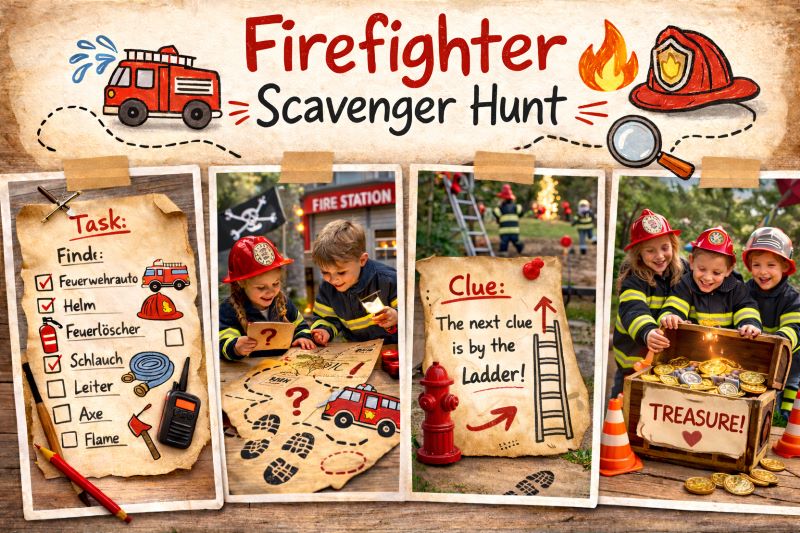
Last updated: April 2026 | Written by Arne, founder of Riddlelicious
About this guide: The 8 Junior Recruit Academy challenges are based on documented IAFF (International Association of Fire Fighters) training standards, NFPA 1001 firefighter professional qualifications, DOT hazmat placard regulations (49 CFR 172.500), fire behavior science (combustion tetrahedron, building construction types), and historical records of the Maltese Cross firefighter tradition. Real firefighter training is deeply scientific — this guide brings that curriculum to a birthday party format.
Professional firefighting is one of the most demanding technical careers in public safety. Recruits spend months learning fire behavior chemistry, building construction physics, hydraulic calculations, search-and-rescue protocols, hazardous materials identification, and high-load knot mechanics — before they ever enter a burning building. The real curriculum is science-heavy and built on life-or-death precision.
The Junior Recruit Academy runs every young firefighter through 8 real training stations. Pass all 8, receive your Maltese Cross badge, and take the Firefighter’s Oath at graduation.
Quick Facts
- Ages: 4–12
- Players: 4–20 (engine companies of 2–4)
- Duration: 75–90 minutes
- Location: Backyard obstacle course + indoor stations
- Equipment: Rope (50 ft), fire hose nozzle toy, obstacle materials (cones, buckets), printed hazmat placards, building construction cards, knot practice rope
- Skills: Fire science, building recognition, hose hydraulics, ladder physics, search protocol, knot tying, hazmat ID, graduation ceremony

Junior Recruit Academy Setup
At arrival, each recruit receives their Badge Number (their engine company assignment), their protective gear (firefighter hat + reflective strip sticker), and their Training Log. The Fire Captain (host) delivers the opening briefing: “Engine Companies — you have a structure fire reported at 8 sectors. Complete all 8 training stations to earn your certification and respond to the call.” Tone: urgent, proud, supportive.

Want Printable Firefighter Scavenger Hunt Cards?
Our Firefighter & Police Scavenger Hunt includes 8 station challenge cards, hazmat ID sheets, knot guide, and a Firefighter Certificate — instant download, print and train.
The 8 Academy Training Stations
Fire Science — The Combustion Tetrahedron
The science: The traditional “fire triangle” (fuel, oxygen, heat) was updated to the combustion tetrahedron when researchers added a fourth element: the uninhibited chemical chain reaction that sustains burning. All four sides are required simultaneously for fire to exist. Removing any one side extinguishes it: remove fuel (starve the fire); remove oxygen (smother with CO₂ or foam); remove heat (water cools the reaction); interrupt the chain reaction (dry chemical agents like monoammonium phosphate). Fire class determines the correct extinguishing method: Class A (ordinary combustibles — water or monoammonium phosphate), Class B (flammable liquids — foam or CO₂), Class C (electrical — CO₂ or dry chemical only, never water), Class D (combustible metals — dry sand), Class K (cooking oils — wet chemical).
Challenge: Teams receive 10 “fire scenario” cards — each describes a type of fire (kitchen oil fire, electrical panel fire, wood pile fire, chemical storage fire, etc.). Teams must identify the fire class and select the correct extinguisher type from 5 options. Scoring: each correct pair = 1 point. After scoring: demonstrate what happens to each tetrahedron element when you spray water on a wood fire vs. an oil fire.
Building Construction — Collapse Risk Assessment
The science: The NFPA (National Fire Protection Association) classifies buildings into five construction types, each with dramatically different fire behavior and collapse timelines. Type I (fire-resistive): reinforced concrete, slowest to fail — modern high-rises. Type II (non-combustible): steel frame, but steel loses 50% structural strength at 1,100°F and can collapse faster than concrete. Type III (ordinary): masonry exterior + wood interior — common in older downtown buildings; walls stand but floors fail. Type IV (heavy timber): 8-inch+ solid wood beams char slowly on the outside while remaining structurally sound — slowest collapse after fire-resistive. Type V (wood frame): residential construction — fastest collapse, typically 20–30 minutes of burn time before floor/roof failure. Firefighters must identify construction type before entry.
Challenge: Teams receive 6 building picture cards (exterior photos or drawings showing construction clues). They classify each building by type and predict: fastest to collapse (Type V), slowest (Type I). Then: arrange all 6 cards in order from fastest to slowest collapse — discuss why a modern steel skyscraper (Type II) can fail faster than an 1890s masonry building (Type III) in a hot fire.
Hose Hydraulics — Water Science
The science: Fire hose hydraulics follows the friction loss formula: FL = C × Q² × L, where C is a friction coefficient based on hose diameter (0.2 for 2½-inch hose; 15.5 for 1¾-inch), Q is flow in hundreds of gallons per minute, and L is hose length in hundreds of feet. Typical residential attack: 1¾-inch hose, 150 gallons per minute, ~100 psi pump discharge pressure. Larger diameter hose delivers more water at lower friction loss — that’s why supply lines from hydrants are larger diameter than attack lines. Nozzle pressure determines stream reach: a 100-psi nozzle delivers a 1-inch solid stream approximately 80 feet; a 50-psi fog nozzle covers a wider area at shorter range.
Challenge: Set up a water relay: teams use a small watering can or garden hose nozzle to fill a bucket 10 feet away — one team fills from 5 feet, one from 10 feet, one from 15 feet. Compare fill rates. Discuss: why does the team at 5 feet win? Apply this to fire hose physics — is it better to have a longer hose delivering less pressure, or a shorter hose at full pressure? When would each choice matter?
Ladder Safety — Angle Physics
The science: Ladder placement follows a precise physics principle: the optimal angle for a straight ladder is 75° from horizontal, also expressed as the 1-in-4 rule — place the base 1 foot away from the wall for every 4 feet of ladder height. Below 70°: the base generates insufficient horizontal reaction force and slides outward (wall friction insufficient). Above 80°: the center of gravity of the firefighter + ladder falls outside the base, causing rearward toppling. At 75°, the weight component forces the base into the ground while the wall provides the horizontal reaction. Fire service training uses the arm-extension test: stand at the base, extend your arm horizontally — if your fingers reach the rung at eye level, the angle is approximately correct.
Challenge: Use a toy ladder or propped plank against a wall. Teams measure and place the ladder at angles of 60°, 75°, and 85°. Load a small weight (water bottle) onto each configuration — which angles hold? Which slip? Then practice the arm-extension test on each angle to experience what 75° feels like. Each recruit identifies which angle is correct and explains why using the weight-component concept.
Search & Rescue — Left-Hand Protocol
The science: In zero-visibility search (thick smoke environments), firefighters use a systematic technique called the left-hand search: upon entering a room or structure, keep the left hand continuously on the wall surface and move in a clockwise direction. This ensures complete room coverage without disorientation — a firefighter who loses their left-hand wall contact in zero visibility has lost their path out. Primary search: fast sweep of statistically likely victim locations (beds, near exit doors, at floor level where cleanest air is found). Secondary search: methodical wall-to-wall sweep after primary search. The RECEO-VS priority order (Rescue, Exposures, Confinement, Extinguishment, Overhaul — Ventilation, Salvage) puts human rescue first, always.
Challenge: Set up a “smoke search” course — a darkened room or crawl-through tunnel (cardboard boxes connected) with a “victim” (stuffed animal) hidden inside. Each recruit is blindfolded and must locate the victim using only left-hand wall contact and verbal communication with their partner outside. Time each attempt. Discuss: why does the left-hand rule work even when you’re disoriented? (Answer: as long as you maintain wall contact, you can always reverse your path to exit.)
Knot Tying — Rescue Applications
The science: Firefighters use specific knots selected for load-bearing reliability and fast deployment. The bowline creates a fixed loop that won’t tighten under load and doesn’t jam — critical for victim rescue (the loop can go around a person without strangling them under weight). It’s documented in ancient Egyptian maritime records from approximately 2500 BCE and named in English by 1627. The clove hitch secures a rope to a cylindrical object (hose to ladder rung) — two half-hitches in opposite directions prevent slipping. The figure-8 on a bight creates a strong, easily inspected anchor loop. The half-hitch (the simplest securing knot) controls direction and is the basis of most other knots.
Challenge: Each recruit learns and ties the bowline in under 2 minutes (the NFPA standard for recruit certification). Practice sequence: “Make a loop — the rabbit comes out of the hole, around the tree, back down the hole.” Timed attempt. Bonus station: tie a clove hitch around a post in 90 seconds. Recruits who pass both earn their “Knot Certification” stamp in their Training Log.
Hazmat Recognition — Placard Science
The science: The US Department of Transportation (DOT) hazardous materials placard system (49 CFR 172.500) uses standardized diamond-shaped signs to communicate hazard class from a safe distance. There are 9 hazard classes: 1 Explosives, 2 Gases, 3 Flammable Liquids, 4 Flammable Solids, 5 Oxidizers/Organic Peroxides, 6 Toxic/Infectious, 7 Radioactive, 8 Corrosives, 9 Miscellaneous. The 4-digit UN/NA number on white placards identifies the specific chemical — cross-referenced in the Emergency Response Guidebook (ERG) orange guide pages for fire/spill response instructions. Firefighters identify placard class before approaching a hazmat incident to determine safe approach distance and personal protective equipment requirements.
Challenge: Teams receive 9 placard cards (one per hazard class) with color, symbol, and number. They match each placard to its hazard description, then receive 6 “incident scenario” cards (a tanker truck has a specific placard visible — which emergency response is needed?). Teams use a simplified ERG reference card to determine the correct response: approach distance, isolation zone, evacuation recommendation.
Graduation — The Maltese Cross and the Oath
The tradition: The Maltese Cross became the symbol of firefighters through a specific historical event. During the Crusades (11th–12th centuries), Knights of St. John (Hospitallers) fought alongside soldiers who used fire as a weapon — flaming oil thrown from containers onto enemy troops. The knights ran through the flames to rescue burning soldiers, earning recognition for their courage. The cross worn by the Knights of St. John — an eight-pointed shape with four V-shaped arms — was awarded to firefighters who saved lives under fire conditions. By the 19th century, the cross had become the universal symbol of the fire service worldwide. Each point represents a knightly virtue: tact, dexterity, explicitness, observation, sympathy, perseverance, gallantry, loyalty.
Graduation: The Fire Captain reads all recruits’ Training Log scores. All recruits who completed at least 6 stations stand in formation and take the Oath: “I will protect life and property from fire. I will support my company. I will never leave a teammate behind.” Each recruit receives their Maltese Cross badge and Firefighter Certificate. Group photo in gear.
Download Ready-Made Firefighter Hunt Cards
Our Firefighter & Police Scavenger Hunt gives you all 8 training station cards, a hazmat placard reference sheet, knot guide, and a Firefighter Certificate. Instant download.
Age Calibration
Ages 4–6
Focus on Stations 1 (fire triangle — simplified to 3 sides), 3 (water relay), and 8 (graduation ceremony). The search tunnel (Station 5) is a favorite for this age. Skip hydraulics math and hazmat codes.
Ages 7–9
All 8 stations. Use simplified friction loss concept (closer = more water = better). Building construction: just order the 6 buildings fastest to slowest, no need for type numbers.
Ages 10–12
Full science at each station. Challenge: calculate the friction loss for 200 feet of 1¾-inch hose at 150 gpm. Introduce the full NFPA construction type classification. Knot tying under 60-second time pressure.
Frequently Asked Questions
Is this safe for young children?
Yes — no actual fire is involved at any station. The fire science station uses cards and discussion only. The “smoke search” station uses a blindfold or cardboard tunnel — fully safe. The water relay uses a small watering can. All props are age-appropriate.
How do I set up the smoke search tunnel?
Connect 4–6 large cardboard appliance boxes end-to-end (tape the openings together to form a tunnel). The recruit crawls through with a blindfold on while keeping one hand on the box wall. Place the stuffed animal “victim” at a dead end or intersection. Alternatively, darken a hallway and have recruits navigate using the left-hand wall rule with eyes closed.
Where do I get firefighter hats and gear props?
Plastic firefighter helmets are available for $3–5 each on Amazon. Add a yellow vest or a strip of reflective tape on a dark jacket for the PPE effect. Even just a red hat dramatically changes the atmosphere. Real fire station open days often give out junior firefighter stickers too — call your local station.
Can I combine this with a police theme?
Absolutely — our Firefighter & Police Scavenger Hunt download includes content for both themes. Divide the party into two “departments” and have each complete both sets of challenges before a joint graduation ceremony.
What if it rains?
The water relay (Station 3) can move indoors to a bathtub or utility sink. The obstacle course (search tunnel) works in a hallway. All other stations are naturally indoor-compatible. The hazmat and building construction stations actually benefit from a table setup — rain doesn’t affect them at all.
Sources & References
- NFPA 1001 (2019). Standard for Fire Fighter Professional Qualifications. National Fire Protection Association.
- International Association of Fire Fighters (IAFF). (2022). Fire Fighter Recruit Training Program. iaff.org
- US Department of Transportation (2020). 49 CFR 172.500 — Hazardous Materials Placarding Requirements.
- US DOT Pipeline and Hazardous Materials Safety Administration (2020). Emergency Response Guidebook. phmsa.dot.gov
- Norman, J. (2012). Fire Officer’s Handbook of Tactics (4th ed.). Fire Engineering Books.
- Erven, L. (1998). The Maltese Cross: History and tradition in the fire service. Fire Engineering, 151(8).
Ready to Train Your Junior Recruits?
The Firefighter & Police Scavenger Hunt gives you all 8 training station cards, hazmat ID sheets, a knot guide, and a Firefighter Certificate. Instant download — print and train.