

Blog
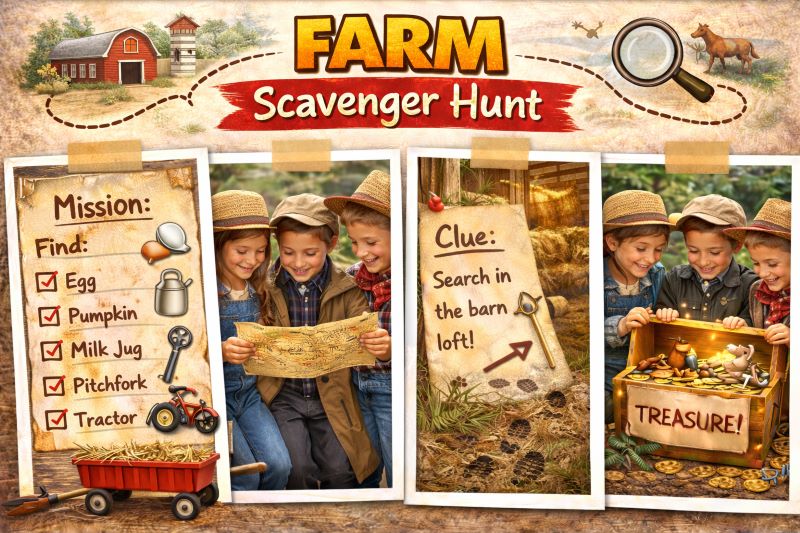
Farm Scavenger Hunt: 8 Junior Farmer Academy Challenges for an Agricultural Birthday Party
Last updated: April 2026 | Written by Arne, founder of Riddlelicious
About this guide: The 8 Junior Farmer Academy challenges here draw on real agricultural science: USDA soil classification and texture triangle standards, 4-H livestock evaluation protocols (Body Condition Scoring 1–9), USDA Cooperative Extension IPM (Integrated Pest Management) guidelines, Merck Veterinary Manual nutrition standards, and the historic 4-H Club curriculum developed by USDA Extension Services in 1902. Modern farming is deeply scientific — these stations bring that reality to a birthday party format.
Professional farming combines soil chemistry, plant biology, animal nutrition, weather forecasting, pest management, and market economics — all applied daily. A working farmer understands photosynthesis, rumen microbiology, evapotranspiration, and futures pricing. The 4-H Junior Farmer Academy is the oldest hands-on agricultural education program in the US, founded in 1902, and still runs on the principle that learning by doing is the most effective teaching method.
The Junior Farmer Academy sends every young farmer through 8 real agricultural science challenges. Complete all 8, fill in your Farm Record Book, and earn your blue ribbon and 4-H certificate at the County Fair ceremony.
Quick Facts
- Ages: 5–12
- Players: 4–20 (farm crews of 2–4)
- Duration: 70–90 minutes
- Location: Backyard garden or indoor with farm decorations
- Equipment: Soil samples (3 types), pH testing kit or strips, plant specimens, animal picture cards, plastic insects, magnifying glasses, small scale for weighing produce
- Skills: Soil science, plant biology, animal nutrition, weather reading, pest ID, farm economics, safety, graduation ceremony

Junior Farmer Academy Setup
At arrival, each junior farmer receives their Farm Badge (a 4-H clover sticker with their crew name), their Crew assignment (Corn Crew, Wheat Crew, Soybean Crew — named after real US crops), and their Farm Record Book. The Farm Manager (host) opens with a 2-minute briefing: “The county fair is in 90 minutes. Your farm has 8 projects to complete. Let’s get to work.” Tone: hardworking, proud, grounded.

Want Printable Farmyard Scavenger Hunt Cards?
Our Farmyard Treasure Hunt includes 8 farm challenge cards, crop identification sheets, and a Junior Farmer Certificate — instant download, print and plant.
The 8 Farm Science Challenges
Soil Science — Reading the Ground Beneath You
The science: Soil has distinct layers called horizons: the O horizon (organic matter — decomposing leaf litter), the A horizon (topsoil — dark, rich in humus, most plant roots here), the B horizon (subsoil — mineral-rich, where clay accumulates), the C horizon (weathered parent rock), and bedrock (R). Soil texture is classified by particle size: sand (>0.05 mm), silt (0.002–0.05 mm), clay (<0.002 mm). The ideal agricultural soil is loam — roughly 40% sand, 40% silt, 20% clay. Soil pH (4–8 scale for most farmland) determines which nutrients are available: most crops grow best at pH 6.0–7.0. Below pH 6.0, aluminum becomes soluble and toxic; above 7.5, iron and manganese become unavailable.
Challenge: Provide 3 soil samples (sand, clay, and garden soil/loam). Teams test each with a pH strip, then do the “squeeze test” (clay holds its shape when squeezed; sand falls apart; loam holds shape but crumbles easily). Which soil is best for growing tomatoes? Which drains too fast? Which holds too much water? Teams record their pH readings and texture classification in their Farm Record Books.
Plant Biology — From Seed to Harvest
The science: Germination requires three factors simultaneously: moisture (to activate digestive enzymes that break down seed starch), oxygen (for cellular respiration in the embryo), and warmth (most vegetable seeds germinate best at 65–85°F). Light is generally not required for germination but is essential afterward. Photoperiodism — a plant’s response to day length — controls flowering: short-day plants (strawberries, chrysanthemums) flower when days are shorter than a critical length; long-day plants (spinach, lettuce) flower when days are longer. Farmers control this with artificial lighting in greenhouses. The plant hormone auxin (IAA) causes phototropism: higher concentration on the shaded side causes that side to elongate, bending the plant toward light.
Challenge: Teams receive 6 “mystery seeds” (bean, corn, sunflower, carrot, lettuce, pea — all labeled with pictures of the mature plant). They predict: which germinates fastest? Which needs the most water? Using a seed germination test (seeds between two moist paper towels), check after 24–48 hours for sprouts. At the party: predict the order and discuss why beans typically beat carrots (smaller embryo = faster energy mobilization).
Livestock Nutrition — Body Condition Scoring
The science: Agricultural scientists use Body Condition Scoring (BCS) on a 1–9 scale (Henneke et al., 1983 for horses; 1–5 scale for cattle) to assess nutritional status visually. Score 1 = severely emaciated; Score 5 (midpoint) = ideal; Score 9 = obese. Key observation points: fat deposits over ribs, spine prominence, tailhead fat cover. Livestock nutrition is measured in Total Digestible Nutrients (TDN): alfalfa hay has ~58% TDN (high protein, high calcium), grass hay ~50% TDN. Ruminants (cattle, sheep, goats) have four stomach chambers: rumen (fermentation tank with 200+ microbial species), reticulum, omasum, abomasum. The rumen microbiome can break down cellulose that no mammal enzyme can digest directly.
Challenge: Teams receive 6 animal picture cards showing livestock at different body condition scores (labeled 1, 3, 5, 7, 9 on the back). They place each animal on a BCS number line. Then: a “feed formulation” puzzle — which hay type (alfalfa vs. grass) is best for a lactating cow vs. a mature dry horse? (Answer: lactating cow needs high-protein alfalfa; mature horse does well on grass hay to avoid excess protein.) Teams explain their reasoning.
Weather Science — The Farmer’s Forecast
The science: Farmers read weather using instruments and observations that predate modern forecasting. A barometer falling rapidly (>0.06 in Hg per hour) signals an incoming storm; steady high pressure means fair weather. The Beaufort Wind Scale (Francis Beaufort, 1806; adopted by Royal Navy 1838) classifies wind from 0 (calm) to 12 (hurricane force) based on observable effects — no instruments needed. Dew point is the temperature at which air becomes saturated; when dew point equals air temperature, fog or rain forms. Evapotranspiration (ET) — the combination of water evaporated from soil plus water transpired from plants — drives irrigation scheduling: farmers calculate ET from temperature, humidity, wind, and solar radiation to decide when and how much to irrigate.
Challenge: Teams observe 6 weather condition cards (a barometer reading, a cloud type photo, a wind description, a temperature/humidity pair) and predict: “Should we irrigate today? Is rain coming?” Then use a simple wind observation outside: watch tree leaf movement, flag flutter, or use a streamer to estimate Beaufort scale level. What does today’s wind suggest about tomorrow’s weather?
Pest ID — Integrated Pest Management
The science: Integrated Pest Management (IPM) is the USDA’s preferred approach to pest control: identify the pest accurately, establish an economic threshold (the pest population level at which control becomes cost-effective), and choose the least toxic effective method first. The IPM hierarchy: biological control (introduce natural predators — ladybugs eat 50–150 aphids per day; parasitic wasps lay eggs in caterpillars), cultural control (crop rotation disrupts pest life cycles), mechanical control (row covers, sticky traps), and chemical control only as a last resort. Key beneficial insects: ladybird beetles (Coccinella sp.) for aphid control, lacewings for whiteflies, ground beetles for soil pests, parasitoid wasps for caterpillar pest management.
Challenge: Teams receive 10 insect picture cards — a mix of pest and beneficial species. They sort into two piles: “Farm Friend” vs. “Farm Pest.” Then: for each pest, which IPM method is best? (Aphids = introduce ladybugs; tomato hornworm = introduce parasitic wasps; Colorado potato beetle = rotate crops away from nightshades.) Check answers against the IPM reference card. Bonus: find 2 real insects in the backyard and identify them.
Farm Equipment Safety — Know Before You Go
The science: Farm machinery causes more occupational fatalities in the US than any other industry sector (OSHA). The most dangerous hazard: Power Take-Off (PTO) shafts — rotating metal shafts that transfer engine power to implements like mowers, balers, and pumps. Loose clothing or hair can catch in milliseconds, causing severe injury. The minimum safe distance is 4 feet from an exposed PTO shaft. ROPS (Roll-Over Protective Structure) — the roll bar on tractors — reduces tractor overturn fatalities by 99% when combined with a seatbelt. Hydraulic systems operate at 2,000–3,000 psi — a hydraulic oil injection injury (fluid forced through skin from a pinhole leak) requires immediate surgical treatment. “Never use your hand to check for a hydraulic leak.”
Challenge: Teams receive 8 “farm scenario” cards showing different equipment situations — some safe, some with a hazard. They identify the hazard in each unsafe scenario and name the correct safety action. Score: 1 point per correct identification. Discuss: which farm hazard surprised you most? Why is the PTO the most dangerous? Teams create one “Safety Rule” for the academy’s Farm Safety Board.
Farm Market Math — Profit & Loss
The science: Farm economics requires calculating the break-even price — the minimum price per unit at which total revenue equals total cost. Formula: Break-even = Total Fixed Costs ÷ (Price per unit − Variable Cost per unit). US corn farming example (2023 USDA data): total cost of production ≈ $5.70/bushel; break-even yield at $5.00/bushel market price requires production efficiency to reduce cost. Commodity prices are set at the Chicago Board of Trade (CBOT) through futures contracts — a farmer can lock in a price months before harvest to reduce market risk. The USDA publishes weekly commodity price reports used by farmers, traders, and food processors.
Challenge: Teams receive a simplified “Mini Farm Budget” sheet: they grew 50 pounds of tomatoes at a cost of $1.20/pound. The farmers’ market price is $3.50/pound; the grocery store offers $2.00/pound. Calculate: (a) profit at each price, (b) how many pounds they’d need to sell at the grocery store price to match the farmers’ market profit. This introduces margin, volume, and channel decisions — real agricultural economics simplified for kids.
County Fair Graduation — Blue Ribbon Ceremony
The tradition: The 4-H Club ribbon system dates to the county fair tradition established alongside 4-H in the early 1900s. Blue ribbon = excellent work; red ribbon = good; white ribbon = fair. The tradition derives from agricultural show judging (itself from British agricultural societies of the 1800s). The 4-H Pledge — “I pledge my head to clearer thinking, my heart to greater loyalty, my hands to larger service, and my health to better living, for my club, my community, my country, and my world” — was written in 1927 by Otis Caldwell and is recited at every 4-H ceremony worldwide.
Graduation: The Farm Manager totals each crew’s Farm Record Book scores. Top crew earns a blue ribbon; all participants earn a “Junior Farmer” ribbon and certificate. The full group recites the 4-H Pledge together (print it on the ceremony card). Each junior farmer takes home their Farm Record Book with their scores and notes from all 8 stations.
Download the Farmyard Hunt — Print & Plant
Our Farmyard Treasure Hunt gives you all 8 farm challenge cards, a crop identification sheet, a pest IPM guide, and a Junior Farmer Certificate. Instant download.
Age Calibration
Ages 5–7
Focus on soil texture (feel the sand vs. clay), seed planting, and insect sorting. Skip pH numbers and math. The animal nutrition station works great with simple “enough food / too little / too much” sorting.
Ages 8–10
All 8 stations at moderate complexity. Use pH numbers for soil, full insect ID, and simplified break-even calculation (whole numbers only). The weather station works well with a real barometer if available.
Ages 11–12
Full science at every station including evapotranspiration concept, rumen microbiology, and the complete farm budget with margin analysis. Challenge: calculate break-even at different market prices.
Frequently Asked Questions
Do we need to be on a real farm?
Not at all. A backyard or indoor space with props works perfectly. Soil samples can come from any garden store (buy a bag of sand, a bag of clay soil, and a bag of potting mix — about $5 total). Animal pictures come from printouts. The IPM station works indoors with picture cards. If you want a real farm visit angle, many US states have agricultural extension demonstration gardens open to the public.
Where do I get soil pH testing supplies?
pH testing strips (universal, 0–14 range) are available at garden centers and pharmacies for $3–5. Digital pH meters are $10–15 on Amazon. Litmus paper works but is less accurate for the 5.5–7.5 range most relevant to farming. Vinegar (~pH 3) and baking soda solution (~pH 9) make good demonstration calibration standards.
How do I set up the seed germination test in time for the party?
Start the germination test 2–3 days before the party: place seeds between moist paper towels in labeled zip-lock bags, keep at room temperature. By party day, you’ll have visible germination differences to examine. Alternatively, use the prediction/discussion format on party day and check results together 24 hours later at home.
Can this run as a school or camp activity?
Yes — many USDA Extension programs run identical workshops for school groups. Stations 1 (soil), 5 (IPM), and 7 (market math) align with middle school science and math standards. USDA 4-H programs offer free curriculum materials through the local Extension office in every US county.
Sources & References
- USDA Natural Resources Conservation Service (2023). Soil Texture Classification. nrcs.usda.gov
- Henneke, D. R., Potter, G. D., Kreider, J. L., & Yeates, B. F. (1983). Relationship between condition score, physical measurements, and body fat percentage in mares. Equine Veterinary Journal, 15(4), 371–372.
- USDA National Institute of Food and Agriculture (2023). Integrated Pest Management. nifa.usda.gov/ipe
- OSHA (2020). Agricultural Safety: Preventing Injuries and Deaths of Farm Workers. osha.gov
- Beaufort, F. (1806). Beaufort Scale of Wind Force. UK Royal Navy Meteorological Office.
- 4-H (2023). 4-H Club Pledge and History. 4-h.org
- USDA Economic Research Service (2023). Commodity Costs and Returns. ers.usda.gov
Ready for Your Farm Party?
The Farmyard Treasure Hunt gives you all 8 farm challenge cards, crop ID sheets, a pest guide, and a Junior Farmer Certificate. Instant download — print and plant.