
Blog
Wizard Scavenger Hunt: 8 Young Alchemist Spell-Casting Challenges for a Magic Birthday Party
Last updated: April 2026 | Written by Arne, founder of Riddlelicious
About this guide: I’ve run magic-themed parties using real chemistry experiments as the “spell stations” for six years. The key insight: kids find actual chemical reactions more impressive than stage magic tricks because the reactions are real and they caused them. Every “spell” in this guide has a genuine scientific explanation, which I give after the effect — the explanation makes the magic better, not less magical.
The problem with most wizard birthday parties: the magic feels fake. Kids wave wands and pretend things happen. The costumes are fun, but there’s nothing genuinely surprising — nothing that makes a kid gasp and say “wait, how did that actually work?”
Real chemistry does that. Acid-base reactions, indicator color changes, density stratification, polymer chemistry — these produce effects that look exactly like movie magic and have a genuine scientific explanation that makes them even more impressive when revealed.
The Young Alchemist’s Academy formats your party as a real apprentice certification program at a wizarding school. Each station is a spell challenge with three components: the incantation (kids say a real Latin chemistry term), the procedure (the actual experiment), and the reveal (the scientific explanation given after the effect). Completing all 8 stations earns Certified Alchemist status.
Quick Facts
- Ages: 6–12
- Players: 4–20 (houses of 3–4)
- Duration: 80–100 minutes
- Location: Kitchen, dining room, or outdoor — needs water access
- Materials: Baking soda, vinegar, red cabbage, cornstarch, food coloring, baby oil
- Science themes: Acid-base chemistry, density, polymer chemistry, chromatography, combustion

The Young Alchemist Academy Setup
Give each house a Spell Book — a small stapled booklet with one page per station. Each page has: the spell name, the incantation, space to record the observation, and a blank “scientific truth” box that gets filled in after the reveal. At the end, the completed Spell Book becomes their Alchemist Certification.
Set up each station before guests arrive. Label them with parchment paper scrolls. Dim the party room slightly (battery candles work well) — lighting is 40% of the atmosphere. Play ambient orchestral music or thunder/rain sounds quietly in the background.
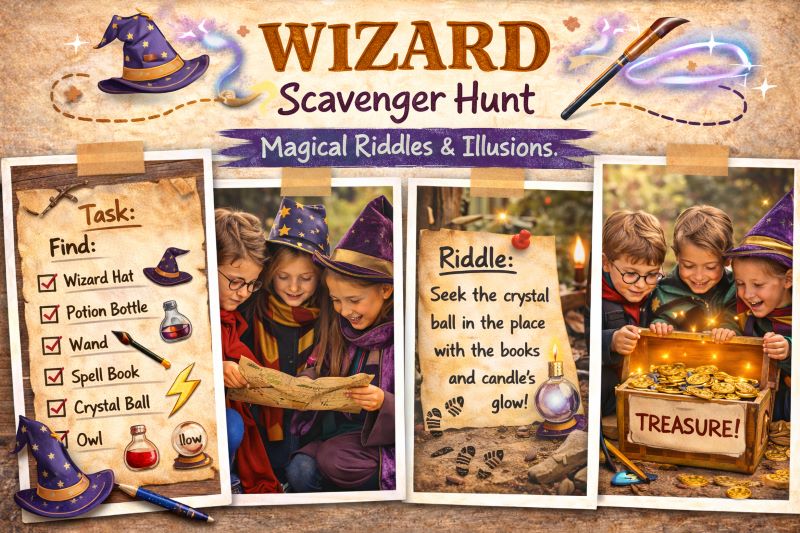
Want Printable Spell Cards and Spell Books?
Our Magic Scavenger Hunt includes illustrated spell station cards, an alchemist’s spell book template, and a complete materials list — instant download, print and enchant.
The 8 Spell Stations
Aqua Mutabilis — The Color-Change Potion
Incantation: “Acidus revelio!” (Latin: “Reveal the acid!”)
Science: Red cabbage contains anthocyanin — a natural pH indicator that turns pink/red in acidic solutions and blue/green in alkaline solutions. This is the same reaction used in real pH test strips.
Procedure: Prepare red cabbage juice ahead (boil 1 cup chopped cabbage in 2 cups water, strain). Fill 4 small glasses with cabbage juice. Provide labeled “potions”: clear vinegar (acid), baking soda water (base), lemon juice (acid), antacid dissolved in water (base). Kids add one potion to each glass and record the color change.
Reveal: Explain pH scale — 0–6 = acid (pink/red), 7 = neutral (purple), 8–14 = base (green/blue). Cabbage juice detects which is which.
Erupto Maxima — The Volcanic Eruption
Incantation: “Bicarbonatus explodus!”
Science: Baking soda (sodium bicarbonate, a base) reacts with vinegar (acetic acid) to produce carbon dioxide gas rapidly — the same reaction used in fire extinguishers. The CO2 expands faster than it can escape, creating the visible eruption.
Procedure: Place a small plastic bottle in a “volcano” formed from salt dough or aluminum foil. Add 2 tablespoons baking soda and a drop of red food coloring. Kids pour in 3–4 tablespoons of vinegar on the incantation. For a slower, more impressive version: add a few drops of dish soap to the baking soda first — it traps the CO2 and creates foam.
Reveal: The gas produced (CO2) is the same gas you exhale. It’s invisible but heavy — demonstrate by pouring it from a cup over a candle flame to extinguish it without blowing.
Densitas Layerus — The Seven-Layer Rainbow
Incantation: “Densitate separatum!”
Science: Liquids layer by density — denser liquids sink below less dense ones if they don’t mix. A precise pouring sequence creates stable permanent layers. Honey (densest) → corn syrup → dish soap → water → vegetable oil → rubbing alcohol → lamp oil (least dense).
Procedure: A tall clear glass and 4–7 liquids, each tinted a different color. Kids pour them in carefully in density order (slowest pour = cleanest layers). Add a small object (grape sinks through oil and water but stops above the honey layer; a raisin behaves differently).
Reveal: Objects in water experience buoyancy equal to the weight of water they displace. An object floats at the layer whose density matches its own. No magic — pure physics.
Solidus Liquidus — The Shape-Shifting Substance
Incantation: “Oobleckus transformus!”
Science: Cornstarch mixed with water creates a non-Newtonian fluid — a substance that behaves as both solid and liquid depending on the force applied. Hit it hard and it acts solid; lift it slowly and it drips like liquid. This is shear thickening — used in bullet-resistant materials and football padding.
Procedure: Mix 1 cup cornstarch with ½ cup water to form “Oobleck” (named after a Dr. Seuss story but the chemistry is real). Each kid gets their own small portion. They punch it (solid), then slowly dip a finger (liquid). Roll a ball in their hands (solid) then stop — it melts. The behavior is startlingly counter-intuitive even knowing the explanation.
Chromaticus Revelio — The Invisible Ink Spell
Incantation: “Pigmentus separatum!”
Science: Chromatography separates mixtures by how fast different molecules travel through a medium. Black ink appears black because it contains multiple dyes mixed together. On damp coffee filter paper, the different dye molecules travel at different speeds — separating into their component colors as the water moves.
Procedure: Draw a thick line with various black markers (non-permanent work best) on coffee filter paper. Dip the bottom edge in a shallow dish of water. Watch the colors separate as the water travels up. Each brand of black marker produces a different color pattern — some reveal green and yellow; others show blue and red.
Bonus: Write a secret message in black ink, then reveal the “invisible content” of each letter through chromatography.
Polymerus Elasticus — The Bouncing Blob
Incantation: “Polymeratus elasticat!”
Science: Polyvinyl alcohol (PVA glue) is a polymer — long chains of repeating molecules that slide past each other. Adding borax solution cross-links these chains together, creating a new network structure that bounces and stretches. This is the chemistry of silicone, Kevlar, and most modern plastics.
Procedure: Mix 2 tablespoons white PVA glue with 1 tablespoon water and food coloring. Slowly add borax solution (1 teaspoon borax in 1 cup water) while stirring. The mixture solidifies in about 30 seconds. Knead until smooth — the result is a bouncing, stretchy ball. Use 1% borax solution for the safest version; supervise closely and wash hands after.
Each kid makes their own polymer ball to take home — the most popular party favor in 6 years of running this party format.
Flamma Colorata — The Colored Fire Spell
Incantation: “Spectrus emittus!”
Science: Different metal salts produce different colored flames when heated — this is atomic emission spectroscopy. Copper burns green, sodium (salt) burns yellow, potassium burns violet. The color depends on how much energy the atom’s electrons release when they fall back to their ground state after being excited by heat. This is how neon signs and fireworks work.
SAFE VERSION for kids: Instead of open flame, use color-changing “fire” with warm water: add different salt solutions (copper sulfate solution = blue, potassium permanganate = purple, iron sulfate = yellow-green) to clear glasses of warm water lit from below with a battery LED pad. The color swirling in warm water looks genuinely spectacular.
Note: If using actual flame tests with adult supervision, use wooden skewers dipped in salt solutions over a tea light — not open alcohol burners. Salt = yellow, copper sulfate = green.
Final Exam — The Grand Alchemical Challenge
Task: Each house receives a sealed “mystery substance” (a small unmarked bag) and must identify it using only the tests learned in the previous 7 stations. The mystery substance is baking soda. Houses must determine: (1) Is it acid or base? (vinegar test or cabbage juice test), (2) What happens when it contacts acid? (bubbles = CO2 release), (3) Does it dissolve in water? (yes), (4) Is it a polymer? (no — doesn’t form blob with borax). Houses write their identification in their Spell Book with full reasoning.
Final pronouncement: each house presents their identification and reasoning. Correct identifications (baking soda = sodium bicarbonate, a base) receive full Alchemist Certification.
Award categories: Most Beautiful Rainbow Layers | Best Chromatography Reveal | Best Polymer Ball | Most Complete Spell Book | Best Final Identification Reasoning
Decoration Ideas
- Laboratory aesthetic: Beakers and flasks filled with colored water scattered around the table — more impressive than candles alone
- Ingredient jars: Label household ingredients with their wizarding names: “Bicarbonatus of Soda,” “Essence of Acetum (Vinegar),” “Oil of Baby” — kids love reading them
- Spell book library: Stack old hardcover books on the table — even better if they have interesting spines or titles
- House banners: Assign each team a house color and hang a banner at their side of the table
- Cauldron centerpiece: A black pot with a LED “flame” inside + dry ice pellets in warm water if you can source them — produces lasting fog effect with zero danger
Snacks
- Potion punch: Clear lemonade with a floating frozen blueberry “orb” — it slowly bleeds color into the drink as it melts
- Cauldron cake: A black-frosted round cake with “bubbling” candy on top (Pop Rocks work perfectly)
- Ingredient cookies: Sugar cookies decorated as molecular diagrams — H2O, NaHCO3 (baking soda) — label them correctly for the full nerdy effect
- Dry ice punch bowl: Grape juice punch in a large bowl with dry ice chips — visually stunning, completely safe (CO2 sublimation, no contact required)
Age Calibration
Ages 6–7
Focus on the eruption, Oobleck, and chromatography — all three have immediate visible effects requiring no explanation for enjoyment. Skip the density layers and polymer ball (supervision-intensive). Simplify Final Exam to just the vinegar test.
Ages 8–10
Full program as described. Polymer ball is the most requested activity at this age. pH color change generates genuine curiosity about what “acid” means. The Final Exam mystery identification is genuinely challenging and engaging.
Ages 11–12
Add: write the chemical equations for the acid-base reactions, calculate approximate density of each layer in the rainbow from reference values, and research which industries use non-Newtonian fluid properties commercially.
Download the Magic Scavenger Hunt Kit
Spell station cards, alchemist spell book template, materials checklist, and house scoring system — ages 6–12, instant download, print and enchant.
Frequently Asked Questions
Is the chemistry safe for kids at birthday parties?
Every station in this guide uses food-safe or common household materials. The polymer ball (borax) requires hand washing and supervision but is safe in normal use. The colored fire station uses the LED/warm water version, not actual flame. Dry ice (if used in the punch bowl) should be handled by adults only and never touched directly — the fog effect doesn’t require contact. No station requires any chemical not found in a typical grocery or dollar store.
How much prep does this require?
About 45–60 minutes the morning of the party. Pre-make the cabbage juice indicator, prepare the density layer liquids in separate labeled cups, and set up the station tables. The volcanic eruption and Oobleck are made fresh during the party — they take 2 minutes each. The polymer ball borax solution can be pre-mixed and stored in a sealed bottle.
What’s the messiest station?
Oobleck (Station 4). Put a plastic tablecloth underneath and have paper towels ready. It cleans up easily with water — it’s just cornstarch — but kids will inevitably drop some. The chromate graphy station is the second messiest (food dye). Everything else is contained in cups or small dishes.
Sources & Further Reading
- Royal Society of Chemistry — Everyday chemistry experiments (rsc.org)
- American Chemical Society — Science of Color (acs.org)
- Oobleck science: non-Newtonian fluid properties — NIST research
- Anthocyanin as pH indicator — Journal of Chemical Education, 2010
- Cross-linked polymer chemistry — MIT OpenCourseWare (Polymer Science basics)