

Blog
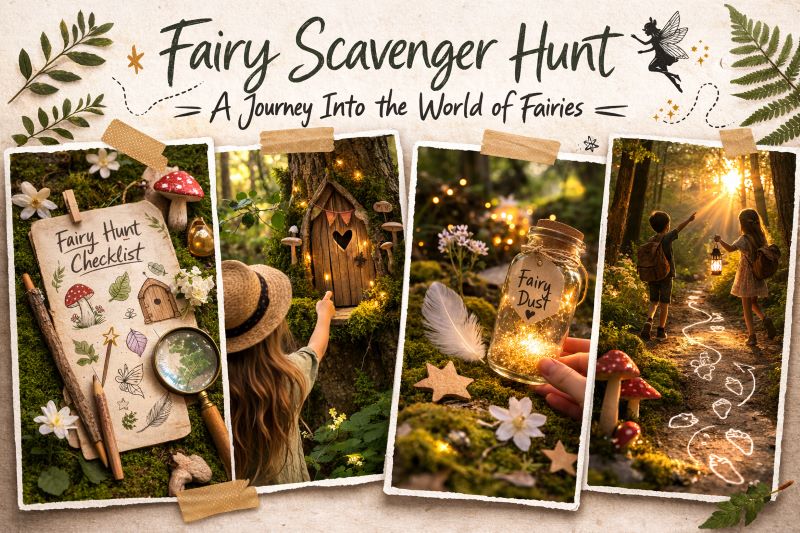
Fairy Scavenger Hunt for Kids: 8 Enchanted Forest Naturalist Challenges for a Magical Birthday Party
Last updated: April 2026 | Written by Arne, founder of Riddlelicious
About this guide: Every “magical” element in the Enchanted Forest stations has a real biological equivalent. Fairy rings are produced by mycelium networks (Marasmius oreades, a ring-forming fungus). Fairy lights correspond to bioluminescence in foxfire fungi (Panellus stipticus), fireflies (Photinus pyralis), and marine dinoflagellates. Fairy wings parallel biomimicry design inspired by butterfly scale structures. Each station uses the real science as the mechanism — the fairy narrative is the frame, the botany and biology are the content.
The best fairy folklore has always been rooted in natural observation. Before microscopes, people needed explanations for: circles of mushrooms appearing overnight, lights in the forest at night, insects that vanished mid-flight, plants that seemed to communicate. Fairies were those explanations. Now we have the actual science — and the actual science is at least as wonderful as the mythology.
The Enchanted Forest Naturalist format invites every kid to become a Junior Forest Scientist who studies the real phenomena that inspired fairy folklore. Complete all 8 investigations and earn a Field Naturalist’s Certificate from the Enchanted Forest Research Station — real biology, magical framing.
Quick Facts
- Ages: 4–10
- Players: 4–20 (research teams of 2–4)
- Duration: 70–85 minutes
- Location: Backyard preferred (outdoor) or indoor with nature specimens
- Equipment: Magnifying glasses, UV flashlight, flower specimens, fairy garden supplies, soil samples, leaves, craft supplies
- Science covered: Mycology (fairy rings), bioluminescence, butterfly wing structure, plant communication, seed dispersal, flower anatomy, water repellency, nature journaling
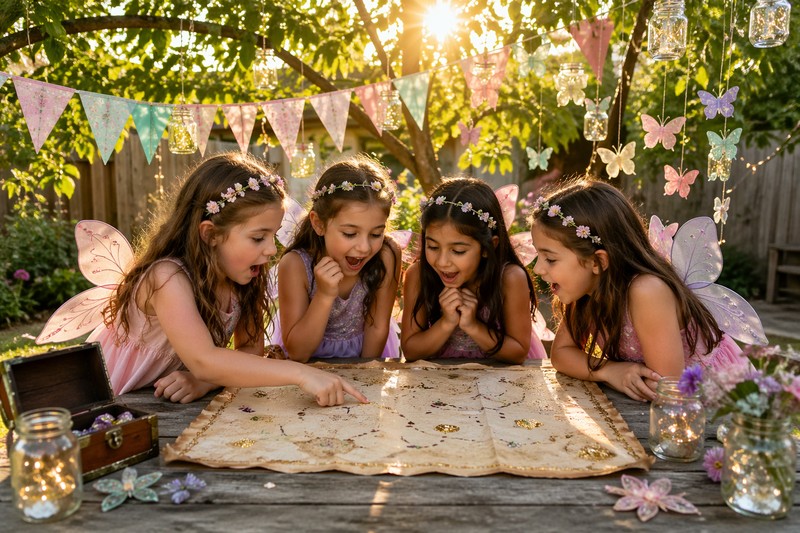
The Enchanted Forest Research Station Setup
Each research team receives a Fairy Field Journal — a small notebook with illustrated headers for each station and drawing space for their observations. The framing: “The Enchanted Forest has been observed producing unusual phenomena. Your team has been dispatched to investigate and document the real science behind each mystery.”
Each station has both a “Fairy Legend” card (the mythological explanation) and a “Forest Science” card (the real biological mechanism). Teams read both, complete the investigation, and record in their Field Journal: what they observed, the fairy legend explanation, and the scientific explanation. By the end, they have a complete illustrated journal of 8 forest phenomena.

Want Printable Fairy Hunt Station Cards?
Our Fairy Scavenger Hunt includes 8 enchanted station cards, fairy garden map, field journal template, and forest naturalist certificate — instant download, print and enchant.
The 8 Enchanted Forest Investigations
Fairy Rings — The Mushroom Circle Mystery
Fairy Legend: Circles of mushrooms appear overnight where fairies danced. Anyone who steps inside a fairy ring will be transported to the fairy realm or compelled to dance until exhausted.
Forest Science: Fairy rings are produced by mycelium — the underground network of a single fungus spreading outward from a central point. As the mycelium grows radially, it depletes nutrients at its center and enriches them at its growing edge — which is where mushrooms fruit. The ring grows approximately 8 inches per year. A 10-foot diameter fairy ring may be 15+ years old. The fungus most responsible: Marasmius oreades, which also produces a darker green ring of grass (from nitrogen released by decomposing mycelium).
Investigation: Create a mini fairy ring using mushroom-print stamps in a circle on paper. Measure the diameter of a “reference ring” (provided illustration from a real field) and calculate its age (÷8 inches per year). Plant a bean seed at the “center” of a drawn ring — what nutrients would the mycelium affect? Journal entry: draw a cross-section of what underground mycelium growth looks like.
Fairy Lights — Bioluminescence
Fairy Legend: Floating lights in forest clearings at night are fairies carrying lanterns, guiding travelers or leading them astray into the marshes (will-o’-the-wisps).
Forest Science: Bioluminescence — the production of light from a chemical reaction — occurs in fireflies (Photinus pyralis, luciferase enzyme + luciferin molecule + ATP energy), foxfire fungi (Panellus stipticus), and marine bioluminescent plankton (dinoflagellates). Firefly light is 90% efficient — almost no heat generated. For comparison, an incandescent light bulb converts only 5% of energy to light; the rest is heat. The “will-o’-the-wisps” of swamps were most likely burning methane gas escaping from decomposing organic matter and igniting spontaneously, not bioluminescence.
Investigation: Using a UV flashlight (365nm), examine: (1) a white piece of paper (UV brighteners fluoresce), (2) a highlighter mark, (3) tonic water (quinine fluoresces blue), (4) a piece of white fabric vs. a natural cotton fabric. Which materials glow? Why? Then: build a model bioluminescent firefly light with a yellow LED and an explanation card of the luciferin-luciferase reaction. Journal: draw the chemical reaction pathway in simplified form.
Fairy Wings — Butterfly Scale Architecture
Fairy Legend: Fairy wings are made from moonlight and morning dew — they’re weightless, shimmer in changing colors, and grant the power of flight to beings as small as a leaf.
Forest Science: Butterfly wings (and moth wings) are covered in microscopic scales arranged like roof tiles. The scales are often hollow and layered — the iridescent colors (blues, greens) aren’t pigments but structural color: the scales’ nanostructure diffracts light waves, producing different colors at different viewing angles (structural coloration, also called thin-film interference). Morpho butterfly wings are the most studied example — they’ve inspired anti-counterfeiting dyes and reflective building materials. The scales also repel water (hydrophobic) and provide thermal regulation.
Investigation: Examine a butterfly wing (illustration or real preserved specimen) under a magnifying glass — see the scale pattern. Then: hold a soap bubble (thin-film interference) in sunlight and observe how colors shift as the film thins. Demonstrate structural color using a CD surface (same physics). Design a “fairy wing” from layered tissue paper and note: which angles produce iridescence? Journal: label a wing diagram with scale structure, structural color layer, and hydrophobic coating.

Fairy Doors — Tree Hollow Ecology
Fairy Legend: Small doors at the base of old trees are entrances to fairy homes. Leave offerings of flowers and milk, and the fairy will grant a wish. Never disturb a fairy door or bad luck follows.
Forest Science: Tree hollows form where branches break or bark is damaged — decay fungi enter and create cavities. These cavities are critical wildlife habitat: 25–35% of forest birds nest in tree hollows. In North American forests, tree hollows are used by owls, woodpeckers, squirrels, bats, and raccoons. Old-growth forests with large, hollow trees are significantly more biodiverse than young forests because it takes decades for hollows to form. The “fairy offerings” tradition may have protected these ecologically critical trees from being cut for firewood.
Investigation: Examine photographs of tree hollow cross-sections — identify the decay pattern, the heartwood vs. sapwood zones, and estimate the tree’s age from growth rings visible at a cut surface. Then: design a “fairy door” birdhouse — what dimensions would a specific bird need? (Bluebird: 1.5″ opening; Barn owl: 6″ opening; Chickadee: 1.125″). Calculate the door size for a fairy of 3 inches tall (proportional scaling). Build a mini fairy door from craft sticks with ecological information attached.
Enchanted Seeds — Dispersal Magic
Fairy Legend: Seeds travel on fairy breath to new places where no plant could grow. A plant appearing in an unexpected location was placed there by a fairy’s wish.
Forest Science: Seed dispersal is one of botany’s most engineered systems. Wind dispersal (anemochory): maple samaras use autorotation (helicopter physics) to generate lift as they fall, extending distance 10x over a non-rotating seed. Dandelion seeds use a parachute structure with a separated tether (the “pappus”) that actually produces a vortex ring, dramatically increasing drag. Animal dispersal (zoochory): blackberries have seeds in brightly colored fruit to attract birds who transport them internally. Water dispersal (hydrochory): coconuts float for months; an estimated 1/3 of Pacific island plant species arrived by ocean current.
Investigation: Examine 5 seed types under a magnifying glass and classify their dispersal method from the seed’s physical structure alone. Test: drop a maple samara and a round bead from the same height — compare distance traveled. Build a paper helicopter samara and optimize its blade angle for maximum rotation. Journal: draw each seed type and label the specific dispersal adaptation.
Fairy Flowers — Pollinator Architecture
Fairy Legend: Flowers bloom where fairies rest — the ring of petals is a tiny fairy bed, with the center as a hidden door. Bees are fairy messengers carrying magic pollen between fairy homes.
Forest Science: Flower anatomy is co-evolution between plant and pollinator. Trumpet-shaped flowers (red, no UV guides) evolved for hummingbirds (can’t smell, attracted to red, long tongue). Flat, open flowers (UV-patterned centers invisible to humans) evolved for bees (can see UV, need a landing platform). Flowers with night blooming + white color + strong scent evolved for moths. The “fairy bed” structure (petals) is precisely engineered to position the entering pollinator’s body against the stamen and stigma for transfer. Plants “designed” the exact animal they needed to carry their pollen by making flowers those animals’ ideal landing structure.
Investigation: Dissect a flower (lily or tulip works well) and identify: petals, sepals, stamen (anther + filament), pistil (stigma + style + ovary). Under UV flashlight, examine flowers — many show UV nectar guides (landing strip patterns) invisible to humans. Classify 5 flower photos by their likely pollinator using color, shape, and scent clues. Journal: labeled flower diagram + pollinator match table.
Fairy Web — The Mycelium Network
Fairy Legend: The forest is connected by invisible fairy threads — messages travel underground between trees, and old trees protect young ones. Forest spirits communicate through the roots.
Forest Science: This legend maps almost exactly to the mycorrhizal network — the underground fungal web that connects 90% of land plants. Trees transfer carbon, water, and chemical signals (warning of insect attack) through this network. “Mother trees” (large, old conifers) are highly connected hubs that preferentially send carbon to seedlings of their own species. Suzanne Simard’s research (University of British Columbia) demonstrated that a single Douglas fir can be connected to hundreds of neighbors through the mycorrhizal network. Peter Wohlleben’s “The Hidden Life of Trees” brought this to mainstream attention.
Investigation: Build a model mycorrhizal network using yarn and cardboard trees: large trees = many connections, small trees = fewer. Then: if you remove the “mother tree” (most connected), how many other trees lose their connection? Simulate a stress signal (pest warning) traveling through the network — which trees receive it first? Journal: draw a bird’s-eye view of a forest plot with the mycelium connections visible underground.
The Enchanted Garden — Build a Fairy Habitat
Science: A habitat requires 4 elements: food, water, shelter, and space. Wildlife habitat gardens (promoted by the National Wildlife Federation’s Certified Wildlife Habitat program) provide all four intentionally. A 4×4 foot garden plot with native plants provides habitat for over 50 insect species, which in turn attracts 5–10 bird species. The smaller the garden, the more intentional each plant choice must be — every plant should serve multiple habitat functions (food for pollinators + nesting material + shelter + seed food for birds).
The finale: Each team designs a “Fairy Garden Habitat” in a small container (a shoebox, a window box, or a section of the yard). Requirements: (1) at least one plant that provides nectar for pollinators, (2) a water source (even a bottle cap), (3) a shelter element (a fairy door, a rock pile, a bundle of sticks), (4) at least one element that provides food for birds or insects. Teams present their garden design to the group and explain the ecological function of each element. Award: Enchanted Forest Naturalist Certificate with their name and “Research Specialization.”
Decoration Ideas
- Mushroom circle entrance: Paper-plate mushrooms on stakes forming a ring around the party entrance — kids step through the “fairy ring” to enter
- Bioluminescent lights: Green and yellow glow sticks in glass jars as table centerpieces — “captured foxfire” for the science-meets-magic aesthetic
- Butterfly wing bunting: Cut wing shapes from iridescent cellophane or holographic paper and hang on string — they catch light and shimmer
- Field journal display: A clothesline with fairy field journals clipped to it — kids add their illustrated pages as the party progresses
Snacks
- Fairy bread: White bread with rainbow sprinkles on butter — classic Australian children’s party food, simple and universally beloved
- Mushroom meringues: White meringue puffs with cocoa powder “dirt” dusted on the base — fairy ring mushrooms in edible form
- Forest punch: Lemonade + blue butterfly pea flower tea (which turns pink/purple when lemon juice is added) — a real color-change reaction kids can trigger themselves
Age Calibration
Ages 4–5
Focus on fairy garden building (hands-on, immediately satisfying), bioluminescence UV station (visual magic), and seed spinning (very physical). Skip mycorrhizal network modeling and flower dissection. The fairy field journal is their main takeaway — let them draw freely rather than following the label format.
Ages 6–8
Full program as described. Butterfly wing and structural color is especially engaging. UV bioluminescence station produces genuine wonder. Fairy ring age calculation (simple division) is the right level of math. The habitat garden finale is the party highlight for this age.
Ages 9–10
Add: calculate thin-film interference wavelengths (simplified formula provided), research one mycorrhizal species in their region and its host tree, and design a pollinator garden for their specific local climate zone using the NWF Plant Finder tool (online or printed regional list).
Download the Fairy Scavenger Hunt
8 enchanted investigation cards, fairy garden map, field journal template, and Forest Naturalist certificate — for ages 4–10, instant download, print and enchant.
Frequently Asked Questions
Can this be done indoors if it rains?
Yes — all stations work indoors with minor adjustments. The fairy garden can use a windowsill planter. The seed dispersal station uses illustrations instead of actual outdoor seeds. The UV bioluminescence and butterfly wing stations are entirely indoor activities. The mycelium network model is table-based. The only station that benefits significantly from outdoors is the mushroom ring station — which can instead use a grass patch photo from the reference card for indoor groups.
Is the flower dissection appropriate for young kids?
For ages 4–6, use a whole flower for observation only (magnifying glass to examine the parts) — no dissection. For ages 7+, a simple tulip or lily dissection with a plastic knife or fingers works well and is neither messy nor delicate. Pre-cut specimens on trays (dissect the flowers yourself the night before) make the station faster and work better for younger kids who may lack the fine motor precision for dissection.
Sources & Further Reading
- Simard, Suzanne. Finding the Mother Tree. Alfred A. Knopf, 2021 — mycorrhizal network research
- Wohlleben, Peter. The Hidden Life of Trees. Greystone Books, 2016
- National Wildlife Federation Certified Wildlife Habitat Program — nwf.org
- Vigneron, Jean-Pol et al. “Structural Color in Morpho Butterflies.” Physical Review E, 2006
- Ellison, Aaron. “Fairy Rings” — Harvard Forest educational materials (harvardforest.fas.harvard.edu)